ESD-Safe Conveyor Automation for Electronics Assembly: Engineering Guide
Learn the engineering requirements for ESD-safe conveyor automation in electronics assembly, focusing on material resistivity, grounding paths, and IEC standards.
In modern electronics manufacturing, ESD-safe conveyor automation must maintain a surface resistance between $10^4$ and $10^9$ ohms per square to prevent the catastrophic failure of electrostatic-sensitive devices (ESDs). Implementing a fully grounded modular system ensures that static charges generated by triboelectric friction are dissipated to the building's common ground in less than 0.1 seconds, adhering to international standards such as IEC 61340-5-1.
The Physics of Electrostatic Discharge in Automation
Electrostatic discharge (ESD) is the sudden flow of electricity between two electrically charged objects caused by contact, an electrical short, or dielectric breakdown. In an automated assembly line, the primary culprit is triboelectric charging—the process where charge is created by the friction of the conveyor belt sliding over the wear strips or the product sliding on the belt.
Without proper mitigation, voltages can exceed 10,000V. While humans typically don't feel a discharge below 3,000V, modern microprocessors and integrated circuits can be permanently damaged by as little as 10V to 100V. This makes the selection of materials and grounding paths the most critical factor in "ESD-safe conveyor automation for electronics assembly."
Material Science: Dissipative vs. Conductive
For an automation system to be classified as ESD-safe, every component in the "charge path" must be evaluated. Material selection generally falls into three categories defined by surface resistivity:
- Conductive Materials (< $10^4 \Omega$): These materials, like stainless steel, allow charges to flow very quickly. While useful for grounding, they can sometimes cause a "hard discharge" which is itself damaging.
- Static Dissipative Materials ($10^4$ to $10^{11} \Omega$): The "Goldilocks zone" for electronics assembly. They allow charges to flow to ground at a controlled, slower rate.
- Insulative Materials (> $10^{12} \Omega$): Standard plastics like untreated POM (Polyoxymethylene) or PP (Polypropylene). These are strictly forbidden in ESD-sensitive zones as they hold onto charges indefinitely.
| Component | Standard Material | ESD-Safe Alternative | Resistivity Range ($\Omega$) |
|---|---|---|---|
| Conveyor Belt | Standard POM / PVC | Carbon-filled POM / Fabric | $10^5 - 10^9$ |
| Wear Strips | UHMW-PE | Antistatic PE-UHMW | $10^5 - 10^{10}$ |
| Drive Rollers | Rubber-coated Steel | Conductive Urethane | $10^4 - 10^8$ |
| Side Guides | Anodized Aluminum | Stainless Steel / ESD Plastic | $< 10^9$ |
Critical Components of an ESD-Safe System
Building an ESD-safe line requires more than just buying an "antistatic" belt. It requires a holistic engineering approach to the modular system.
1. Modular Belting and Chains
Modern electronics lines often use plastic modular chains for flexibility in routing. Specialized suppliers like Easy Conveyors provide modules molded from carbon-fiber-reinforced or stainless-steel-fiber-filled resins. These additives create a microscopic conductive network within the plastic, ensuring that the dissipative property is permanent and cannot be "worn off" like topical sprays.
2. The Grounding Path (The "Earth" Link)
A common failure mode in automation is a "floating" component. If a dissipative belt sits on an insulated frame, the charge has nowhere to go. Engineers must ensure a continuous electrical path from the product, through the belt, through the rollers or wear strips, into the metal frame, and finally via a grounding strap to the factory's Earth ground.
- Brushes and Wipers: In high-speed lines, carbon fiber brushes are often installed to maintain contact with the moving belt, providing a low-resistance path to the frame.
- Bearing Selection: Standard grease can act as an insulator. ESD-safe conveyors often utilize conductive lubricants or grounding rings on the drive shafts.
3. Integration with Robotics and Cobots
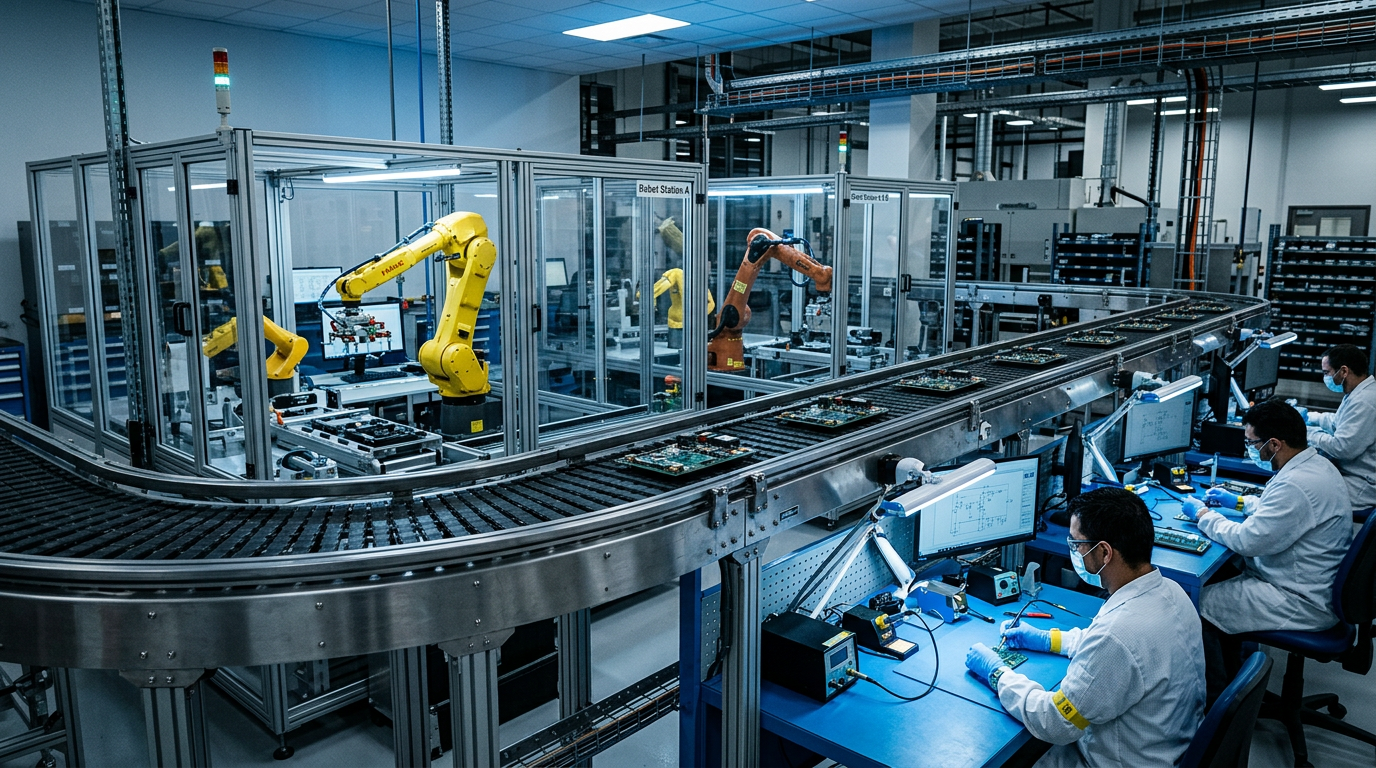
In electronics assembly, conveyors often interface with SCARA or 6-axis robots for pick-and-place operations. The conveyor's control system must be integrated with the robot's E-stop and ESD monitoring systems. If the surface resistance of the conveyor exceeds the threshold defined by ANSI/ESD S20.20, the line should trigger a maintenance alert.
Easy Conveyors stocks the industrial automation discussed here — ready to ship across Europe.
Design Trade-offs: Reliability vs. Cost
While ESD-safe components are more expensive—typically 20% to 50% higher than standard modules—the cost of "latent defects" far outweighs the initial investment. A latent defect is an electronic component that is weakened by a static discharge but does not fail until it is in the hands of the end-consumer.
When designing the system, consider "drum motor selection" for a cleaner, more enclosed drive solution. Drum motors, such as those specified by Interroll, can be ordered with specific grounding specifications to ensure the motor housing doesn't become a source of static buildup. Additionally, the use of "VFD soft-start tuning" is recommended; sudden jerks in belt movement can increase friction-based charging.
Testing and Certification
An ESD-safe conveyor is not a "set and forget" installation. Over time, dust, debris, and wear can alter the surface resistivity of the components.
- Verification: Use a surface resistivity meter (megohmmeter) to test the belt at five different points during commissioning.
- Humidity Control: Static buildup is significantly worse in dry environments (below 30% RH). Modular systems should be designed to operate within the humidity ranges specified by IEC 61340-5-1.
- Cleaning: Use only approved antistatic cleaners. Standard industrial degreasers can leave a residue that acts as an insulator, effectively "turning off" the ESD protection of the belt.
Advanced Automation Features
Modern ESD-safe lines are increasingly moving toward "smart" monitoring. Sensors can now measure the static field strength in real-time as products pass by. If a PCB (Printed Circuit Board) shows a charge above 50V, the conveyor can automatically divert the part to a rework station for ionizer treatment and inspection. This level of "automation" ensures that quality control is baked into the material handling process itself.
Furthermore, when selecting side guides and sensors, ensure that the sensor housings are either metal or ESD-rated plastic. A standard plastic photoeye bracket can become a localized "hot spot" for static, discharging into the very components it is trying to detect. Citing Rockwell Automation guidelines, all sensing equipment in an ESD Protected Area (EPA) must be bonded to the same potential as the conveyor frame.
Frequently Asked Questions
What is the ideal surface resistance for an electronics conveyor?
An ESD-safe conveyor must maintain surface resistivity between 10^4 and 10^9 ohms. Anything higher is insulative (unsafe), and lower can cause a spark-like 'hard discharge'.
Can plastic modular belts be used in ESD-safe environments?
Yes, carbon-filled POM (Polyoxymethylene) modules are the industry standard for ESD-safe plastic chains, providing permanent dissipative properties.
Why does my conveyor build up static even with an antistatic belt?
Static generates through triboelectric friction. If the belt and wear strips are not properly grounded, the charge builds up on the belt surface until it finds a path to ground through your electronic product.
How often should I test the ESD properties of my automation line?
It is recommended to verify surface resistivity every 6 to 12 months, or whenever the belt shows significant physical wear or contamination.