Optimizing OPC UA Integration for Smart Conveyor Modules
Learn how OPC UA integration for smart conveyor modules enables IEC 62541-compliant interoperability, reducing integration time by 50% and enabling predictive maintenance.
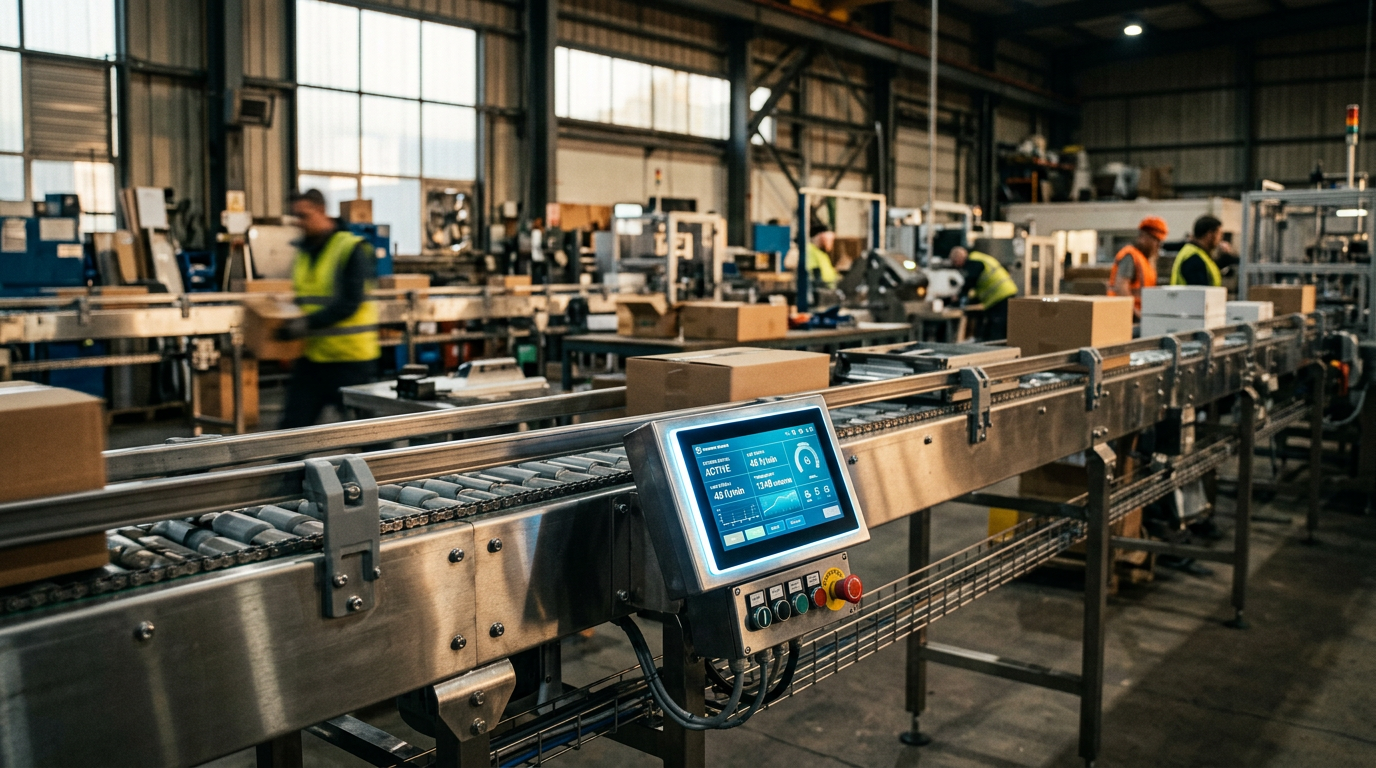
To achieve seamless interoperability in Industry 4.0 environments, OPC UA (Open Platform Communications Unified Architecture) integration for smart conveyor modules utilizes the IEC 62541 standard to provide a platform-independent, service-oriented architecture that reduces integration time by up to 50% compared to legacy fieldbus systems. By leveraging standardized Information Models (IMs) and the companion specification for Weighing and Conveying, engineers can achieve real-time diagnostics and horizontal machine-to-machine (M2M) communication without the need for custom driver development.
The Shift from Fieldbus to Information Models
Traditional conveyor control relied heavily on specific fieldbus protocols like PROFINET or EtherNet/IP. While effective for cyclic I/O data, these protocols often create "data silos" where higher-level SCADA or ERP systems require complex gateways to interpret motor temperatures, vibration data, or energy consumption.
OPC UA changes this paradigm by moving from raw bit-mapping to Information Modeling. A smart conveyor module is no longer just a set of memory addresses; it is an object with defined properties (e.g., BeltSpeed, MotorCurrent, MaintenanceStatus). According to the IEC 62541 standard, these objects contain their own metadata, allowing any OPC UA client—whether it is a PLC, an edge gateway, or a cloud-based analytics platform—to browse the conveyor’s capabilities automatically.
Key Technical Advantages of OPC UA in Conveying
Integrating OPC UA directly into the drive controller or the modular conveyor's distributed I/O hub offers several architectural benefits:
- Semantic Interoperability: Through the use of Companion Specifications (developed by the VDMA), different conveyor brands can "speak" the same language. A sorter from one vendor and a merge module from another can exchange status data without mapping tables.
- Security by Design: Unlike older protocols, OPC UA includes built-in security layers, including X.509 certificate handling, encryption (AES-256), and user authentication, which are critical for conveyors connected to corporate IT networks.
- Scalability: For large-scale e-commerce sortation centers, the "Publish-Subscribe" (Pub/Sub) extension of OPC UA allows for efficient 1-to-many communication, reducing network jitter in high-speed applications.
| Feature | Legacy Fieldbus (e.g., Profibus) | OPC UA (IEC 62541) |
|---|---|---|
| Communication Style | Master-Slave / Cyclic I/O | Client-Server / Pub-Sub |
| Data Structure | Raw Bits/Bytes | Object-Oriented (Nodeset) |
| Security | Minimal (Physical Isolation) | TLS/SSL Encryption & Certs |
| Integration Effort | High (Manual Mapping) | Low (Self-Discovery) |
| Hardware Platform | Vendor Dependent | Platform Independent |
Implementing OPC UA in Modular Systems
When designing modular systems, such as those provided by Easy Conveyors, the integration of OPC UA allows for "Plug-and-Produce" capabilities. In a modular setup, each section—whether it is a roller conveyor, a belt curve, or a lift—functions as an independent cyber-physical system.
For instance, a smart roller conveyor module equipped with an OPC UA-enabled motor starter can report its own IE3 efficiency class performance data. If a belt begins to slip or a bearing shows signs of heat-induced wear, the module pushes a "Condition Monitoring
Easy Conveyors stocks the industrial automation discussed here — ready to ship across Europe.
" event directly to the maintenance team's dashboard via the OPC UA server, bypassing the main line PLC if necessary.
Hardware Requirements and Network Topology
To successfully deploy OPC UA for smart conveyor modules, engineers must consider the hardware footprint. Modern VFDs (Variable Frequency Drives) and PLC-less "Smart Hubs" now often include embedded OPC UA servers.
- Edge Gateways: For older modular systems, an Edge Gateway can act as a "wrapper," translating Modbus or IO-Link signals into OPC UA nodes.
- TSN (Time-Sensitive Networking): In high-speed packaging lines where millisecond precision is required, combining OPC UA with TSN (IEEE 802.1) ensures that deterministic control traffic and heavy diagnostic data can coexist on the same physical wire without interference.
Use Case: Predictive Maintenance in Food Grade Lines
In hygienic environments, modular conveyors must often withstand rigorous wash-down cycles. Integrating OPC UA allows sensors to monitor the integrity of seals and the effectiveness of cleaning cycles. By mapping IP69K-rated sensors to an OPC UA information model, plant managers can track "Clean-in-Place" (CIP) metrics across the entire facility.
If a motor's power consumption rises by 15% over a week, the OPC UA server triggers a "Quality of Service" (QoS) alert. This data is structured according to the PLCopen standards, ensuring that the analytics software understands exactly what the data point represents without manual intervention.
Design Trade-offs: Latency vs. Data Depth
While OPC UA is superior for data richness, engineers must balance the "sampling rate." Collecting high-resolution vibration data from 500 conveyor rollers simultaneously can saturate a 100Mbps network.
Best Practices for Sizing:
- Use Report-by-Exception: Configure the OPC UA server to only send data when a value changes beyond a specific threshold (deadband).
- Logical Grouping: Group non-critical telemetry (e.g., total runtime) into slower update cycles (1-5 seconds), while keeping safety-related status on high-priority cyclic paths.
- VFD soft-start tuning: Use OPC UA to remotely adjust acceleration ramps during product changeovers, reducing mechanical stress on modular plastic belts.
Future-Proofing with Companion Specifications
The true power of OPC UA integration for smart conveyor modules lies in the "Companion Specifications." These are industry-specific dictionaries. For material handling, the OPC UA for Weighing and Conveying Technology (a joint effort by VDMA and OPC Foundation) provides standardized names for conveyor states: Idle, Running, Faulted, and EmergencyStop.
This standardization ensures that a "Smart Conveyor" from one manufacturer is recognized by a warehouse management system (WMS) in exactly the same way as a unit from a different manufacturer. This interoperability is the cornerstone of the "Smart Factory," allowing for rapid reconfiguration of lines to meet changing consumer demands without weeks of reprogramming.
By adopting these standards, manufacturers move away from proprietary lock-in and toward a flexible, data-driven ecosystem where every conveyor module is an intelligent, self-reporting asset. For deep dives into drive integration, consider reviewing our guides on drum motor selection and hygienic wash-down design to ensure your mechanical hardware matches your digital sophistication.
Frequently Asked Questions
How does OPC UA differ from standard Industrial Ethernet protocols in conveyor systems?
OPC UA provides a vendor-neutral 'Information Model' that allows devices to describe themselves to the network, whereas standard industrial Ethernet protocols (like PROFINET) often focus on moving raw bits of data between a specific PLC and its I/O.
Can I use OPC UA for conveyors without a central PLC?
Yes, many modern variable frequency drives (VFDs) and smart sensors now include built-in OPC UA servers, allowing them to communicate directly with IT systems without needing a PLC as an intermediary.
What is the specific standard for conveyor data modeling?
The VDMA 'OPC UA for Weighing and Conveying' companion specification is the primary standard for defining how conveyor data should be structured for maximum interoperability.
Is OPC UA secure enough for a factory-wide network?
OPC UA uses X.509 certificates and AES-256 encryption, which are significantly more robust than the 'security by obscurity' used in traditional fieldbus systems, making it safer for IIoT applications.