OPC UA Integration for Smart Conveyor Modules: The Future of Interoperability
Learn how OPC UA integration transforms modular conveyors into smart assets, enabling vendor-independent data exchange and lowering commissioning costs by 30%.
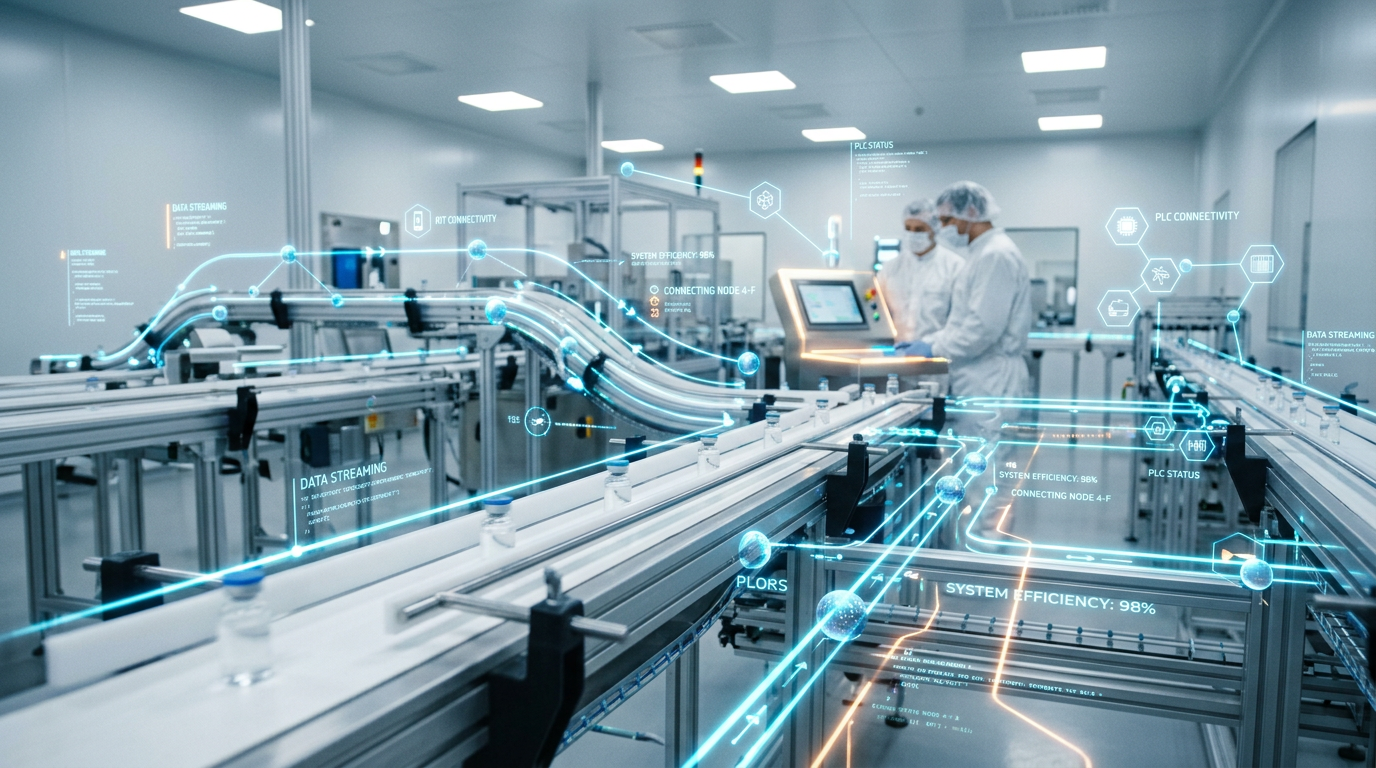
Integrating OPC UA into smart conveyor modules enables vendor-independent interoperability by providing a unified information model that reduces commissioning time by up to 30% compared to legacy fieldbus protocols. This communication standard, defined by IEC 62541, ensures that conveyor hardware can exchange real-time telemetry and control data directly with ERP or SCADA systems without the need for middle-tier protocol converters.
The Shift from Fieldbus to Information Models
For decades, conveyor automation relied on hardware-specific fieldbus systems. While effective for cyclic I/O, these protocols often created "data silos" where motor temperature, vibration data, and energy consumption remained locked within the PLC. Implementing OPC UA (Open Platform Communications Unified Architecture) transforms a standard conveyor into a "smart module" by replacing raw bit-streams with structured objects.
Unlike traditional Modbus or Profibus, OPC UA is platform-independent and focuses on the high-level semantic description of data. This means a roller conveyor module from one vendor can describe its "Maximum Speed" or "Current Load" in a way that a central warehouse management system (WMS) understands natively.
Technical Architecture of Smart Conveyors
To achieve true "Plug-and-Produce" functionality, smart conveyor modules typically utilize a service-oriented architecture (SOA). The integration usually follows three primary layers:
- Field Level: Intelligent drives and sensors collect raw physical values (RPM, torque, photo-eye status).
- Control Level: A decentralized controller or an intelligent drive functions as an OPC UA Server. It maps internal PLC variables to the OPC UA Information Model.
- Management Level: SCADA, MES, or Cloud applications act as OPC UA Clients, subscribing to specific data nodes for monitoring and optimization.
Engineering partners like Easy Conveyors specialize in modular systems that leverage these digital communication standards, ensuring that mechanical hardware seamlessly fits into a software-defined factory.
Key Performance Benefits
The primary driver for OPC UA integration is the reduction of Total Cost of Ownership (TCO). By utilizing standardized information models, such as the VDMA Companion Specification for OPC UA, engineers can automate the configuration of global material handling systems.
| Feature | Legacy Fieldbus (Profinet/EtherNet/IP) | OPC UA Integration |
|---|---|---|
| Data Structure | Raw Bits/Bytes | Object-Oriented Nodes |
| Semantic Context | Requires Manual Mapping | Self-Describing (Metadata) |
| Security | Minimal (Relies on Network Isolation) | Built-in (AES-256/X.509 Certificates) |
| Scalability | Limited by Controller Local Memory | High (Edge/Cloud Connectivity) |
| Efficiency Class | N/A | Supports IE3/IE4 Monitoring (IEC 60034-30-1) |
Safety and Security in Modular Systems
Security is often the Achilles' heel of connected industrial equipment. Standard IEC 62443 provides the framework for industrial cybersecurity, which OPC UA
Easy Conveyors stocks the industrial automation discussed here — ready to ship across Europe.
addresses through its transport layer. Every smart conveyor module can require certificate-based authentication, ensuring that only authorized clients can change a motor's speed or reset an E-stop.
Furthermore, the integration of OPC UA Safety allows for the transmission of safety-related data (up to SIL3/PLe) over the same cable as standard telemetry. This eliminates redundant wiring for emergency circuits in large-scale modular installations.
Predictive Maintenance and Condition Monitoring
The real power of OPC UA integration lies in its ability to support "Digital Twin" strategies. By exposing internal drive parameters as OPC UA variables, a conveyor module can transmit its vibration profile and thermal signature to an AI-driven maintenance platform.
Key variables typically monitored include:
- Motor Inverter Temperature: Early detection of cooling fan failure.
- Line Current (Amps): Identification of mechanical binding or belt misalignment.
- Total Energy (kWh): Compliance with ISO 50001 energy management standards.
- Cycle Counts: Tracking the fatigue life of rollers and modular belts.
Implementation Challenges
While OPC UA offers immense benefits, integration requires careful planning of network bandwidth. Unlike cyclic I/O, which runs at fixed millisecond intervals, OPC UA often uses a "Publish-Subscribe" (PubSub) model. While PubSub is highly efficient for large datasets, it requires a robust Ethernet backbone, typically utilizing Time-Sensitive Networking (TSN) to ensure that time-critical conveyor handovers (e.g., high-speed sortation) are not delayed by background telemetry traffic.
When designing a new line, it is critical to select components that support "Companion Specifications." These are standardized dictionaries for specific industries, such as the "OPC UA for Weighing Technology" or "OPC UA for Robotics." Utilizing these ensures that a smart conveyor "speaks the same language" as the rest of the packaging machine.
Integration with Modern Control Systems
Modern automation focuses on VFD soft-start tuning and precision speed control. When these drives are integrated via OPC UA, the tuning parameters can be dynamically adjusted based on the specific SKU being transported. For example, a heavy automotive part might trigger a high-torque profile via the OPC UA server, whereas a lightweight pharmaceutical box triggers a high-speed, low-vibration profile.
This adaptability moves modular systems beyond being simple mechanical assets toward becoming active participants in the Industrial Internet of Things (IIoT). By standardizing on OPC UA, manufacturers future-proof their investments, ensuring that a conveyor module installed today can still communicate with the software architectures of 2030 and beyond.
Conclusion
OPC UA integration for smart conveyor modules represents the pinnacle of modern material handling. By moving away from proprietary protocols and toward an open, secure, and semantic communication standard, facilities gain the transparency needed to optimize throughput, reduce energy waste, and eliminate unplanned downtime. As manufacturing moves toward "Lot Size 1" production, the flexibility provided by OPC UA-enabled modular systems is no longer a luxury—it is a competitive necessity.
Frequently Asked Questions
How does OPC UA differ from standard Profinet or EtherNet/IP?
OPC UA provides a standardized 'language' (information model) that allows conveyors, PLCs, and cloud software to communicate without custom drivers, regardless of the manufacturer.
Can OPC UA be used directly at the drive level?
Yes, many modern VFDs and smart motors now feature embedded OPC UA servers, allowing them to provide telemetry directly to IT systems without going through a PLC.
Is OPC UA secure for factory networks?
OPC UA includes built-in security features like X.509 certificate exchange, AES-256 encryption, and user authentication, making it significantly more secure than legacy fieldbus protocols.
How does OPC UA reduce commissioning time?
By utilizing the 'OPC UA for Machine Tools' or 'VDMA' companion specifications, engineers can use pre-defined templates, reducing manual data mapping and testing time by up to 30%.