Modular Plastic Belt Materials: POM vs PP vs PE Selection Guide
Master modular plastic belt selection: Compare POM, PP, and PE materials for temperature, load capacity, and chemical resistance in industrial conveyor systems.
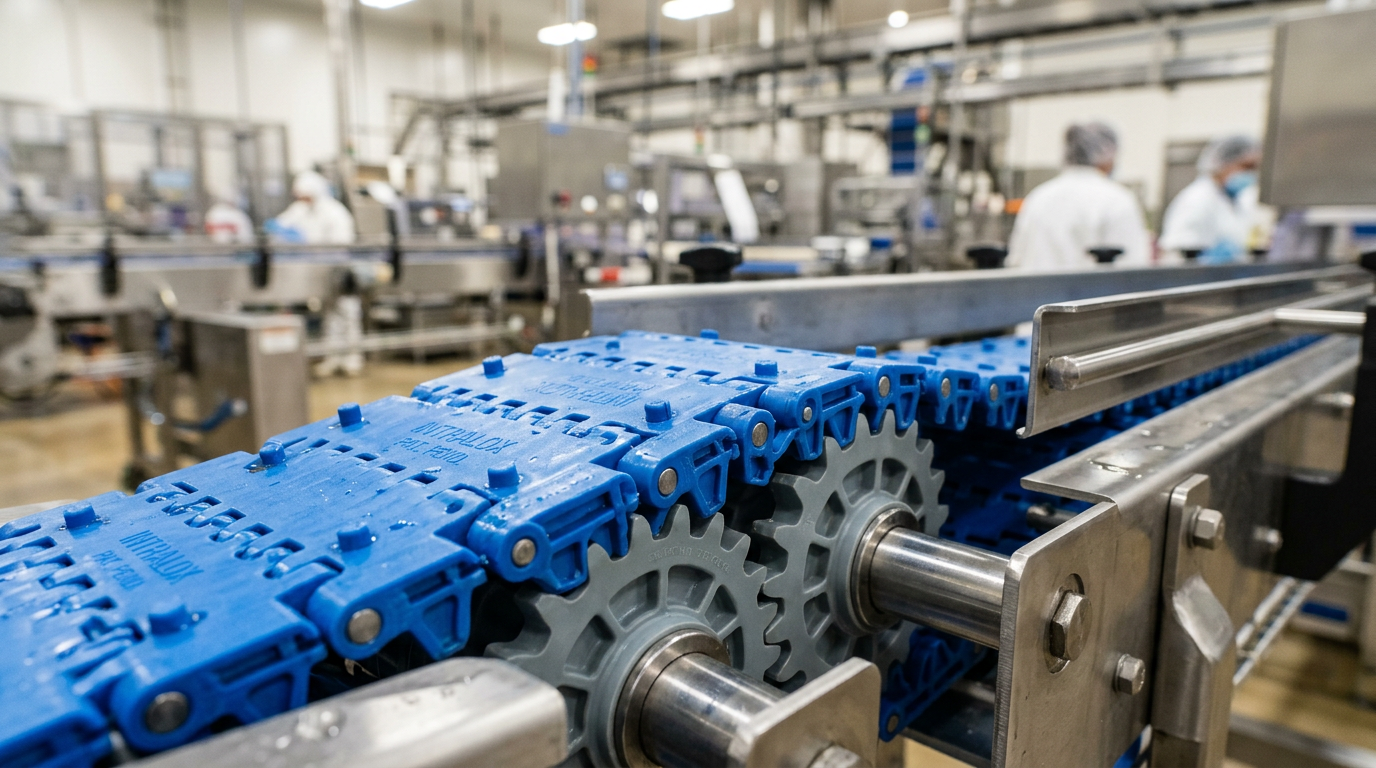
Choosing between POM, PP, and PE modular plastic belt materials requires balancing temperature limits (from -73°C to +104°C) with mechanical strength and chemical resistance. Polyacetal (POM) is the industry standard for high-load applications due to its high tensile strength and low friction coefficient of 0.15–0.20, whereas Polypropylene (PP) offers superior chemical resistance at higher temperatures, and Polyethylene (PE) remains the primary choice for cryogenic environments down to -73°C.
Engineering Fundamentals of Modular Plastic Belts
Modular plastic belts have revolutionized material handling by replacing traditional fabric belts with interlocking modules driven by sprockets. This positive-drive system eliminates slippage and tracking issues. However, the performance of these systems is almost entirely dependent on the polymer selected for the modules.
When engineering a conveyor system, the material choice dictates the maximum allowable belt pull, the energy consumption of the drive motor, and the lifespan of the wear strips. For instance, selecting a material with a high coefficient of friction in a long-distance accumulation line can lead to motor overheating and premature belt elongation.
POM (Polyacetal): The High-Performance Workhorse
Polyacetal, commonly referred to by the brand name Delrin, is the most widely used material in modular belt conveyors. Its primary advantage is its exceptional mechanical strength and dimensional stability.
Key Characteristics of POM
- High Tensile Strength: POM can handle significantly higher loads than PP or PE, making it ideal for long conveyors and heavy-duty palletizing.
- Low Friction: With a naturally lubricated surface, POM minimizes the drag between the belt and the wear strips. This reduces the required torque from the drum motor selection process and lowers electricity costs.
- Impact Resistance: It withstands the physical abuse of heavy products being dropped onto the belt surface.
However, POM is sensitive to certain chemicals. Exposure to high concentrations of chlorine (often used in aggressive cleaning agents in food plants) can cause the polymer chains to break down, leading to "chalking" and eventual link failure.
PP (Polypropylene): The Chemical and Heat Expert
Polypropylene is a versatile thermoplastic that bridges the gap between POM and PE. It is significantly lighter than POM (with a density of approximately 0.90 g/cm³) and offers excellent resistance to almost all organic solvents and non-oxidizing acids.
Why Choose PP?
- Chemical Resistance: PP is the go-to material for applications involving aggressive wash-down procedures or chemical processing.
- Elevated Temperatures: While POM loses structural integrity around +60°C to +80°C in some environments, PP can maintain performance up to +104°C in dry conditions.
- Economic Value: Generally, PP modules are more cost-effective than POM, providing a lower total cost of ownership for light-to-medium load applications.
The trade-off with PP is its brittleness at low temperatures. If used in a cold-storage environment, PP becomes prone to cracking under impact.
Easy Conveyors stocks the conveyor components discussed here — ready to ship across Europe.
PE (Polyethylene): The Cold Chain Solution
Polyethylene, specifically Ultra-High-Molecular-Weight (UHMW) or High-Density (HDPE) variants, is specialized for extreme environments. Its most defining characteristic is its ability to remain ductile at temperatures where other plastics would shatter.
PE Performance Profile
- Cryogenic Stability: Capable of operating at temperatures as low as -73°C, PE is essential for blast freezers and frozen food packaging lines.
- Release Properties: PE has a "waxy" surface that provides excellent product release, preventing sticky substances (like raw dough or meat) from adhering to the belt.
- High Impact Strength: Even in freezing conditions, PE absorbs energy without fracturing.
The primary limitation of PE is its low tensile strength. Design engineers must account for higher belt elongation and lower load capacities when specified.
Direct Material Comparison: POM vs. PP vs. PE
The following table summarizes the physical properties and performance metrics essential for modular system design.
| Property | POM (Polyacetal) | PP (Polypropylene) | PE (Polyethylene) |
|---|---|---|---|
| Density (g/cm³) | 1.40 | 0.90 | 0.95 |
| Tensile Strength | Very High | Medium | Low |
| Temp Range (Min/Max) | -40°C to +90°C | +1°C to +104°C | -73°C to +66°C |
| Impact Resistance | High | Medium (Low at cold) | Excellent |
| Coefficient of Friction | Lowest (0.15-0.20) | Medium (0.25-0.30) | Medium (0.22-0.28) |
| Chemical Resistance | Good | Excellent | Great |
| FDA / EU Approval | Yes | Yes | Yes |
Design Considerations and Trade-offs
When working with modular systems, engineers must look beyond the belt material itself. For example, when integrating belts into a full system, Easy Conveyors emphasizes the importance of matching the belt material to the wear strip material (typically UHMW-PE) to ensure thermal expansion coefficients are managed.
Thermal Expansion
Plastic belts expand and contract significantly more than metal ones. POM expands about 0.12 mm/m/°C. In a 30-meter conveyor subjected to a 40-degree temperature swing during wash-down, the belt length could change by nearly 150mm. Designers must use VFD soft-start tuning and proper take-up units to manage this slack.
Hygiene and Wash-down
In food-grade environments, the material must meet EHEDG or FDA standards. While all three materials are available in food-grade variants, the hygienic wash-down design of the module itself (open vs. closed hinge) is just as critical as the polymer. PP is often favored in these scenarios because it resists the caustic chemicals used in CIP (Clean-In-Place) systems better than POM.
Friction and Power Consumption
A common mistake in procurement is ignoring the coefficient of friction (CoF). A POM belt on a UHMW wear strip has a much lower CoF than a PP belt on the same strip. Using PP in a high-speed application may require a larger motor or a more robust drive shaft to overcome the internal friction of the system.
Summary of Selection Logic
To select the correct material, follow these rules of thumb:
- Is it a freezer application? Use PE.
- Is it a high-load or long-distance line? Use POM.
- Are aggressive acids or high heat (+80°C) involved? Use PP.
- Is the product sticky? Use PE.
- Is the environment standard (ambient, dry, low-impact)? POM is usually the safest default for mechanical longevity.
By understanding the molecular advantages of these polymers, plant operators can significantly extend the mean time between failures (MTBF) and optimize the energy efficiency of their material handling infrastructure.
Frequently Asked Questions
Which material is best for high-load conveyor lines?
POM is the preferred material for high-load applications because it has the highest tensile strength and the lowest coefficient of friction, reducing strain on the motor.
What is the most economical modular belt material?
Polypropylene (PP) is generally the most cost-effective material, though its performance limits in cold or high-impact environments must be considered.
Can I use POM belts in environments with heavy chlorine cleaning?
While POM is durable, it is susceptible to degradation from high concentrations of chlorine and bleach. Polypropylene (PP) offers much better resistance to these cleaning agents.
Which plastic belt material is best for blast freezers?
Polyethylene (PE) is the only reliable choice for temperatures below 0°C, as it remains flexible and impact-resistant down to -73°C, whereas PP becomes brittle.