Optimizing Line Balancing with Modular Aluminium Profile Conveyor Frames
Learn how aluminium profile conveyor frames enable rapid line balancing and throughput optimization. Explore technical specs, modular benefits, and design tips.
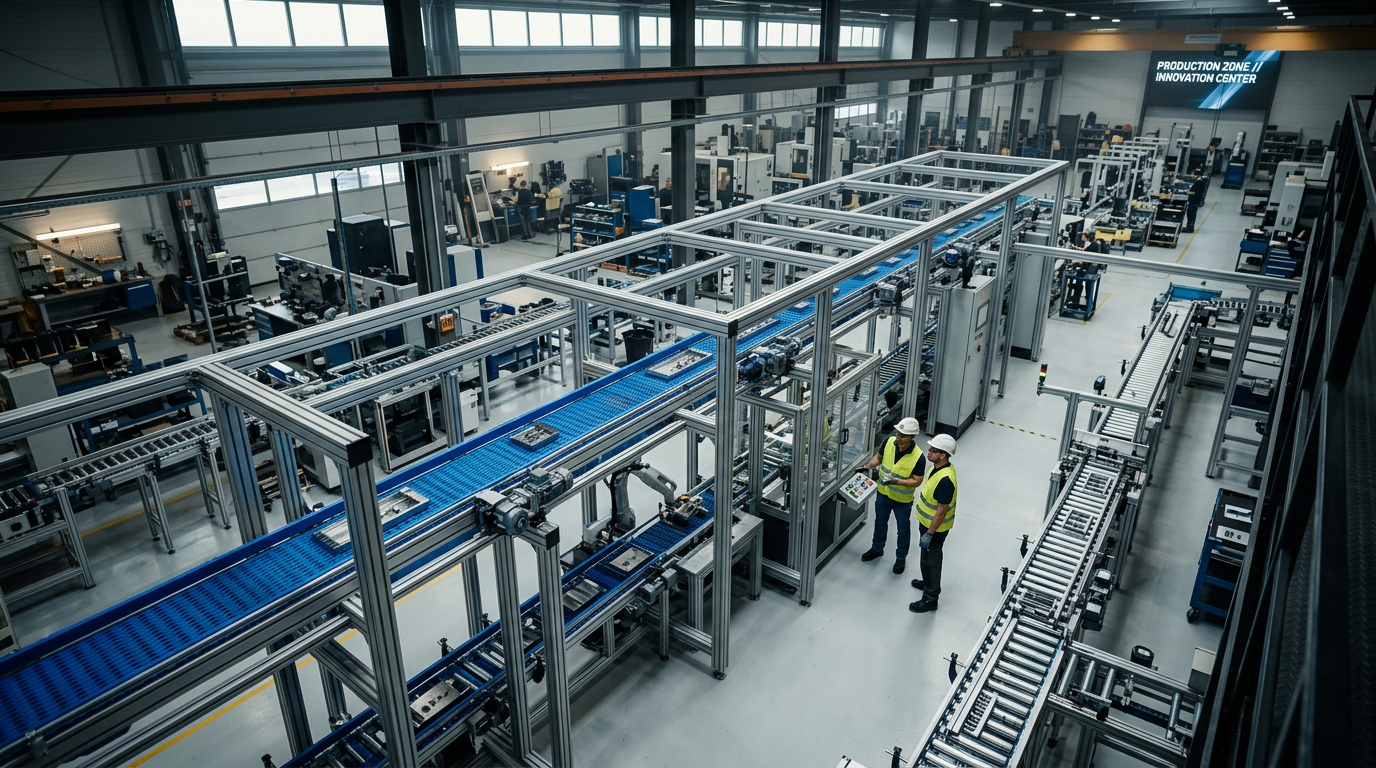
Modular aluminium profile conveyor frames provide the structural agility required for line balancing, allowing for throughput adjustments of up to 40% through rapid reconfiguration of buffer zones and workstation heights. These systems utilize standardized T-slot dimensions, typically 45mm or 50mm profiles, to integrate sensors, diverters, and stop-gates without structural welding or drilling.
The Role of Aluminium Profiles in Modern Line Balancing
Line balancing is the process of aligning the production rate with the Takt time to ensure a smooth flow of materials. In high-mix, low-volume manufacturing environment, static conveyor setups often become bottlenecks when product dimensions or cycle times change. Aluminium profile conveyor frames address this by offering a "Lego-like" modularity. Unlike welded steel frames, which require grinding and repainting for any modification, aluminium profiles allow for the immediate repositioning of drive units, idlers, and support legs.
Engineers utilize these profiles to create dynamic buffer zones. By extending a conveyor segment or adding a parallel "bypass" lane using standard bracketry, a facility can absorb fluctuations in machine uptime. This flexibility is critical for maintaining an OEE (Overall Equipment Effectiveness) above 85% in complex assembly lines.
Technical Specifications and Material Selection
When selecting aluminium profiles for conveyor frames, the mechanical properties must align with the intended load and span. Most modular systems utilize EN AW-6063 T66 aluminium, providing an excellent strength-to-weight ratio.
| Feature | Specification (Standard) | Heavy-Duty Variant |
|---|---|---|
| Profile Size | 45 x 45 mm | 90 x 90 mm |
| Material | Anodized Aluminium (20µm) | Anodized Aluminium (20µm) |
| Moment of Inertia (Ix) | ~11.0 cm⁴ | ~150.0 cm⁴ |
| Max Load per Meter | 50 kg | 250 kg |
| T-Slot Width | 8 mm or 10 mm | 10 mm |
| Flexibility | High (Field modifiable) | Moderate (Higher rigidity) |
The use of anodized coatings (typically 15-20 microns thick) ensures that the frames are resistant to corrosion and wear, while the internal T-slots serve as integrated cable ducts and mounting points for pneumatic components.
Strategies for Line Balancing with Modular Profiles
To achieve effective line balancing, the conveyor system must do more than move parts from point A to point B; it must act as a dynamic regulator of flow.
1. Adjustable Buffer Zones
By using aluminium profiles, engineers can easily implement "accordion" sections. If a downstream process is slower than an upstream one, the length of the conveyor run can be increased within the existing footprint using 90-degree turns and multi-tier stacking. This increases the "work-in-progress" (WIP) capacity, preventing the faster machine from entering a forced downtime state.
2. Rapid Height and Angle Adjustments
Ergonomics play a massive role in manual assembly line balancing. Aluminium profiles allow for the integration of telescopic legs. During a shift change or a product changeover, the conveyor height can be adjusted by +/- 200mm in minutes. This ensures that the human operator—often the most variable element in line balancing—can maintain a consistent cycle time.
3. Integrated Sensor Mounting
Precise flow control requires data. T-slots allow for the mounting of photoelectric sensors and encoders at any point along the frame. If a bottleneck is detected, the Easy Conveyors modular system components can be used to quickly install a "merging" or "diverting" module to redistribute the load across parallel workstations.
Easy Conveyors stocks the conveyor components discussed here — ready to ship across Europe.
Design Trade-offs: Aluminium vs. Stainless Steel
While aluminium is the gold standard for versatility, it is not always the correct choice for every environment. In food processing or pharmaceutical applications requiring caustic wash-downs, a hygienic wash-down design using 304 or 316 stainless steel is mandatory. However, for dry packaging, automotive assembly, and electronics, aluminium wins on cost and lead time.
- Weight: Aluminium is roughly one-third the weight of steel, reducing the load on floor structures and making overhead conveyor installations simpler.
- Cost: While the raw material cost per kg is higher for aluminium, the total cost of ownership (TCO) is often 20-30% lower because no welding, priming, or painting is required.
- Conductivity: Aluminium profiles provide inherent grounding paths for ESD-sensitive electronics manufacturing, provided that conductive T-bolts are used.
Maintenance and Longevity in High-Throughput Lines
The primary failure mode in aluminium frames is not structural fatigue but the loosening of fasteners due to vibration. In high-speed sortation or lines using heavy drum motor selection logic, vibration-resistant T-nuts and thread-locking compounds are essential.
Regular inspections should focus on:
- Joint Integrity: Checking the torque on gusset plates and corner brackets.
- Alignment: Ensuring that the parallel profiles have not splayed, which could cause belt tracking issues or increased wear on the wear strips.
- Slot Cleanliness: In environments with airborne debris, using T-slot cover strips prevents the accumulation of grime that can interfere with future reconfigurations.
Implementing a VFD soft-start tuning strategy also extends the life of the aluminium frame. By reducing the mechanical shock during start-stop cycles, the peak stress on the profile joints is minimized, preserving the precision of the line balance over millions of cycles.
Integrating Automation with Profile Systems
The convergence of "Industry 4.0" and modular hardware allows for "intelligent" line balancing. Modern aluminium frames are designed to house decentralized motor starters and I/O blocks directly on the side of the conveyor. This reduces the "cable spaghetti" often found in traditional plants and makes "plug-and-play" module swaps possible.
If a specific section of the line becomes a permanent bottleneck, a new modular segment—complete with its own motor and sensors—can be wheeled into place, bolted to the existing aluminium frame, and integrated into the PLC network within a single production break. This level of agility is the cornerstone of modern lean manufacturing.
Frequently Asked Questions
What is the standard profile size for medium-duty conveyors?
Standard 45x45mm or 45x90mm anodized aluminium profiles (EN AW-6063 T66) are the most common due to their balance of weight and structural rigidity.
Can aluminium profile frames be used in food-grade wash-down zones?
While aluminium is durable, it is not recommended for high-pressure wash-down environments where caustic chemicals are used; stainless steel is preferred for those applications.
Are aluminium conveyor frames suitable for ESD-sensitive environments?
Yes, using conductive T-nuts and ensuring all segments are electrically bonded makes aluminium frames ideal for ESD-safe electronics assembly.
How much faster is it to reconfigure aluminium frames compared to steel?
Line balancing with modular frames is typically 30-50% faster than with welded steel because it eliminates the need for hot work permits, welding, and painting.
What is the biggest maintenance concern for aluminium profile systems?
Vibration can cause fasteners to loosen. Using serrated lock nuts, T-bolts with thread-locker, and regular torque checks prevents this.