Modular Plastic Belt Materials: POM vs PP vs PE Selection Guide
Guide to modular plastic belt materials: Compare POM, PP, and PE for tensile strength, chemical resistance, and temperature limits in industrial conveyor systems.
Selecting the optimal modular plastic belt material depends on the operating temperature and coefficient of friction, where Polyacetal (POM) offers the highest tensile strength of up to 40,000 N/m and a low friction coefficient of 0.15-0.20, making it the standard for high-speed bottling and packaging lines. While Polypropylene (PP) provides superior chemical resistance and cost-efficiency for high-temperature applications up to 105°C, Polyethylene (PE) is the preferred choice for cryogenic environments down to -70°C due to its impact resistance at low temperatures.
Understanding the "Big Three" Modular Materials
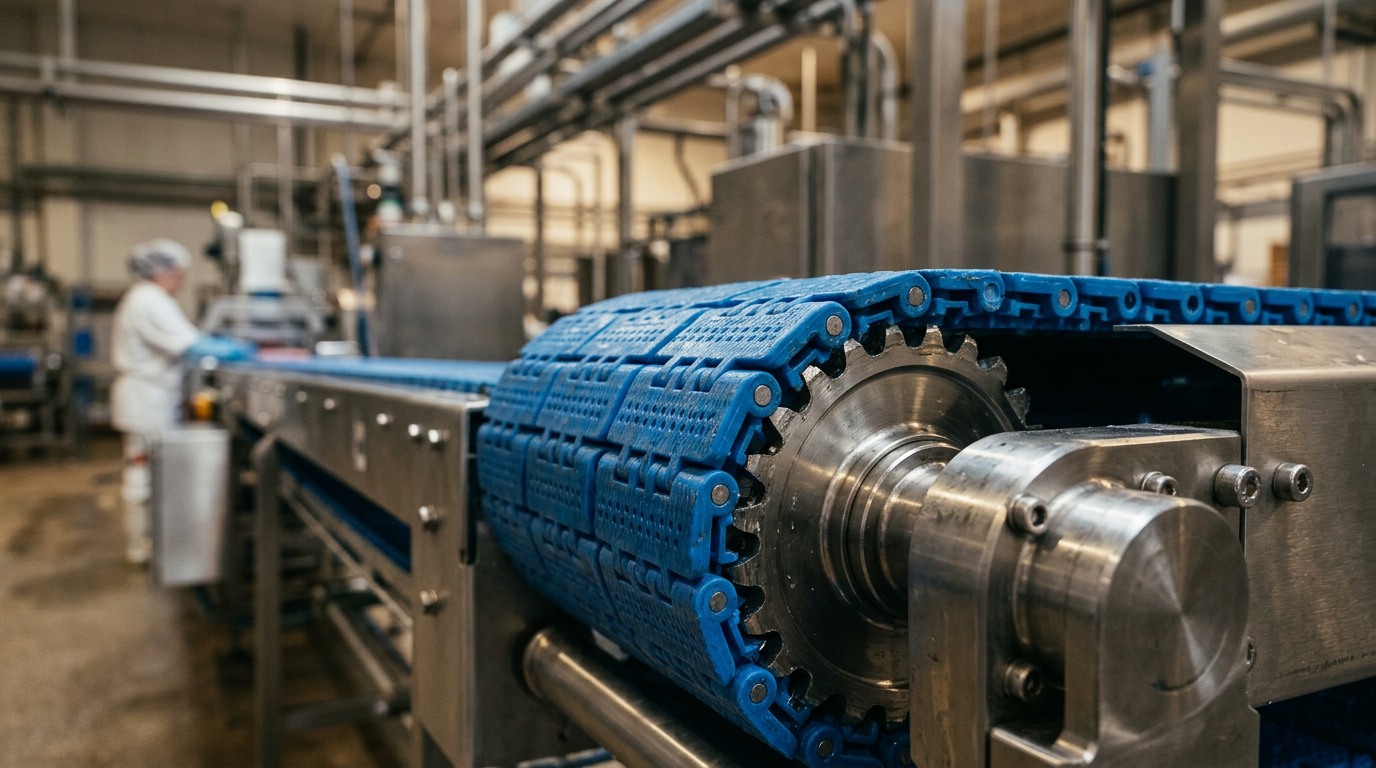
Modular plastic belts have revolutionized material handling by replacing traditional PVC and rubber belts with interlocking modules that allow for easy repair and customized configurations. However, the performance of these systems is dictated by the polymer selected during the design phase. The three primary materials—Polyacetal (POM), Polypropylene (PP), and Polyethylene (PE)—each serve distinct mechanical and environmental niches.
Engineering teams must balance mechanical load requirements with environmental factors such as chemical exposure, wash-down protocols, and thermal cycling. Choosing the wrong material often leads to premature belt elongation, fatigue failure, or "scuffing" where the belt material contaminates the product.
Polyacetal (POM): The Performance Leader
Polyacetal, often referred to as POM or Delrin, is the workhorse of high-capacity modular systems. It is characterized by its high mechanical strength, stiffness, and excellent dimensional stability.
Key Advantages of POM
- Low Friction: POM has a naturally "slick" surface. This reduces the motor torque required to drive the system, often allowing for longer conveyor runs without intermediate drives.
- High Tensile Strength: According to technical data from Intralox, POM modules can handle significantly higher allowable pulls than PP or PE. This makes it the default choice for heavy-duty palletizing and long-distance transport.
- Impact Resistance: It maintains its shape under high-impact loading, such as when heavy cases are diverted or merged onto the line.
However, POM is sensitive to certain chemicals. It can degrade when exposed to high concentrations of chlorine or strong acids, which are common in some intensive food-industry sanitation cycles. For these environments, consulting a specialist like Easy Conveyors can help identify if a specialized POM blend or an alternative material is required.
Polypropylene (PP): The Chemical Specialist
Polypropylene is a versatile, lightweight polymer favored for its chemical inertness and elevated temperature range. While it lacks the raw strength of POM, it compensates with resistance to a vast array of acids, bases, and salts.
When to Choose PP
- High Temperatures: PP remains stable at continuous temperatures up to 105°C, making it suitable for blanching, pasteurization, and drying tunnels.
- Chemical Exposure: In applications involving aggressive cleaning agents or acidic food processing (like citrus or pickling), PP outlasts POM.
- Cost Sensitivity: PP is generally more economical than POM, providing a lower Total Cost of Ownership (TCO) for light-to-medium load applications.
The primary trade-off with PP is its brittleness at low temperatures. If the ambient temperature drops below 5°C, PP becomes prone to cracking under impact, making it unsuitable for cold storage or outdoor use in winter climates.
Polyethylene (PE): The Cold Chain Essential
Polyethylene is the most ductile of the three materials. Its standout feature is its ability to remain flexible and impact-resistant at extreme sub-zero temperatures.
Advantages in Cryogenics
- Low-Temperature Performance: PE is rated for use down to -70°C. It is the industry standard for spiral freezers and blast freezing tunnels.
- Flexibility: Because it is less rigid than POM or PP, it can better withstand the stresses of rapid thermal expansion and contraction.
- Release Properties: Many sticky food products release more easily from PE surfaces than from harder plastics.
The drawback of PE is its relatively low tensile strength and high coefficient of friction. PE belts require more frequent support and shorter conveyor lengths to prevent excessive belt stretch under load.
Easy Conveyors stocks the conveyor components discussed here — ready to ship across Europe.
Comparison Table: POM vs. PP vs. PE
| Technical Property | Polyacetal (POM) | Polypropylene (PP) | Polyethylene (PE) |
|---|---|---|---|
| Tensile Strength | High (40,000+ N/m) | Medium (20,000 N/m) | Low (10,000 N/m) |
| Temp Range (°C) | -40 to +90 | +5 to +105 | -70 to +65 |
| Friction Coeff. | Low (~0.15) | Medium (~0.25) | High (~0.35) |
| Impact Resistance | Good | Fair (Poor in cold) | Excellent |
| Chemical Resistance | Moderate | Excellent | Excellent |
| Density (g/cm³) | ~1.40 | ~0.90 | ~0.95 |
Selection Criteria and Design Trade-offs
When designing a modular system, engineers must look beyond the belt material itself and consider the interaction with conveyor components such as wear strips and sprockets.
1. Thermal Expansion
All plastics expand and contract with temperature changes significantly more than steel. POM and PP have different expansion coefficients. If a conveyor operates through a wide temperature delta (e.g., a wash-down at 80°C in a room that is 10°C), the catenary sag must be sized to accommodate the change in belt length to prevent sprocket jumping.
2. Hygiene and Food Safety
All three materials can be manufactured in FDA-compliant grades (FDA 21 CFR 177). However, for high-care environments, the "cleanability" of the material matters. PP's resistance to harsh sanitizers makes it a favorite for meat and poultry processing, while POM is preferred in dry packaging where friction-generated dust must be minimized.
3. Energy Efficiency
The choice of material impacts the drive system requirements. A POM belt on UHMW-PE wear strips provides the lowest friction, reducing the load on the motor and potentially allowing the use of a smaller IE3-rated motor (IEC 60034-30-1). Conversely, a PE belt will create more drag, increasing energy consumption over the lifecycle of the machine.
Specialized Material Variants
Beyond the standard grades, manufacturers have developed specialized blends to solve specific industrial problems:
- Anti-Static (ESD): Used in electronics manufacturing to prevent static discharge that could damage components.
- Flame Retardant: Necessary for airports and logistics centers to meet fire safety codes (e.g., UL 94 V-0).
- Metal Detectable: Infused with metallic particles so that broken belt fragments can be caught by downstream metal detectors, a critical safety feature in food production.
- Self-Lubricating: POM resins infused with oils or waxes to further reduce the coefficient of friction for high-speed sortation.
Summary of Selection Logic
For high-speed, high-load, or long-distance conveyors at room temperature, POM is almost always the correct choice. It provides the mechanical integrity needed for 24/7 industrial operations.
If the application involves corrosive chemicals or high-heat processing (above 80°C), PP becomes the necessary selection, provided the environment stays above freezing.
For freezing and cold-storage applications, PE is the only reliable choice to prevent material embrittlement and catastrophic belt failure.
Designing a system involves more than just picking a polymer; it requires calculating the allowable belt pull, verifying sprocket engagement, and ensuring the VFD soft-start tuning is calibrated to the inertia of the specific material chosen. By matching the polymer to the environment, plant managers can ensure a modular system that provides years of reliable service with minimal maintenance.
Frequently Asked Questions
Why is POM the standard for high-speed packaging lines?
POM is preferred for high-speed packaging because it has the lowest coefficient of friction (0.15-0.20), which reduces heat buildup and motor load while offering high tensile strength.
Can I use Polypropylene (PP) in a cold storage warehouse?
Polypropylene (PP) should be avoided in freezing environments because it becomes brittle and loses impact resistance at temperatures below 5°C, leading to cracked modules.
Which material is best for spiral freezers?
Polyethylene (PE) is the only reliable choice for cryogenic applications down to -70°C, as it remains flexible and resistant to impact when other plastics become brittle.
What are the trade-offs when switching from POM to PP for chemical resistance?
While PP has excellent chemical resistance, it is significantly weaker than POM, often requiring more drive units or shorter conveyor runs to stay within allowable belt pull limits.
Does Polyacetal (POM) react poorly to cleaning chemicals?
POM can be damaged by high concentrations of chlorine or acids (pH < 4). In food plants using heavy chlorine-based sanitizers, PP or specialized acid-resistant POM should be used.