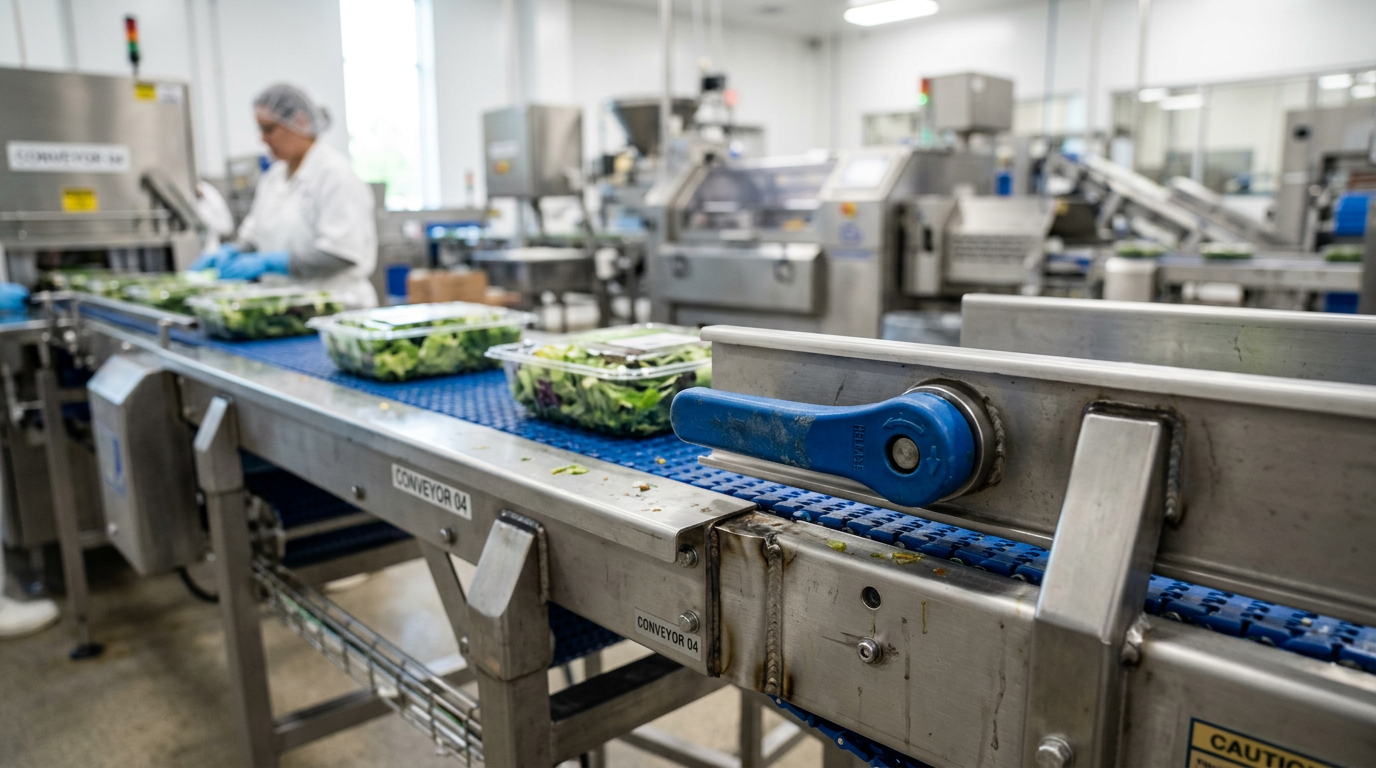
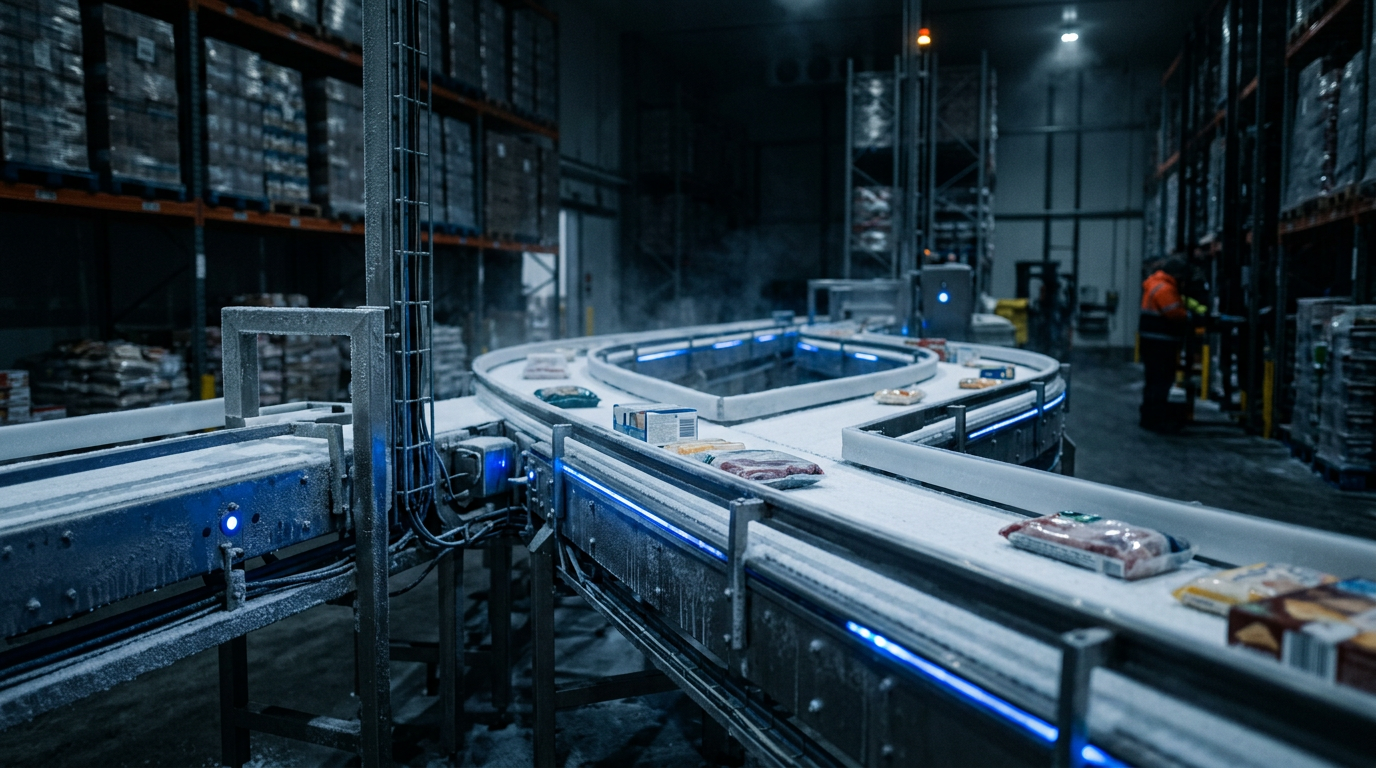
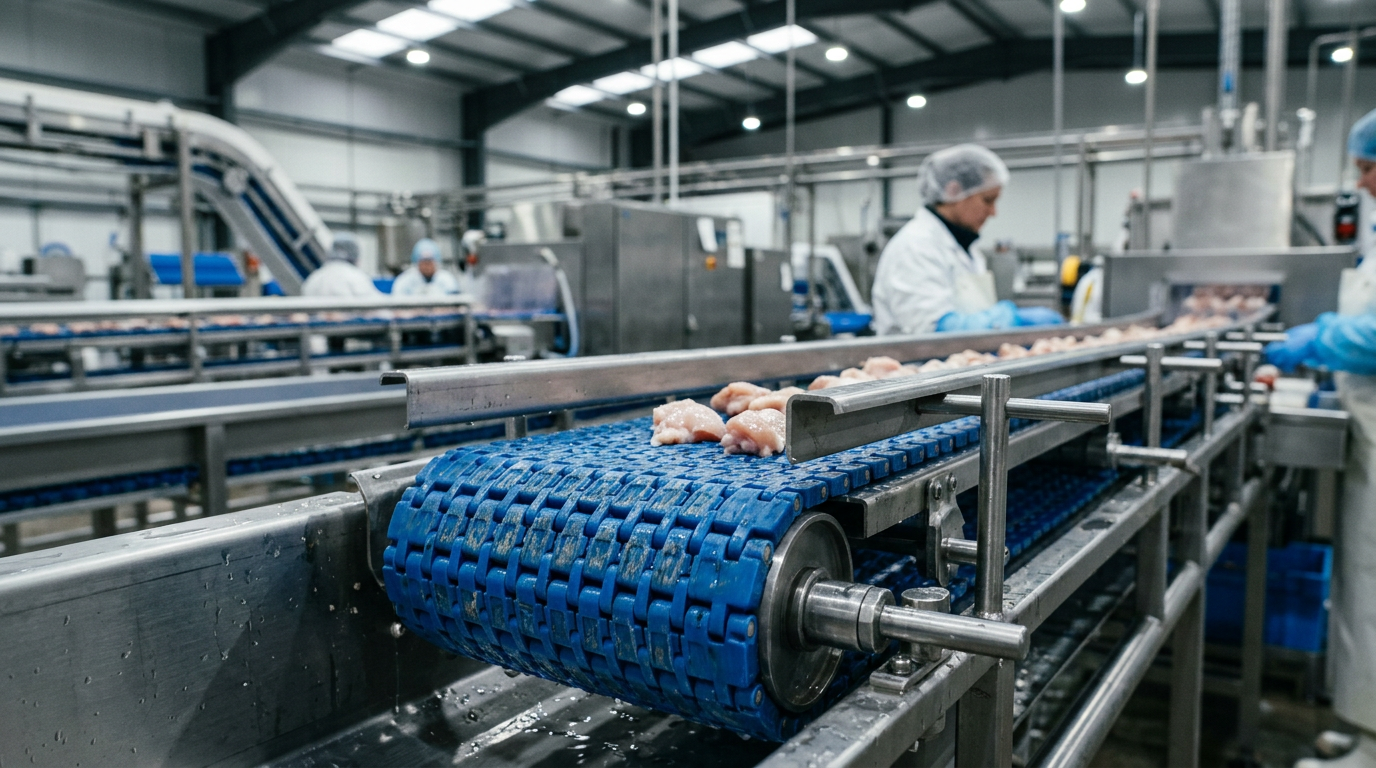
Modular Plastic Belt Conveyors in High-Care Food Production
Explore the critical role of modular plastic belt conveyors in high-care food production, from material selection for FDA compliance to hygienic frame design.
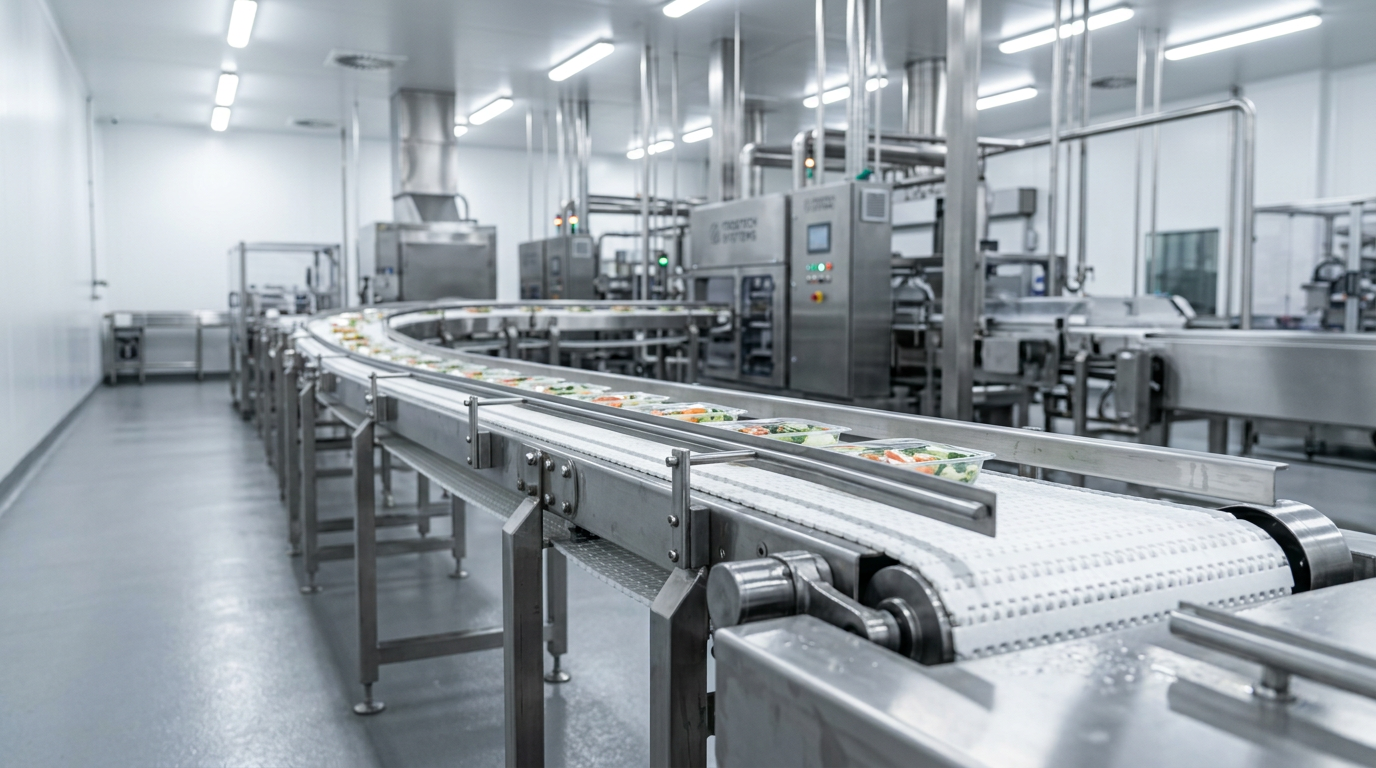
Modular plastic belt conveyors are advanced material handling systems utilizing interlocking thermoplastic links, specifically designed to meet the rigorous hygiene and sanitization requirements of high-care food production environments. These systems replace traditional fabric or rubber belts with food-grade materials such as Polyethylene (PE), Polypropylene (PP), or Polyacetal (POM), ensuring FDA and EU 1935/2004 compliance.
The Role of Modular Belting in High-Care Zones
In the hierarchy of food manufacturing, "high-care" zones represent environments where products that are susceptible to microbiological contamination (like ready-to-eat meals, cooked meats, or dairy) are handled. In these areas, the conveyor system is not merely a transport mechanism; it is a critical control point for food safety.
Modular plastic belt conveyors have become the industry standard in these zones because they solve the primary failure point of traditional flat belts: the inability to provide a truly cleanable surface on both sides. Fabric-backed belts often suffer from "wicking," where fluids and bacteria soak into the carcass of the belt, leading to internal microbial growth that cannot be reached by chemical sanitizers.
Modular belts, by contrast, feature a "non-porous" construction. The links are joined by hinge pins, which, when designed correctly, allow for 360-degree cleaning access. For engineers designing these lines, selecting the right sprocket-to-belt engagement is essential to avoid "dead zones" where organic matter can accumulate.
Material Selection: POM vs. PP vs. PE
The choice of thermoplastic is the first critical decision in the engineering phase. Each material offers distinct chemical resistance and mechanical properties that dictate its suitability for specific food processes.
| Feature | Polypropylene (PP) | Polyethylene (PE) | Polyacetal (POM) |
|---|---|---|---|
| Temperature Range | +5°C to +105°C | -73°C to +66°C | -43°C to +95°C |
| Impact Resistance | Moderate | Very High | High |
| Chemical Resistance | Excellent (Acids/Bases) | Exceptional | Good |
| Friction Coeff. | Medium | Low | Very Low |
| Hygienic Rating | High (Steam cleanable) | High (Deep freeze) | Moderate (Not for high-acid) |
Polypropylene (PP)
PP is the workhorse of high-care environments involving heat. It can withstand high-temperature washdowns (up to 105°C) and is resistant to a wide array of aggressive cleaning chemicals. However, it becomes brittle at temperatures below 5°C, making it unsuitable for blast freezers or cold storage.
Polyethylene (PE)
PE is the go-to for frozen food applications. It remains flexible at temperatures as low as -73°C. Because it is a softer plastic, it has remarkable impact resistance but lower load-bearing capacity compared to POM.
Polyacetal (POM)
Often referred to by the brand name Delrin, POM is chosen for its immense tensile strength and low coefficient of friction. This makes it ideal for long conveyor runs and high-speed sortation. However, engineers must be cautious: POM can degrade when exposed to high concentrations of chlorine (a common bleaching agent in food plants), which can lead to stress cracking over time.
Engineering for Cleanability: Frame and Component Design
In a high-care facility, the belt is only as hygienic as the frame it sits on. Modular systems in these zones must utilize "open-frame" designs, typically constructed from 304 or 316L stainless steel.
Eliminating Bacteria Harbors
To meet EHEDG (European Hygienic Engineering & Design Group) standards, the conveyor frame should avoid horizontal flat surfaces. Instead, surfaces should be pitched at a minimum of 3° to ensure water and chemical runoff. Hollow tubing is strictly avoided; instead, "open-profile" C-channel or solid round bar frames are used to ensure there are no "blind" cavities where bacteria could colonize.
Drive Systems and Motors
The integration of the drive system is another area where high-care requirements influence design. Many modern lines are moving toward stainless steel drum motor selection to eliminate the external motor cooling fans that can circulate airborne contaminants. If a traditional gearmotor is used, it should be an IP69K-rated, paint-free unit with a smooth-bodied casing.
Easy Conveyors specializes in these modular systems, providing the engineering precision required to ensure that the belt-to-frame interface minimizes friction while maximizing access for Sanitation Standard Operating Procedures (SSOP).
Easy Conveyors stocks the modular systems discussed here — ready to ship across Europe.
Maintenance and Failure Modes in Food Lines
While modular belts are robust, they are not indestructible. Understanding common failure modes helps in proactive maintenance.
- Pin Migrations: In substandard designs, the hinge pins that hold the modules together can "walk" out of the side of the belt. This creates a catastrophic risk of foreign object contamination. Modern high-care belts use "headed pins" or "clipping" mechanisms to lock pins permanently in place.
- Sprocket Misalignment: If the drive sprockets are not perfectly aligned or if the belt tension is too high, the teeth of the sprocket will shave off small fragments of plastic. This "plastic dust" is a frequent cause of product recalls.
- Elongation: Unlike fabric belts, modular belts do not "stretch" in the traditional sense. Instead, the holes for the pins wear down into an oval shape over years of service, effectively lengthening the belt. Regular inspections of the "catenary sag"—the unsupported section of the belt returning to the drive end—are essential for proper VFD soft-start tuning and preventing belt jump.
Advanced Sanitization: Clean-In-Place (CIP) Units
The most significant advancement in modular belt technology for high-care zones is the integration of automated Clean-In-Place (CIP) manifolds. These systems consist of stainless steel spray bars mounted inside the conveyor frame.
A well-designed CIP system targets:
- The Sprockets: The primary area for organic buildup.
- The Underside of the Belt: Often neglected by manual labor.
- The Wearstrips: The surfaces where the belt slides.
By automating the "pre-rinse, foam, and final rinse" cycle, plants can achieve more consistent microbial results than with manual scrubbing. Furthermore, using hygienic wash-down design principles reduces water consumption by up to 30%, as the open structure of modular belts requires less pressure to flush debris through the links.
Compliance and Safety Standards
When procuring these systems, engineers must verify:
- FDA 21 CFR: For materials in contact with food.
- EU 10/2011: For plastic materials intended to come into contact with food.
- IP69K: The rating for electrical components, ensuring they can withstand high-pressure, high-temperature jets (80-100 bar at 80°C).
- ISO 14159: Safety of machinery—hygiene requirements for the design of machinery.
In summary, modular plastic belt conveyors offer the most versatile and food-safe solution for modern manufacturing. By selecting the correct polymer, ensuring an open-frame design, and implementing automated cleaning protocols, manufacturers can significantly reduce the risk of cross-contamination while improving uptime through modular repairability.
Frequently Asked Questions
Which plastic material is best for high-temperature washdowns?
Polypropylene is best for high-temperature and chemical resistance, whereas Polyethylene is required for sub-zero frozen food applications.
How do CIP systems improve food safety in conveyor lines?
Clean-in-Place (CIP) systems use automated spray bars to sanitize the belt and frame, reducing water waste and ensuring consistent microbial control.
Why is IP69K rating necessary for modular food conveyors?
The IP69K rating is essential because it guarantees that motors and sensors can withstand high-pressure (up to 100 bar) and high-temperature (80°C) jets used during sanitization.
Are modular belts safer than fabric belts for RTE food?
Modular belts are safer because they are non-porous, preventing 'wicking' (bacterial absorption) common in fabric belts, and they allow for 360-degree cleaning access.
How do you prevent pin migration in modular belts?
Pin migration is prevented by using 'locked-pin' designs or headed pins that physically cannot slide out of the hinge assembly during operation.
Sources & references
- [1]Hygienic Design of Conveyors for Food Processing (Doc 44)
- [2]Food Contact Substances (FCS) - Regulations and Compliance
- [3]Modular Belt Series and Food Safety Standards
- [4]EHEDG Guidelines for Food-Grade Modular Belts
- [5]ISO 14159:2002 Safety of machinery — Hygienic requirements for the design of machinery