Modular Curve Conveyors: Engineering for Tight-Radius Layouts
Modular curve conveyors enable high-density layouts with inner radii as small as 1.5x belt width. Learn to optimize space and reduce friction in tight-radius designs.
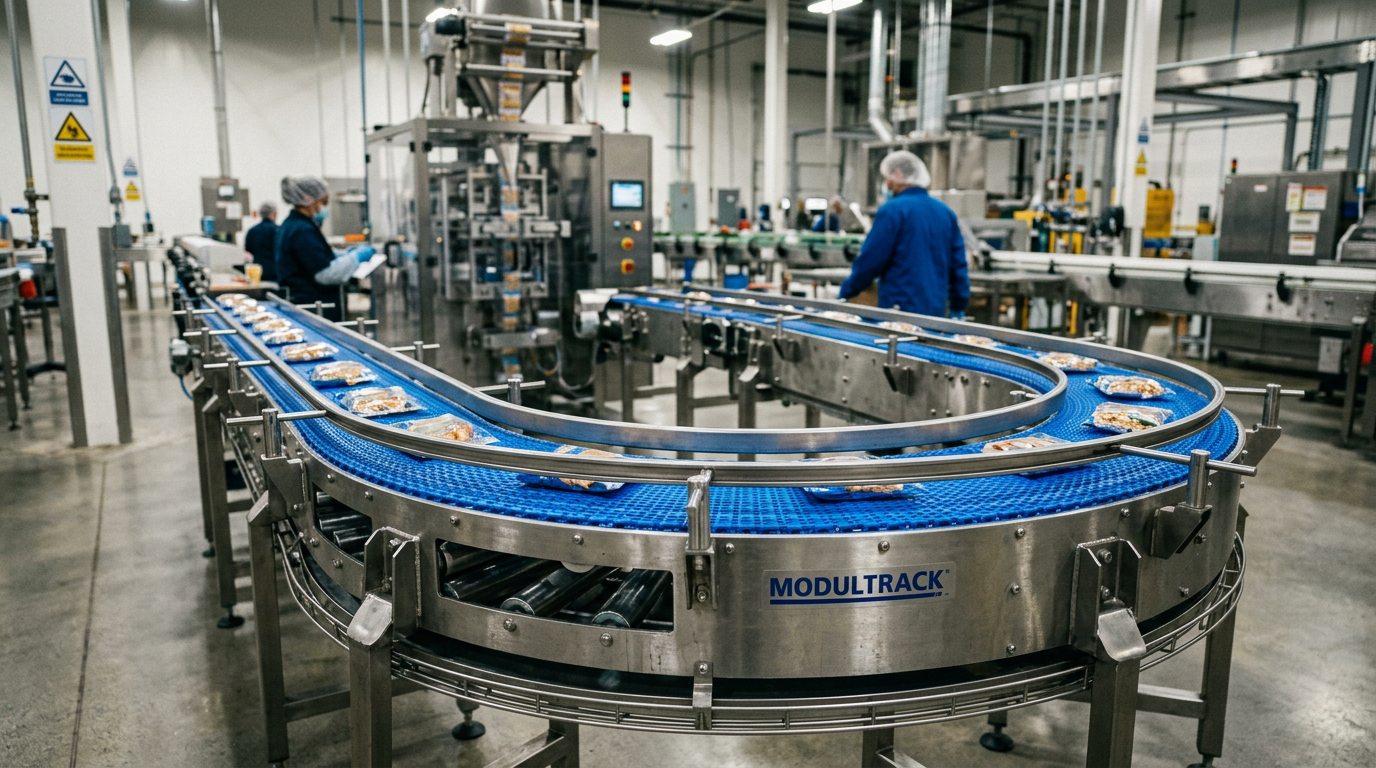
Modular curve conveyors for tight-radius layouts enable high-density facility design by achieving inner turning radii as small as 1.5 to 2.0 times the belt width, significantly reducing the floor space required compared to standard long-radius curves. By utilizing side-flexing plastic modular chains and specialized guiding systems, these units maintain product orientation and throughput at speeds exceeding 60 meters per minute while navigating corners from 30° to 180°.
The Engineering Logic of Tight-Radius Curves
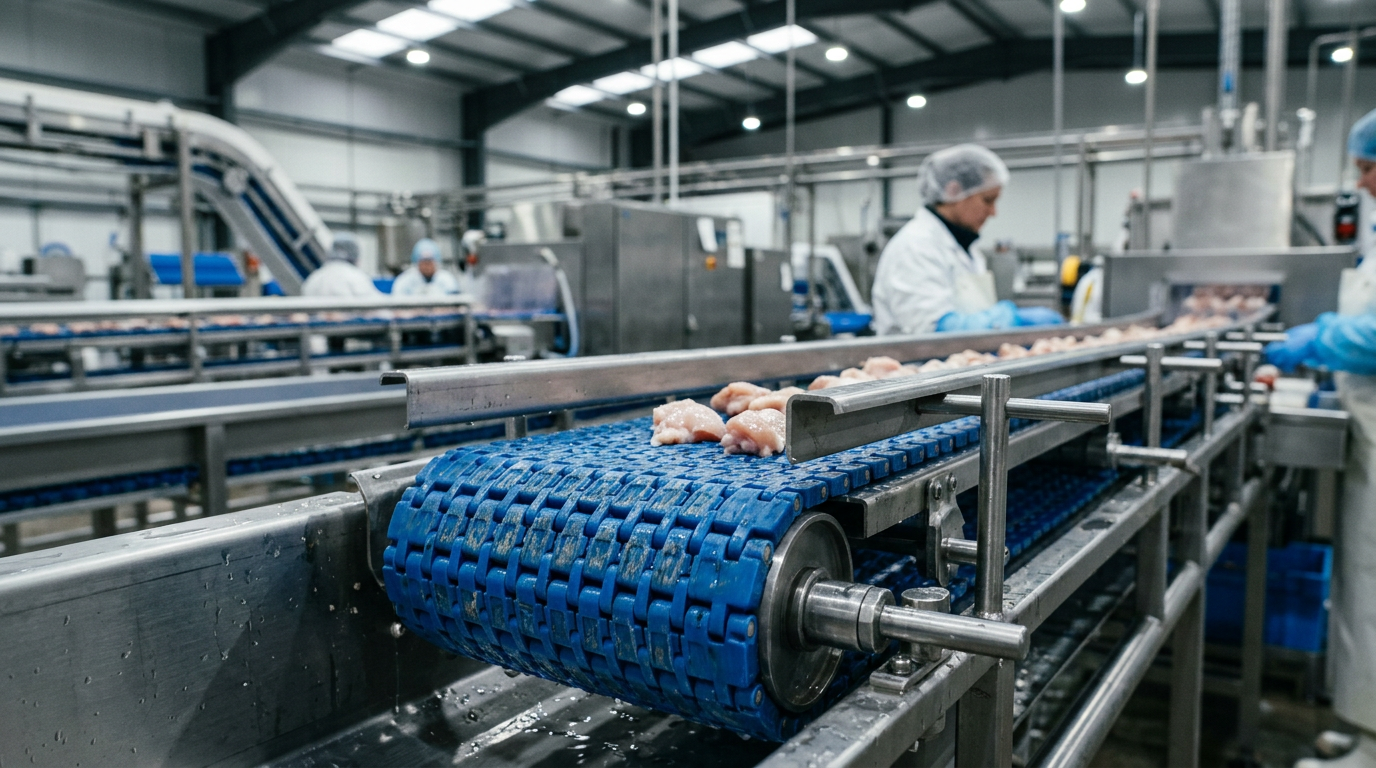
In modern facility design, square footage is often the most expensive variable. Traditional fabric belt curves typically require large footprints because the belt must be tensioned evenly across a conical pulley system. In contrast, modular curve conveyors utilize side-flexing chains—usually made of Polyacetal (POM) or Polypropylene (PP)—that pivot on integrated hinge pins.
The technical advantage of modular systems lies in their ability to handle "tight-radius" configurations. The industry benchmark for a tight radius is generally defined by an inner radius ($R_{in}$) that is less than 2.5 times the belt width ($W$). High-performance systems can achieve $R_{in} = 1.5 \times W$, allowing for "U-turns" and "S-curves" in spaces where traditional conveyors would fail.
Side-Flexing Mechanics and Material Choice
The performance of a tight-radius curve depends heavily on the friction coefficient and tensile strength of the modular belt. According to Habasit, POM is the preferred material for these applications due to its high strength and low coefficient of friction against wear strips.
| Feature | Polyacetal (POM) | Polypropylene (PP) | Stainless Steel (Ref) |
|---|---|---|---|
| Tensile Strength | High (up to 30,000 N/m) | Medium | Extremely High |
| Friction Coeff. | 0.15 - 0.20 | 0.25 - 0.30 | 0.30+ |
| Temp Range | -40°C to +90°C | +5°C to +105°C | -60°C to +250°C |
| Chemical Resistance | Good (Oils/Solvents) | Excellent (Acids/Bases) | Superior |
| Standard Radius Factor | 1.5x to 2.2x Width | 2.0x to 2.5x Width | Fixed (Custom) |
Key Design Considerations for Tight Radius Layouts
When designing a system with tight-radius modular curves, engineers must account for several mechanical stressors that do not exist on straight runs.
1. The Centrifugal Force and Product Stability
As products enter a 90° or 180° curve, centrifugal force acts upon them. In tight-radius layouts, this force is amplified. Designers often use "high-friction" inserts or rubber-top modules to ensure that lightweight packages do not slide outward. Furthermore, the conveyor's speed must be synchronized with the radius to prevent "product toppling," a common failure mode in tall, narrow containers like beverage cans or pharmaceutical vials.
2. Guide Rail Dynamics
In a modular curve, the belt is physically pulled against the inner radius of the frame. This creates a high-pressure point. Standard designs utilize Ultra-High Molecular Weight Polyethylene (UHMW-PE) wear strips to minimize heat build-up. For high-speed applications, specialized magnetic guides or "tab" systems are employed to keep the belt flat and prevent "tenting"—a phenomenon where the outer edge of the belt lifts during high-tension turns.
3. Effective Width vs. Physical Width
It is a common misconception that the belt width remains the "usable" width in a curve. Because modular belts collapse on the inner radius and expand on the outer radius to facilitate the turn, the "carry surface" changes. Engineers must ensure the product footprint fits within the "collapsed" pitch of the inner radius. Easy Conveyors specializes in engineering these modular curves to maximize the effective carrying area, ensuring that even at a 1.5x width radius, the belt remains stable and the pitch remains consistent.
Integration and Drive Systems
One of the most significant benefits of modular curves is their ability to be driven by a single motor across multiple sections. Unlike fabric belts that require a separate drive for every curve, modular chains can navigate a "straight-curve-straight" sequence using one gearmotor.
VFD Soft-Start Tuning
Because tight curves increase the total system friction, the motor must overcome higher breakaway torque. Utilizing a Variable Frequency Drive (VFD) with an optimized acceleration ramp is critical. According to SEW-Eurodrive, soft-starting reduces the peak tension on the modular hinge pins by up to 40%, significantly extending the life of the belt.
Calculating Chain Tension
The tension in a modular curve is calculated using the "Eberle Formula" or similar proprietary algorithms from manufacturers like Intralox. The formula accounts for:
- Total load (kg/m)
- Friction factor of the wear strips
- The "Curve Factor": A multiplier that increases based on the number of turns and the tightness of the radius. A single 90° tight curve can add as much friction to the system as 10 meters of straight conveyor.
Easy Conveyors stocks the modular systems discussed here — ready to ship across Europe.
Hygiene and Maintenance Standards
In food and pharmaceutical environments, tight-radius curves must adhere to strict sanitary standards. The EHEDG (European Hygienic Engineering & Design Group) provides guidelines for open-frame designs that allow for easy cleaning.
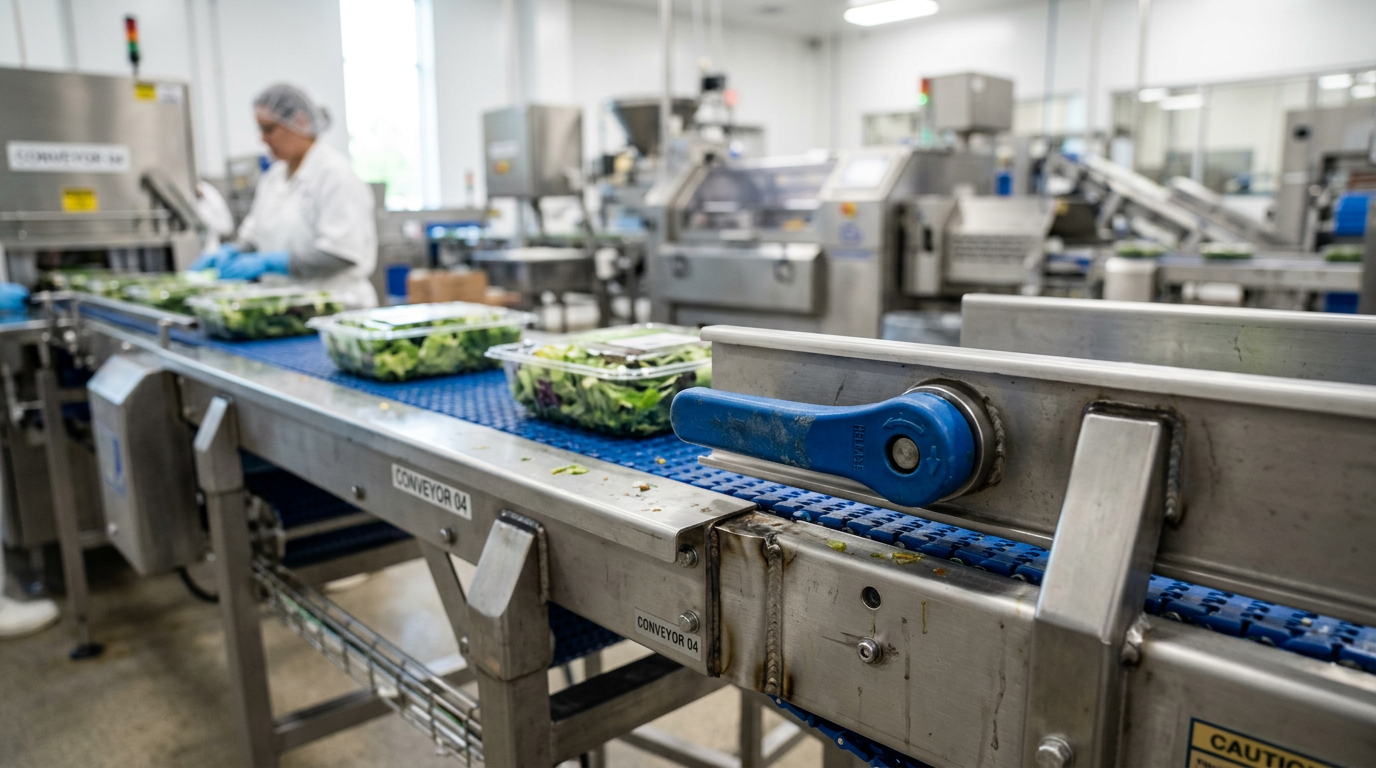
- Wash-down Capability: Modular belts are inherently easier to clean than fabric belts because they can be lifted, and the "hinge" points can be accessed with high-pressure water.
- Self-Lubricating Materials: Modern POM chains often include internal lubricants to eliminate the need for external oiling, which is a major contamination risk in food zones.
- FDA Compliance: All plastic components in the modular curve should be FDA compliant for food contact, typically verified by the 21 CFR 177.2470 standard for polyacetal.
Common Failure Modes and Prevention
- Pin Migration: In extremely tight turns, the hinge pins may begin to work their way out of the modules. This is usually prevented by using "headless" pins or specialized locking end-caps.
- Wear Strip Grooving: If the belt tension is too high, the modules can cut grooves into the UHMW-PE wear strips. Regular inspection of the inner radius guide is mandatory every 2,000 operating hours.
- Surging (Slip-Stick): In long systems with multiple curves, the belt may move in a jerky motion. This is often caused by insufficient take-up tension or an undersized VFD. Increasing the drive sprocket diameter or using a "catenary sag" take-up can resolve this.
Future Trends: The "Zero-Tangent" Revolution
The industry is moving toward "Zero-Tangent" modular curves. Traditionally, a modular curve required a straight lead-in and lead-out section to allow the chain to transition. New designs allow the curve to start immediately after a sprocket or transfer, further reducing the machine footprint. This is particularly useful in robotic palletizing cells where space is at an absolute premium.
By integrating advanced modular systems, manufacturers can reclaim up to 30% of their floor space while increasing the reliability of their material handling operations. Proper selection of belt material, radius factor, and drive control ensures these systems provide a decade or more of service in even the most demanding 24/7 environments.
Frequently Asked Questions
What is the minimum turning radius for a modular conveyor?
The standard tight radius for modular conveyors is typically 1.5 to 2.2 times the belt width, depending on the specific chain series and material used.
Should I use POM or PP for a side-flexing conveyor belt?
Polyacetal (POM) is usually preferred over Polypropylene (PP) for curves because it has higher tensile strength and a lower coefficient of friction, which reduces heat and wear during turns.
How do tight curves affect product stability?
Centrifugal force in tight curves can cause products to slide or tip. High-friction modules or rubber-top inserts are used to maintain product orientation during high-speed turns.
Can a single motor drive multiple curves?
Yes, one of the main advantages of modular chains is that a single drive can power multiple curves and straight sections, provided the total chain tension remains within the belt's limits.
What is 'tenting' in modular curve conveyors?
Tenting occurs when the outer edge of a modular belt lifts during a turn. It is prevented by using 'tab' or 'magnetic' guiding systems that lock the belt edges into the conveyor frame.