Engineering Modular Curve Conveyors for Tight-Radius Layouts
Modular curve conveyors enable 90° and 180° turns in tight-radius layouts using side-flexing chains. Learn the collapse factors and design rules for compact footprints.
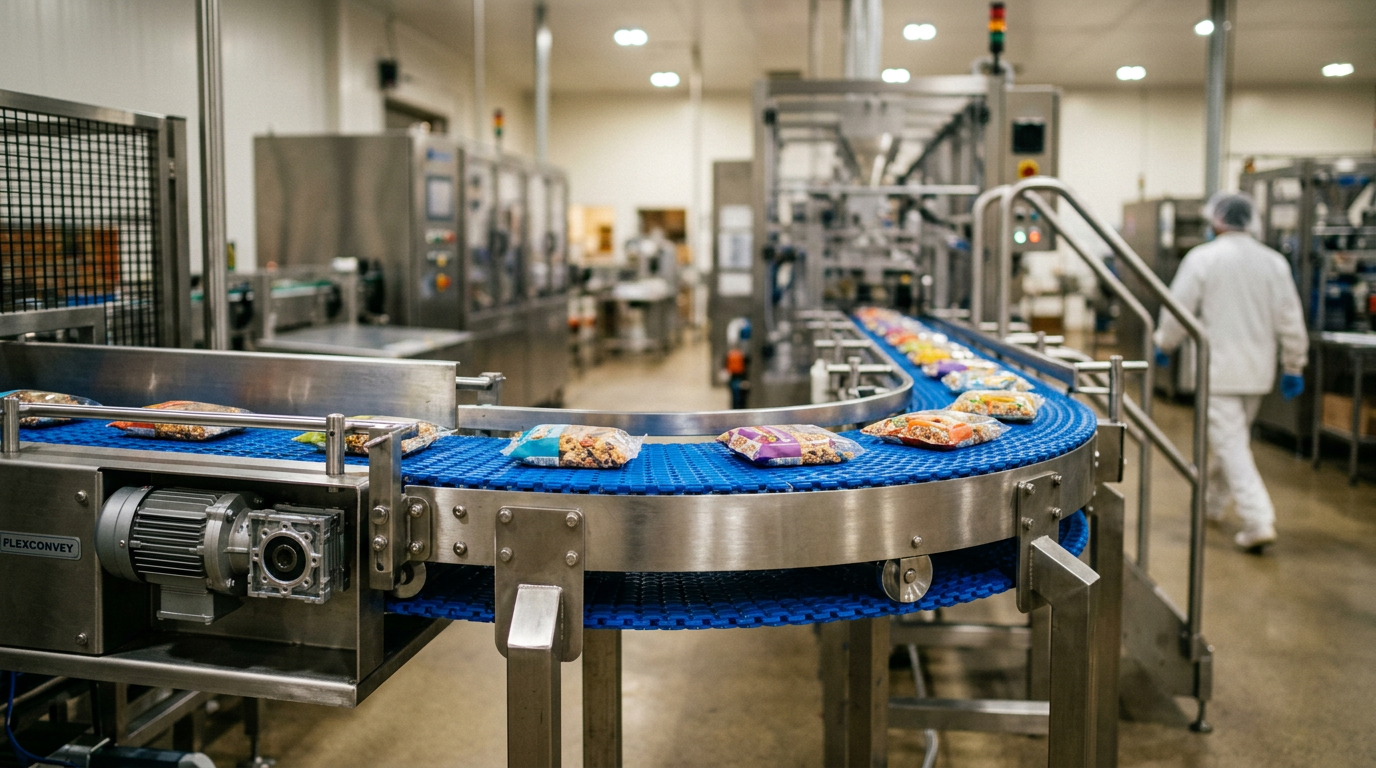
Modular curve conveyors for tight-radius layouts typically achieve a minimum inner radius of 1.5 to 2.2 times the chain width, allowing for 90-degree and 180-degree turns within a footprint up to 40% smaller than traditional banked or oversized radius systems. By utilizing side-flexing plastic modular chains with collapse factors as low as 1.6, engineers can maintain high throughput in constrained floorplans without the tracking issues associated with standard fabric belts.
The Engineering Logic of Tight-Radius Curves
In modern manufacturing environments, floor space is often the most expensive asset. Designing a conveyor layout that maximizes vertical and horizontal density requires curves that can pivot almost on their own axis. Modular curve conveyors solve the geometric challenge of "differential speed" across the belt width—where the outer edge must travel significantly faster than the inner edge—using side-flexing links.
Unlike flat-belt curves which require conical pulleys and complex tensioning to prevent "walking," modular systems use positive sprocket drives and captive tracking features. This allows for a consistent speed across the pitch line and eliminates the need for the wide, sweeping corners that consume valuable square footage.
The Collapse Factor and Radius Calculation
The most critical metric in selecting a tight-radius conveyor is the collapse factor. This is a dimensionless ratio between the minimum inner radius ($R_{in}$) and the chain width ($W$).
- Standard Side-Flexing: 2.2 to 2.5 ratio.
- Tight-Radius Specialized: 1.5 to 1.7 ratio.
For example, a 300mm wide chain with a 1.6 collapse factor can achieve an inner radius of 480mm. When comparing this to traditional PVC belt curves, the modular approach often saves between 0.5 and 1.2 meters of lateral space per 90-degree turn.
Material Selection: POM vs. Reinforced Polymers
The friction and tension forces in a tight curve are significantly higher than in a straight run. As the chain enters the curve, the load is transferred to the outer edge of the links. Consequently, material choice is paramount for longevity.
| Feature | Polyacetal (POM/Acetal) | Reinforced Polypropylene (PP) | High-Performance PBT |
|---|---|---|---|
| Tensile Strength | High | Medium | Very High |
| Coefficient of Friction | Low (0.15 - 0.25) | Moderate | Ultra-Low |
| Temperature Range | -40°C to +90°C | +5°C to +105°C | -40°C to +120°C |
| Chemical Resistance | Good (Hydrocarbons) | Excellent (Acids/Bases) | Excellent |
| Application Suitability | General Purpose/Automotive | Food Processing | High-Speed Bottling |
For high-speed applications, engineers should specify materials that meet ISO 21102 standards for friction testing to ensure the conveyor motor doesn't overheat due to excessive drag in the curve guides.
Overcoming Centrifugal and Centripetal Forces
In a tight-radius modular curve, two physical forces threaten stability: the tendency of the chain to "pop out" of the track and the "tipping" of tall, narrow products (like wine bottles or aerosol cans).
Captive Tracking Systems
To counteract the radial tension that pulls the chain toward the center of the curve, modern modular systems use "tabs" or "beveled edges" that lock into the wear strip. This ensures the chain remains perfectly flat even under high tension. European specialists like Easy Conveyors have refined these guide rail geometries to minimize the "chatter" often seen in poorly designed curve modules.
Managing Product Stability
As the radius tightens, the angular velocity increases. According to CEN standards for conveyor safety, stability must be maintained at the maximum rated speed. For tight curves, we recommend:
- Low-friction top surfaces: Allowing the product to adjust its position slightly without catching.
- Integrated side guards: Often built directly into the modular link to prevent the "dead zone" gap between the belt and a stationary rail.
- Active transfer rollers: Small-diameter rollers at the entry and exit of the curve to ensure smooth hand-offs from straight sections.
Easy Conveyors stocks the modular systems discussed here — ready to ship across Europe.
Design Trade-offs: Throughput vs. Footprint
While tight-radius curves save space, they introduce specific mechanical constraints that must be accounted for during the "modular system sizing and selection" phase.
- PVP (Pressure-Velocity) Limits: The friction between the chain edge and the wear strip generates heat. In a tight curve, this heat is concentrated. Exceeding the PV limit of the material will lead to premature wear or "welding" of the plastic links to the guides.
- Effective Chain Strength: A side-flexing chain in a curve only utilizes about 20-30% of its rated straight-pull strength because the load is concentrated on the outer links. If the layout includes multiple curves, a "multi-drive" configuration or an intermediate drive module may be required to keep tension within NEMA motor load guidelines.
Maintenance and Wear Monitoring
The wear strips in the curve are sacrificial components. In a 24/7 e-commerce fulfillment center, these strips may need replacement every 12-18 months.
Failure modes in tight-radius layouts often manifest as:
- Chain elongation: Specifically on the outer edge, leading to "snaking" in straight sections.
- Wear strip thinning: If the radius is too tight for the speed, the inner guide will show a "scalloped" wear pattern.
- Sprocket jump: Occurs when the back-tension from the curve exceeds the drive sprocket's ability to grip the modular hinges.
Standardizing on high-density polyethylene (PE-HD 1000) or specialized "Lubricated" PA (Nylon) for the curve guides can extend service intervals by up to 300%. Proper "VFD soft-start tuning" is also critical to prevent the sudden jerks that cause link fatigue in the curved sections.
Future Trends: The "Universal" Flex Chain
We are seeing a shift toward magnetic curve technology where the chain is held down by permanent magnets embedded in the frame. This eliminates the need for mechanical tabs, reducing friction significantly and allowing for even tighter radii without the risk of "pop-out." Furthermore, the integration of IE3 efficiency class motors in curve modules helps offset the higher energy demand caused by the radial friction of tight layouts.
When designing a new line, always begin with the "conveyor throughput calculation" and then apply the collapse factor of your chosen modular chain. If the footprint remains too tight, consider a spiral elevator or a vertical switch, though these significantly increase complexity compared to a well-engineered modular curve.
Frequently Asked Questions
What is a conveyor belt 'collapse factor'?
The collapse factor is the ratio between the minimum inner radius and the belt width. A lower factor (e.g., 1.6) allows for a tighter turn in a smaller footprint.
Why choose a modular curve over a traditional flat belt curve?
Modular curves use side-flexing links and captive tabs to stay on track, whereas flat belts require conical pulleys and are prone to tracking errors at high speeds.
Can I use a standard modular chain for a tight-radius turn?
Yes, but since only the outer links carry the load in a turn, the permissible tension is usually reduced to 25-30% of the chain's straight-run rating.
What is the best material for tight-radius conveyor chains?
Polyacetal (POM) is the industry standard due to its high tensile strength and low friction, though self-lubricating blends are preferred for very high-speed tight curves.
What is the minimum radius for a modular curve conveyor?
The inner radius should typically be at least 1.5 to 2.2 times the width of the chain to ensure mechanical stability and prevent excessive wear.