The Engineer’s Guide to Modular Curve Conveyors for Tight-Radius Layouts
Optimize your floor space with modular curve conveyors. Learn about radius ratios, POM material selection, and engineering tight 90/180-degree transitions.
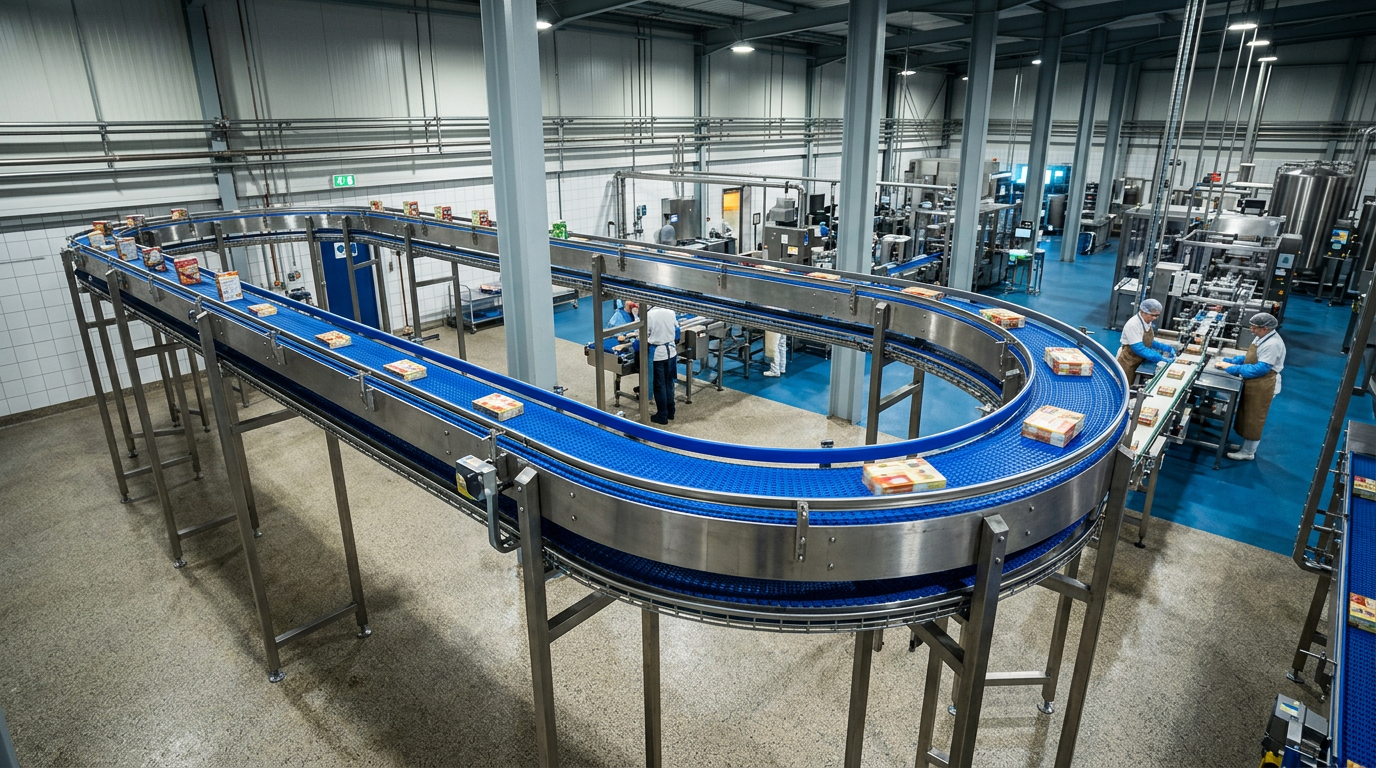
Modular curve conveyors allow for 90-degree and 180-degree turns with a typical inner radius-to-belt width ratio of 1.5:1 to 2.2:1, significantly reducing the floor space required for material handling transitions. Unlike traditional straight-to-straight transfers, these systems utilize side-flexing chains—typically made from Polyoxymethylene (POM)—to maintain product orientation and constant velocity throughout the turn, preventing jams and ensuring high-speed stability.
The Engineering Behind Tight-Radius Transitions
In modern manufacturing environments, particularly in the European e-commerce and food processing sectors, floor space is a premium asset. Engineering departments are increasingly tasked with "packing" more automation into smaller footprints. This is where modular curve conveyors excel.
Traditional conveyor turns often relied on tapered rollers or wide-radius friction belts. However, these systems struggle with small product footprints and high-speed stability. Modular curves utilize side-flexing plastic chains that run in dedicated guide rails. These rails are engineered with specific friction coefficients to manage the radial forces generated as the belt attempts to straighten under tension.
Radius Ratios and Geometric Constraints
When designing a layout, the "tightness" of a curve is defined by its inner radius ($R_i$). A common industry standard for modular side-flexing chains is $R_i = 2.0 \times W$, where $W$ is the belt width.
However, advanced systems can achieve ratios as low as 1.5:1. For a 400mm wide belt, a 1.5:1 ratio translates to an inner radius of 600mm. Achieving this requires precise management of the "collapse factor"—the ability of the chain modules to nest into one another on the inside of the curve while stretching on the outside.
Material Selection: POM vs. Reinforced Polymers
The choice of chain material is critical for curve longevity. Since curving generates significant lateral pressure against the wear strips, the material must have high PV (Pressure-Velocity) limits.
| Feature | Polyoxymethylene (POM/Acetal) | Reinforced Polyamide (PA) | Polypropylene (PP) |
|---|---|---|---|
| Tensile Strength | High (Approx. 40-50 MPa) | Very High | Low |
| Coefficient of Friction | Low (0.15 - 0.20) | Medium | Medium |
| Max Temp Range | -40°C to +90°C | 0°C to +120°C | +5°C to +105°C |
| Chemical Resistance | Medium (Acids) | High (Oil/Grease) | Excellent |
| Best Use Case | Standard High-Speed Lines | Heavy Duty / Automotive | Corrosive / Chemical |
As a European specialist / engineering partner for modular conveyor systems, Easy Conveyors provides high-performance side-flexing solutions that utilize low-friction materials to ensure smooth turns even under heavy loads.
Critical Design Factors for Curve Layouts
1. The Catenary Sag and Tension Management
In a modular curve, the belt tension is not distributed evenly. The outer edge of the belt carries the majority of the tensile load, while the inner edge "compresses." If the system tension is too high, the belt will attempt to "flip" out of the guide rails.
To mitigate this, modular curves require a carefully calculated catenary sag. This slack section, usually located after the drive sprocket, allows the belt to expand and contract as it transitions from straight paths to curves. For engineers, getting the catenary sag calculation right is the difference between a 10-year lifespan and a 6-month failure cycle.
2. Guide Rail Friction and Thermal Expansion
In tight-radius layouts, the heat generated by friction between the chain edge and the wear strip can become a failure point. Using UHMW-PE (Ultra-High Molecular Weight Polyethylene) with lubricating additives is the industry standard for these wear strips.
If your facility experiences temperature fluctuations—common in "hygienic wash-down design" environments—you must account for thermal expansion. Modifying the gaps between wear strip segments ensures that the rails don't buckle and pinch the belt during hot cleaning cycles.
3. Product Orientation and Centrifugal Force
At high speeds (above 40 m/min), centrifugal force can shift lightweight products (like empty PET bottles or small pharma cartons) toward the outer edge of the curve. To maintain product orientation:
- Low-friction top modules allow the belt to slide under the product if a jam occurs.
- Friction-top inserts can be used if the product needs to stay precisely indexed during the turn (though this increases the motor's torque requirements).
Easy Conveyors stocks the modular systems discussed here — ready to ship across Europe.
Integration with Upstream Systems
Modular curve conveyors aren't islands. They must be synchronized with the rest of the line. Modern installations often utilize a shared drive system where one motor powers both a straight section and a curve, or they use VFD soft-start tuning to prevent the "jerking" motion that can occur when a long chain segment starts under load.
When transitioning into a tight curve from a high-speed sorter, engineers should also consider drum motor selection for the drive end. Drum motors provide a compact, IP66/IP69K rated drive solution that fits within the conveyor frame, maintaining the "tight footprint" philosophy of the curve itself.
Maintenance and Common Failure Modes
The most common failure in tight-radius modular conveyors is "scalloping" of the guide rails. This occurs when the radial force of the chain wears a wavy pattern into the UHMW-PE strip. Once scalloping begins, vibration increases, leading to premature chain pin wear.
Inspection Checklist:
- Monthly: Check the "inner radius" wear strips for thinning. Replace if wear exceeds 2mm.
- Quarterly: Inspect the chain pins. Side-flexing chains rely on the integrity of these pins to hold the modules together under asymmetric load.
- Bi-Annually: Verify the drive sprocket alignment. If the sprockets are off-center, they will pull the belt unevenly into the curve, accelerating wear.
Environmental Sustainability and Efficiency
Switching from multiple straight conveyors with transfer plates to a single continuous modular curve can improve total system efficiency (TSE). Every transfer point is a potential energy loss (friction) and a risk for product damage. By using a single curve driven by an IE3 or IE4 efficiency class motor, facilities can reduce their carbon footprint while simultaneously lowering decibel levels on the factory floor. Continuous runs are also far easier to clean, making them the preferred choice for EHEDG-compliant food lines.
Frequently Asked Questions
What is the minimum radius for a modular curve conveyor?
The industry standard for modular side-flexing chains is an inner radius of 2.0 times the belt width, though specialized systems can achieve 1.5:1 ratios.
Why is POM the preferred material for side-flexing belts?
POM (Acetal) is preferred for curves because it offers a very low coefficient of friction and high tensile strength, reducing wear on guide rails during turns.
How does catenary sag affect curve performance?
Catenary sag allows for the expansion and contraction of the belt as it moves from straight to curved paths, preventing the belt from jumping out of the guides.
Can I run a curve conveyor at speeds over 60 meters per minute?
While possible, it is discouraged at high speeds. Centrifugal force can cause product instability. It is better to use a single continuous curve with a wider footprint if high speeds are necessary.