Mastering Modular Curve Conveyors for Tight-Radius Layouts
Explore the engineering behind modular curve conveyors. Learn how tight-radius layouts maximize floor space, reduce maintenance, and ensure product stability.
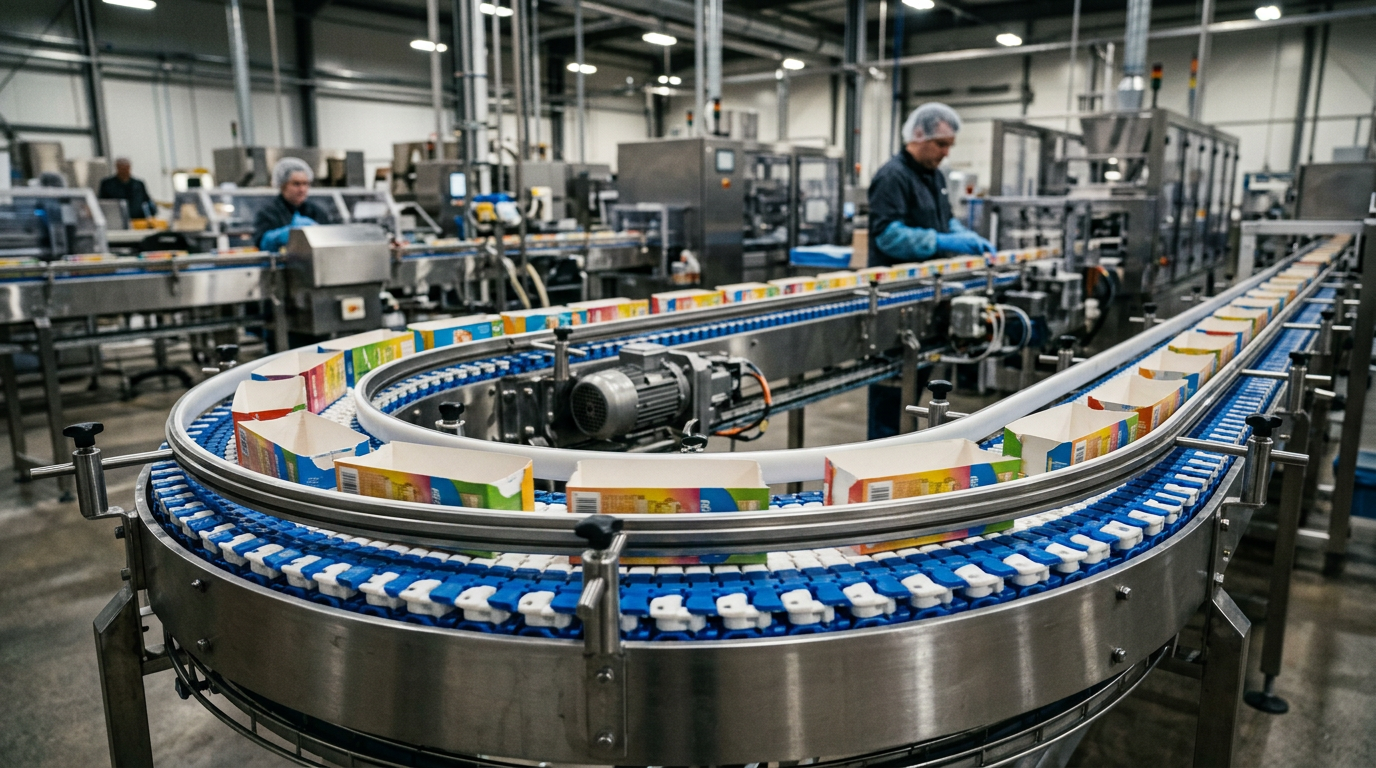
Modular curve conveyors are specialized material handling units designed to transport goods through turns—ranging from 30° to 180°—while maintaining the orientation and stability of the product within a compact footprint. These systems utilize interlocking plastic belt modules or flexible chain links that articulate laterally, allowing for tight-radius layouts that maximize available floor space in dense manufacturing environments.
In modern facility design, the "straight line" is often a luxury that plant engineers cannot afford. Whether navigating around structural building columns, integrating new machinery into an existing line, or designing multi-tier cooling spirals, the ability to change direction efficiently is critical. Modular curve conveyors have superseded traditional fabric belt curves in many industries due to their superior tracking, ease of repair, and ability to handle complex geometries without the tensioning issues common in flat-belt alternatives.
Key Takeaways
- Space Optimization: Tight-radius modular curves allow for "U-turns" and "S-curves" that drastically reduce the total square footage required for a conveyor line.
- Reduced Maintenance: Unlike fabric belts that can fray or mistrack in curves, modular plastic belts are positively driven by sprockets, eliminating slippage and tracking adjustments.
- Product Stability: Modular curves maintain constant speed across the width of the belt (when using specific radius-to-width ratios), preventing product disorientation or "shingling."
- Standardization: Using modular components allows for rapid reconfiguration if the production layout needs to change in the future.
Engineering Principles of Modular Curve Design
Designing a curve is significantly more complex than a straight run. In a modular curve conveyor, the chain or belt must be able to collapse on the inner radius while expanding on the outer radius. This is achieved through "side-flexing" modules that feature elongated hinge holes.
The Turn Radius Ratio
The most critical metric in curve design is the inner radius (Ri). Most modular belts require an inner radius that is at least 1.5 to 2.2 times the width of the belt. For example, a 400mm wide belt might require an inner radius of 800mm. However, "tight-radius" modules are specifically engineered to push these boundaries, sometimes achieving a 1.0x width ratio. This is essential in industries like e-commerce sortation or pharmaceutical packaging where every centimeter of floor space is accounted for.
Frictional Forces and Centripetal Acceleration
As a product enters a curve, physics dictates that it wants to continue in a straight line. Modular curves manage this through:
- High-Friction Inserts: Some modules include rubber "grip-top" surfaces to ensure products don't slide outward.
- Guide Rails: Precision-engineered lateral guides, often lined with UHMW-PE (Ultra-High Molecular Weight Polyethylene), keep the belt and product on track.
- Hold-down Tabs: To prevent the belt from "tenting" or lifting out of the track due to the radial tension, modular chains often feature bottom-mounted tabs that lock into the conveyor frame profile.
Material Selection and Standards
The choice of material for the modular belt dictates the environment in which the curve can operate. Most modular curve conveyors utilize one of three primary plastics:
- Polypropylene (PP): Ideal for chemical resistance and higher temperatures (up to 100°C), often used in industrial parts washing.
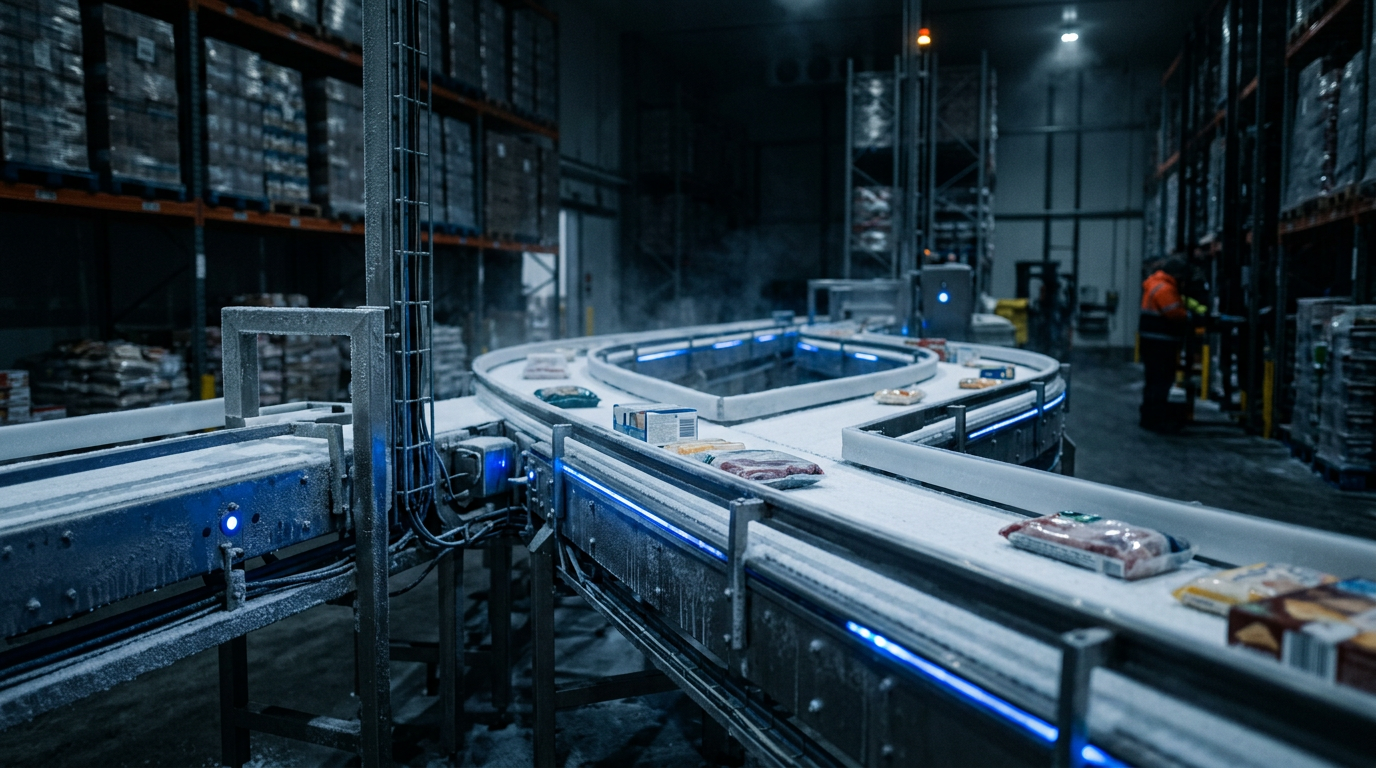
- Polyethylene (PE): Best for low-temperature applications, such as food freezing lines, where flexibility at -40°C is required.
- Acetal (POM): The "gold standard" for curves due to its high tensile strength and low coefficient of friction. This is the preferred material for high-speed bottling and canning lines.
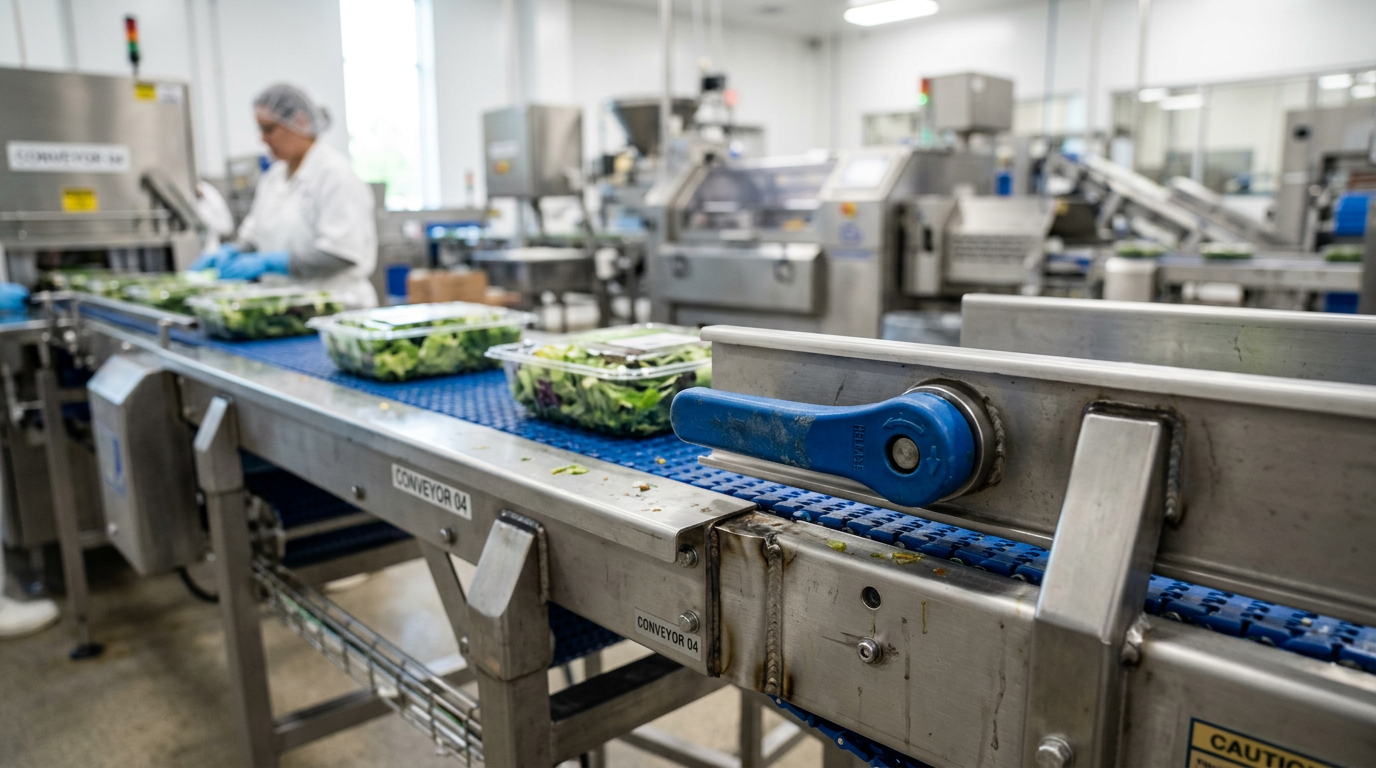
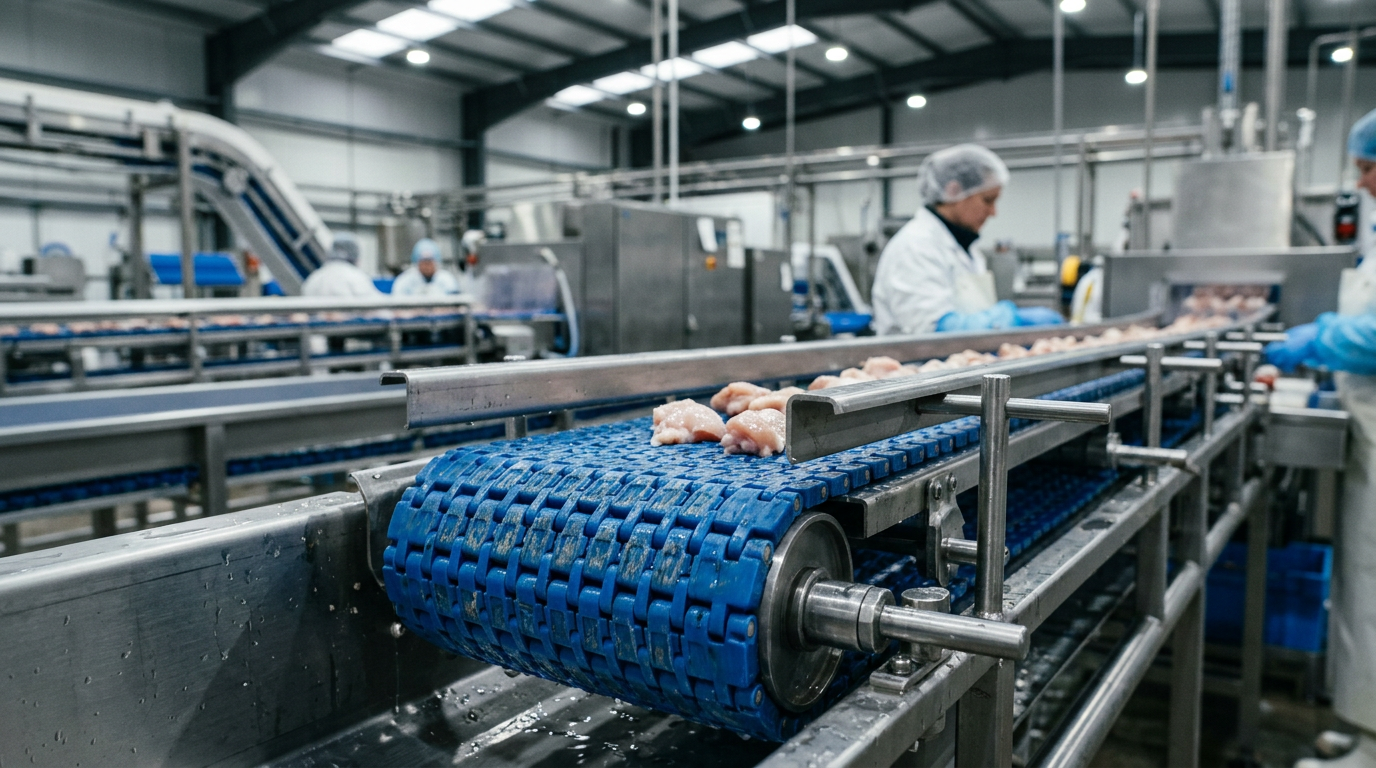
In the food and beverage sector, compliance with EHEDG (European Hygienic Engineering & Design Group) and FDA standards is non-negotiable. Modular curves in these environments are typically built with stainless steel (AISI 304 or 316) frames and "open-hinge" belt designs that allow for easy Clean-in-Place (CIP) procedures.
Integrating Curves into Tight-Radius Layouts
Successful integration requires more than just picking a belt. It requires an understanding of the entire system's dynamics. For manufacturers looking to optimize their floor plan, Easy Conveyors offers specialized engineering support to ensure that modular curve systems integrate seamlessly with existing straight sections and drive units.
Drive Configurations
In a tight-radius layout, the location of the drive motor is paramount.
- Head Drive: The most common setup, where the motor pulls the belt from the discharge end. This is ideal for one-way traffic.
- Center Drive: Required for reversible conveyors, placing the drive unit in the middle of a straight section, though this adds complexity to the tensioning system.
- Omega Drive: Used in high-load applications to increase the wrap angle around the drive sprocket, ensuring no teeth jump even under heavy load in a curve.
Catenary Sag and Tensioning
Modular belts are not tensioned like fabric belts; they run "loose." The "catenary sag"—the loose section of the belt on the return path—serves as the tensioning mechanism. In curve conveyors, managing this sag is vital because the uneven tension across the belt width (outer edge vs. inner edge) can cause the belt to bunch if not properly calculated.
Easy Conveyors stocks the modular systems discussed here — ready to ship across Europe.
Applications Across Industries
Food and Bakery
In industrial bakeries, modular curve conveyors are used for "proofer" and "cooler" spirals. A tight-radius spiral can provide hundreds of meters of travel length while occupying only 10 square meters of floor space. The modular nature allows for airflow through the belt, essential for cooling bread or pastries.
E-commerce and Logistics
Sortation centers use modular curves to transition packages between different levels or to divert items into shipping chutes. High-speed modular chains made of low-friction acetal can handle throughputs of over 3,000 units per hour without the noise levels associated with traditional roller curves.
Automotive and Heavy Assembly
For heavier loads, modular curves use reinforced pins (often steel or thick nylon) to handle the torque required to pull pallets around a bend. Here, the focus shifts from speed to load-bearing capacity, often utilizing "heavy-duty" series modules with 2-inch pitches.
Common Failure Modes and Prevention
- Outer Edge Stress: In a curve, the outer edge of the belt carries the majority of the tensile load. If the belt is overloaded, the outer "links" can fatigue and snap. Overcoming this requires specifying high-strength links or reducing the chain pull by adding intermediate drives.
- Sprocket Wear: If the belt is not properly aligned entering the curve, the sprocket teeth will wear unevenly. Routine inspection of the "tracking" at the entry and exit points is mandatory.
- Debris Accumulation: In the tight clearance of a modular curve, a single fallen bolt or excess product waste can wedge between the belt and the wear strip, causing a catastrophic "jump" or motor trip. Using "open-frame" designs helps debris fall through to a collection tray.
Future Trends: Intelligence in the Curve
The next generation of modular curve conveyors is moving toward Industry 4.0 integration. We are seeing the emergence of:
- Smart Lubrication: Automated systems that apply food-grade dry film lubricants to the wear strips only when sensors detect increased friction.
- Vibration Monitoring: Sensors mounted on the curve frames that use AI to predict bearing or motor failure before it occurs.
- Distributed Drive Systems: Instead of one large motor, multiple small 24V DC "motorized rollers" drive the belt at various points, reducing total chain tension and allowing for even tighter radii.
When planning a facility that requires direction changes, the modular curve conveyor stands out as the most versatile tool in the engineer's kit. By understanding the relationship between belt width, radius, and material friction, operations can achieve a high-throughput system that fits into the most challenging architectural constraints.
Frequently Asked Questions
What is the minimum turn radius for a modular curve conveyor?
The standard rule of thumb for modular belts is an inner radius of 1.5 to 2.2 times the belt width, though specialized 'tight-radius' modules can achieve a 1.0x ratio.
Why choose a modular curve over a traditional fabric belt curve?
Modular curves use positive sprocket drives, eliminating the tracking issues common with fabric belts. They also offer easier repair (replacing a single module vs. an entire belt) and better chemical/temperature resistance.
What materials are best for modular curve conveyor belts?
Acetal (POM) is the most common for high-speed or heavy-load curves due to its strength and low friction. Polypropylene is used for chemical resistance, and Polyethylene is preferred for cold environments like freezers.
How do you prevent a modular belt from lifting or 'tenting' in a curve?
Tenting occurs when the belt lifts out of the track due to high tension in a curve. This is prevented by using 'hold-down tabs' or 'side-guides' that lock the belt into the conveyor frame.
Do modular curve conveyors require lubrication?
While many modular curves are designed to be low-maintenance, dry-film lubricants can be used on UHMW-PE wear strips to reduce friction, lower chain pull, and extend the lifespan of the motor and belt links.
Sources & references
- [1]Modular Conveyor Belt Systems and Components
- [2]Conveyor System Safety and Standards
- [3]ISO 10218-2:2011 - Robots and robotic devices — Safety requirements for industrial robots — Part 2: Robot systems and integration
- [4]Modular Belt Solutions for Curve Conveyors
- [5]Material Handling Systems and Engineering Floor Space Optimization