Modular Conveyor Systems for Cold Storage: Engineering for the Freeze
Learn the engineering requirements for modular conveyor systems in cold storage warehouses, including material selection, ice mitigation, and drive efficiency for -30°C.
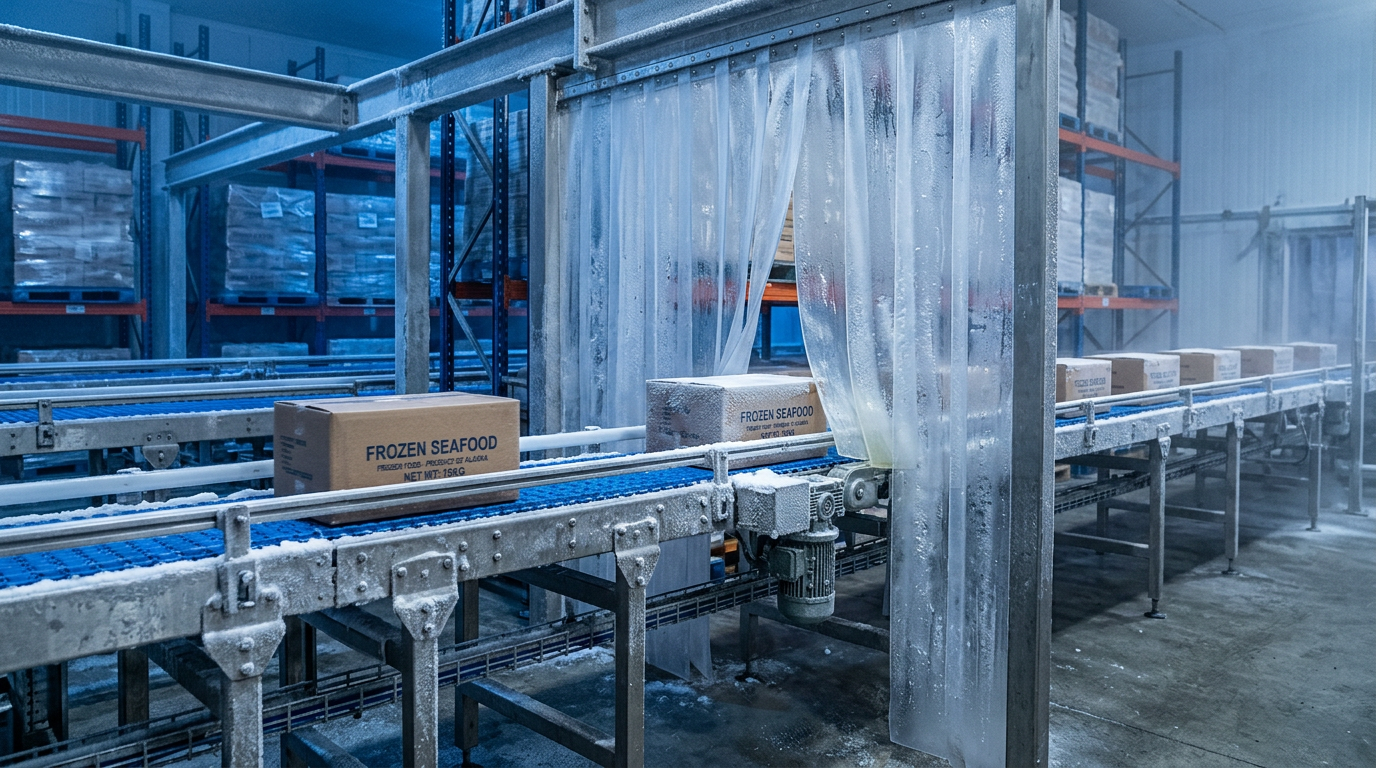
Modular conveyor systems for cold storage must utilize components rated for temperatures as low as -30°C, typically employing specialized low-temperature lubricants, POM-D acetal chains with increased impact resistance, and stainless steel frames to prevent embrittlement and corrosion. Selecting the right modular system ensures that throughput remains consistent despite the high-friction environment created by ice buildup and the thermal contraction of plastic components.
The Engineering Challenges of Sub-Zero Intralogistics
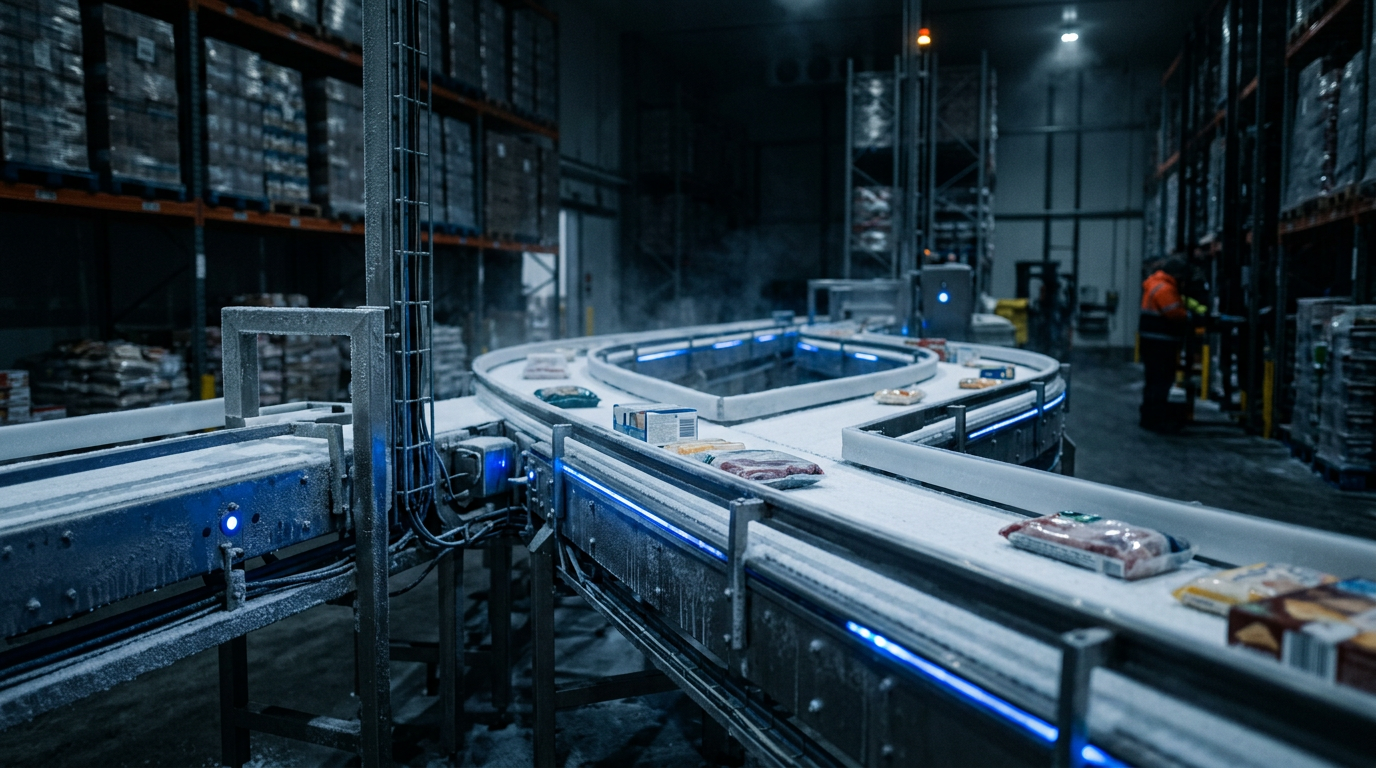
Designing internal transport systems for cold storage and blast freezers requires a departure from standard ambient engineering principles. In environments ranging from +5°C (chill) to -30°C (deep freeze), materials behave differently. Metals become brittle, standard lubricants solidify, and plastics can lose up to 50% of their impact resistance.
The primary goal of a modular conveyor in these settings is to minimize "thermal bridges" and ensure that the mechanical drive system remains functional under constant thermal stress. Modular plastic belts are often preferred over traditional rubber belts because they do not suffer from the tracking issues caused by cold-induced stiffening. However, the coefficient of friction changes significantly when frost or ice is present, requiring higher torque ratings for drive motors.
Material Selection: Staying Flexible in the Freeze
When selecting materials for cold storage conveyors, the choice of polymer for the modular belt is critical.
- Polyethylene (PE): Excellent for deep freeze environments down to -70°C. PE remains flexible and impact-resistant where other plastics would shatter. However, it has a lower load-bearing capacity compared to POM.
- Polypropylene (PP): Generally avoided in cold storage as it becomes brittle below 0°C.
- Acetal (POM): The industry standard for high-strength applications. For cold storage, "impact-modified" POM versions are required to handle the shock loads of frozen crates or pallets.
The frame construction typically utilizes 304 or 316-grade stainless steel. According to AISI standards, these austenitic steels maintain their ductility at cryogenic temperatures, unlike carbon steel which undergoes a ductile-to-brittle transition.
Drive Systems and Motor Efficiency
In cold storage, energy efficiency is paramount because every kilowatt of heat generated by a motor must be removed by the refrigeration system, effectively doubling the energy cost. Moving to IE3 or IE4 efficiency class motors is not just a sustainability goal; it is a thermal management necessity.
| Component | Standard Ambient Spec | Cold Storage Spec (-25°C) |
|---|---|---|
| Belt Material | Standard POM / PP | PE or Impact-Modified POM |
| Lubrication | Standard Mineral Oil | Synthetic Low-Temp / NSF H1 |
| Motor Class | IE2 / IP55 | IE3-IE4 / IP66 (with heaters) |
| Bearings | Shielded Steel | Sealed Stainless w/ Low-Temp Grease |
| Control Logic | Standard VFD | VFD with "Keep-Warm" DC injection |
Easy Conveyors provides modular solutions specifically engineered for these demanding environments, utilizing split-sprocket designs that simplify maintenance when technicians are working in bulky thermal gear.
Dealing with Condensation and Ice
The most dangerous phase for a conveyor is not the constant cold, but the transition zones (e.g., from a -20°C freezer to a +2°C loading doc
Easy Conveyors stocks the modular systems discussed here — ready to ship across Europe.
k). When warm, moist air hits a cold conveyor frame, condensation forms instantly. If that conveyor then moves back into the freezer, that condensation turns into "black ice."
To mitigate this, modular systems should incorporate:
- Open-lattice belt structures: These allow for maximum airflow, which helps equalize temperature and reduces the surface area where ice can bond.
- Drip trays with heating cables: In high-humidity transition zones, heated trace elements prevent ice buildup on the return path of the belt.
- Scraper systems: Specialized polymer scrapers can be installed to physically remove frost from the belt surface before it reaches the drive sprockets.
Maintenance and Operational Longevity
Maintenance in cold storage is notoriously difficult. Tools stick to surfaces, and manual dexterity is limited by gloves. Therefore, "Tool-less" modular features are essential. Systems that allow for the quick release of belt tension or the replacement of a modular link without specialized pins are highly valued.
Engineers must also account for thermal contraction. A 50-meter conveyor will physically shorten when the temperature drops from the installation ambient (e.g., 20°C) to operational (-25°C). Modular belts solve this better than long-run fabric belts because the slack can be distributed across the entire length, though catenary sags must be sized appropriately to prevent the belt from jumping the wear strips.
For further technical details on motor performance in varying temperatures, refer to the SEW-Eurodrive technical documentation regarding gearmotor thermal ratings. Proper VFD soft-start tuning is also critical to prevent the high-torque snapping of frozen chains during morning startups.
Integration with Automation
Modern cold storage facilities are increasingly automated to reduce the time human workers spend in sub-zero conditions. Modular conveyors act as the "connective tissue" between ASRS (Automated Storage and Retrieval Systems) and picking stations. Integrating sensors in these areas requires IP67 or IP69K ratings to handle both the cold and the potential wash-down cycles. Using high-quality components from manufacturers like Rockwell Automation ensures that the control logic remains reliable despite signal noise caused by moisture and frost. In many cases, hygienic wash-down design principles usually reserved for food safety are applied here to facilitate easy cleaning of ice and debris.
Sizing and Selection Checklist
When commissioning a modular system for a freezer environment, verify the following:
- Chain Pull Limits: Are the pull limits derated for the 25% strength loss typical at -20°C?
- Sprocket Engagement: Will frost buildup in the sprocket teeth cause "jumping"? Consider "ice-breaker" tooth profiles.
- Expansion/Contraction: Have you calculated the 0.1% to 0.5% length change in the plastic belt?
- Brake Systems: If the conveyor is inclined, will the brake hold on a frosted surface? Modular chains with "friction top" inserts (made of specialized TPE) may be required.
By focusing on these thermal-specific variables, plant managers can ensure that their modular conveyor systems provide the same 10-15 year lifespan expected in ambient conditions, rather than failing prematurely due to brittle fractures or motor burnout. Monitoring drum motor selection criteria is also a valid alternative for compact freezer spirals where external motors would create a thermal bridge through the freezer wall.
Frequently Asked Questions
What is the best material for modular belts in deep-freeze environments?
Polyethylene (PE) is the preferred choice for deep-freeze environments down to -70°C because it remains flexible. Impact-modified Acetal (POM) is used for higher-load applications but requires careful selection to avoid brittleness.
How do you prevent ice buildup on modular conveyors?
Condensation at transition zones is the main cause. This can be mitigated using open-lattice belts for airflow, heated drip trays, and mechanical scrapers to remove frost before it enters the drive sprockets.
Do I need special lubrication for conveyor bearings in freezers?
Standard lubricants can become as thick as peanut butter in cold storage, causing motor overloads. Specialist low-temperature synthetic lubricants or NSF H1 food-grade oils rated for -30°C must be used.
Does thermal contraction affect conveyor belt length in cold storage?
Yes, plastic belts contract significantly when cooled. A 100-meter belt can shorten by several centimeters when moved from room temperature to -20°C, necessitating adjustable take-up units or specific catenary sag allowances.
Why is motor efficiency more important in cold storage than in ambient warehouses?
High-efficiency motors (IE3/IE4) generate less waste heat. In a freezer, every watt of heat produced by a motor adds to the load on the refrigeration system, so efficient motors lower both electricity and cooling costs.