Modular Bottle Handling Conveyors for Filling Lines: An Engineering Guide
Optimize filling line efficiency with modular bottle handling conveyors. Learn how POM-D chains, hygienic design, and VFD tuning prevent bottle tipping and breakage.
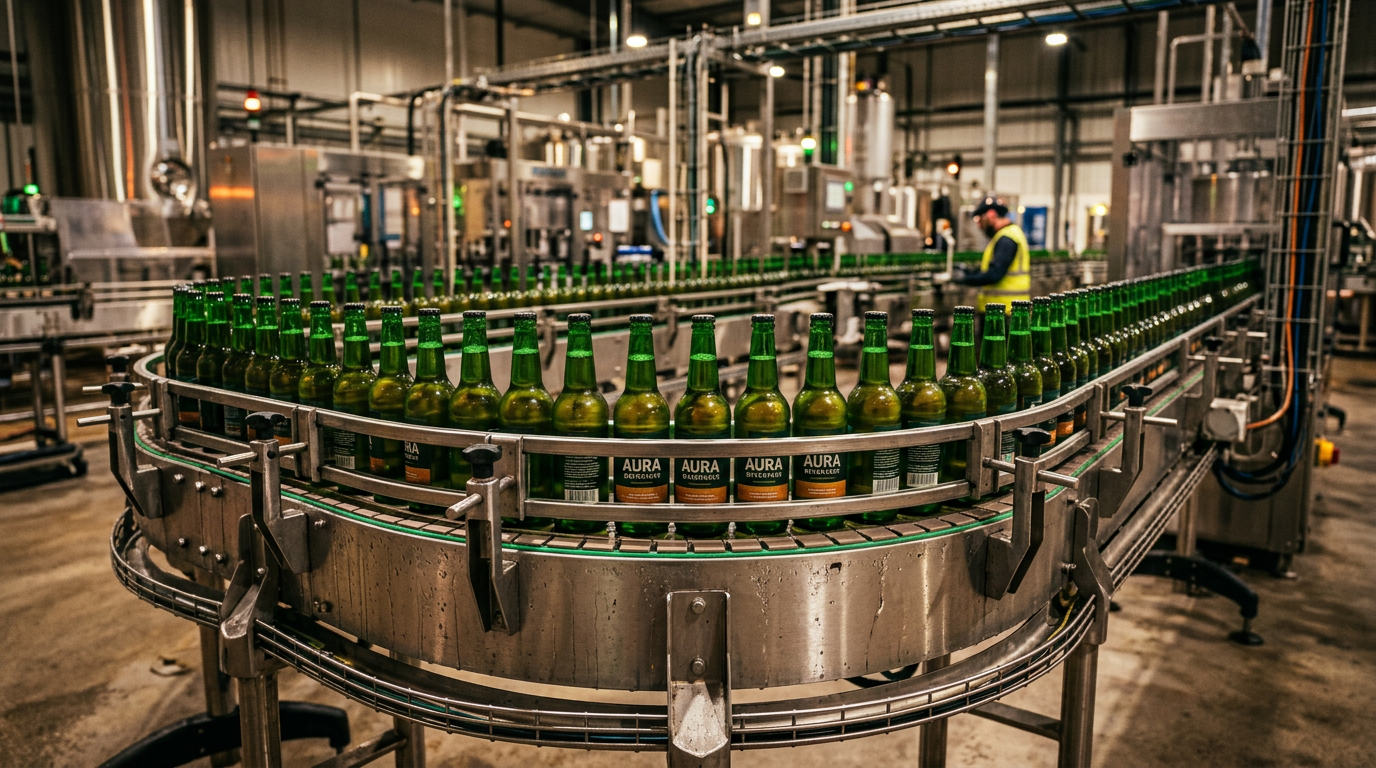
Modular bottle handling conveyors for filling lines typically achieve throughput rates of 10,000 to 60,000 units per hour (UPH) while maintaining container stability through low-friction POM-D acetal chains and adjustable side guides. These systems leverage standardized 85mm to 300mm wide modules to balance high-speed transport with the delicate acceleration required to prevent product breakage or foaming in beverage, pharmaceutical, and cosmetic applications.
Engineering Foundations of Modular Bottle Handling
In modern filling lines, the conveyor system is the nervous system of the facility. A bottleneck in transport is a bottleneck in revenue. The transition from traditional stainless steel slat chains to modular plastic chain systems has revolutionized how engineers manage high-speed container flow.
The primary challenge in bottle handling is the center of gravity. Whether dealing with lightweight PET water bottles or heavy glass wine bottles, the conveyor must provide a vibration-free surface. High-performance modular systems utilize "side-flexing" chains that allow for continuous flow through curves without the need for dead-plate transfers, which are notorious for causing bottles to tip or "bridge" (jam).
Material Selection: POM-D vs. Stainless Steel
While stainless steel chains were once the industry standard, modern engineering leans heavily toward Polyoxymethylene (POM), specifically POM-D (homopolymer) or POM-C (copolymer). According to ISO 1043-1, these materials offer the necessary mechanical strength and low friction coefficients required for high-speed accumulation.
| Feature | POM-D Modular Chain | Stainless Steel Slat Chain |
|---|---|---|
| Friction Coefficient | 0.15 - 0.20 (Dry) | 0.25 - 0.35 (Dry) |
| Noise Level | Low (<75 dB) | High (>85 dB) |
| Max Speed | Up to 80-100 m/min | Up to 60 m/min |
| Maintenance | Low (Self-lubricating) | High (Requires lubrication) |
| Weight | Lightweight (Energy efficient) | Heavy (High inertia) |
Critical Components of the Filling Line
To ensure a seamless flow from the de-palletizer to the filler, capper, and labeler, several modular sub-systems must work in synchronization.
1. Infeed and Single-Filing Modules
Infeed sections often receive bottles in bulk. The conveyor must utilize "mass flow" modules that gradually neck down into a single file. This is achieved through varying belt speeds controlled by VFD soft-start tuning to ensure that the pressure between bottles (backline pressure) does not exceed the structural integrity of the container.
2. High-Speed Curves and Bends
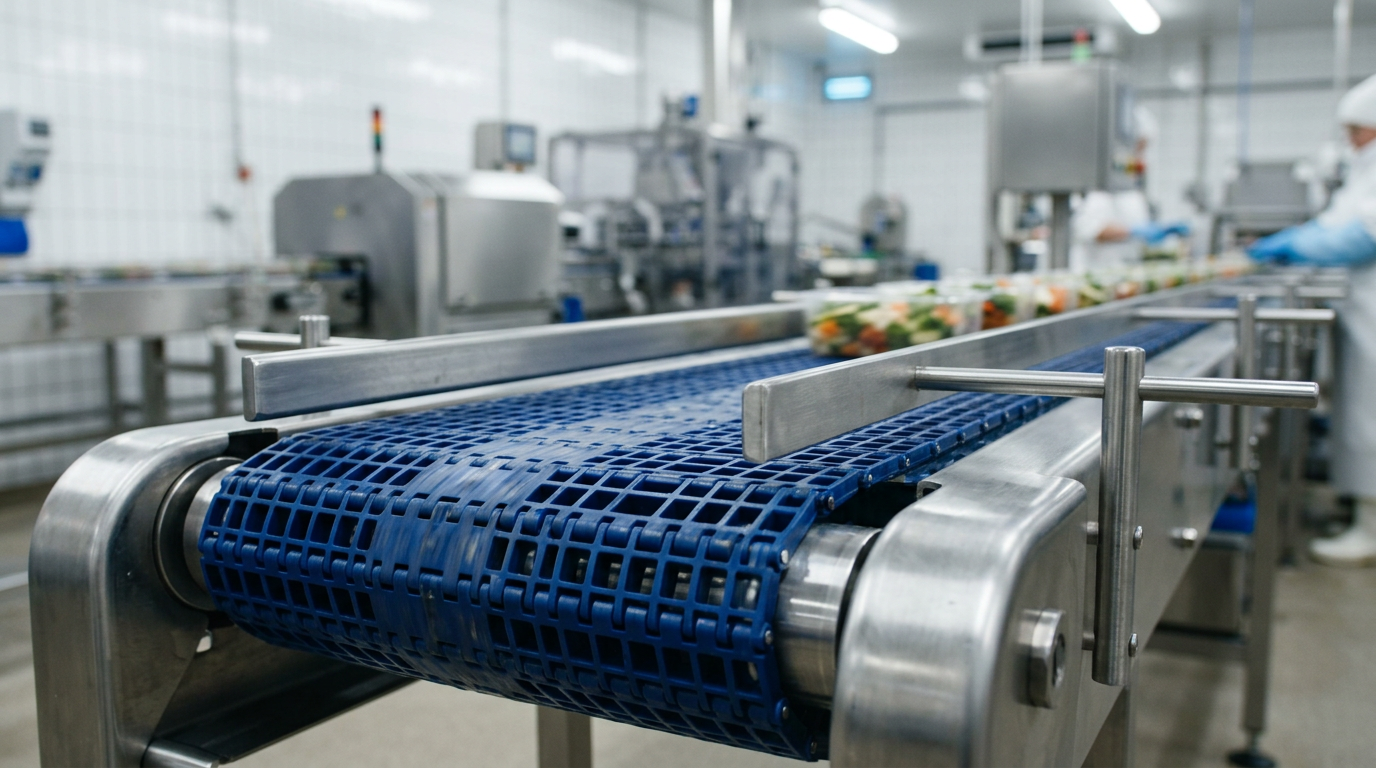
Bottle stability is most at risk during directional changes. Modular systems like those offered by Easy Conveyors utilize magnetic curves or tab-retained chains. These technologies hold the chain flat against the wear strips, preventing "tenting" or lifting during high-speed operation, which is a common failure mode in traditional systems.
3. Accumulation Tables
Accumulation is the buffer that keeps the filler running if a downstream labeler or packer stops. Modular "zero-pressure" accumulation systems use bi-directional tables or "FIFO" (First-In, First-Out) towers. These tables use low-friction modular belts that allow bottles to slide or spin in place without scuffing labels or generating excessive heat.
Easy Conveyors stocks the modular systems discussed here — ready to ship across Europe.
Hygienic Standards and Wash-down Design
In the beverage and pharmaceutical sectors, conveyors must meet stringent hygienic requirements. The EHEDG (European Hygienic Engineering & Design Group) provides guidelines for equipment that is easy to clean and free of "dead zones" where bacteria can grow.
For filling lines, this means:
- Open Frame Construction: Utilizing stainless steel (AISI 304 or 316) frames with minimal horizontal surfaces to prevent liquid pooling.
- FDA-Compliant Materials: All plastic components in contact with the bottles must meet FDA 21 CFR standards.
- NEMA 4X / IP69K Ratings: Drive motors and sensors must withstand high-pressure, high-temperature wash-downs. Using IE3 or IE4 efficiency class motors (IEC 60034-30-1) not only reduces energy costs but often provides better thermal management in sealed environments.
Optimizing Throughput with Automation
The integration of smart sensors and PLC logic transforms a simple conveyor into an intelligent bottle handling system.
Speed Matching and Gapping
To prevent bottles from crashing into the filler stars, the conveyor speed must be dynamically adjusted. Using laser sensors, the system detects the "gap" between bottles. If the gap is too small, the infeed conveyor slows down; if too large, it accelerates. This prevents the "harmonica effect" where pulses of pressure travel back up the line.
Preventing Breakage and Foaming
For carbonated beverages, sudden changes in velocity can cause foaming, leading to inaccurate fill levels. Proper drum motor selection ensures smooth torque delivery, while specialized modular chains with "closed top" surfaces minimize vibrations that could agitate the product.
Maintenance and Long-Term Reliability
Modular systems are designed for rapid repair. A damaged section of a modular chain can be replaced in minutes by removing a single hinge pin, unlike traditional belts that require vulcanization or mechanical lacing.
Key maintenance indicators include:
- Elongation: Measuring chain pitch to ensure it hasn't stretched beyond the 2-3% limit.
- Wear Strip Inspection: Checking UHMW-PE (Ultra-High-Molecular-Weight Polyethylene) strips for grooves that could increase friction.
- Catenary Sag: Ensuring the return side of the chain has the correct amount of slack to prevent excessive tension on the drive sprockets.
By focusing on modularity, manufacturers can scale their lines quickly. If a new labeling machine is added, the modular frame can be extended with standard components, drastically reducing the Total Cost of Ownership (TCO) compared to bespoke, welded conveyor systems.
Frequently Asked Questions
Why is POM plastic preferred over other materials for bottle handling?
POM (Acetal) is preferred for bottle conveyors because it has a very low coefficient of friction (0.15-0.20), high tensile strength, and excellent wear resistance, which prevents bottle tipping and scuffing.
How does a single-filer module work in a filling line?
Mass flow conveyors use multiple parallel chains running at different speeds to gently guide a wide bank of bottles into a single line, minimizing back-pressure and potential breakage.
What role does EHEDG play in conveyor design?
EHEDG (European Hygienic Engineering & Design Group) standards ensure that conveyor components are designed to be easily cleaned, preventing bacterial growth in food and pharma environments.
How often should modular bottle conveyors be maintained?
Conveyor speed should be checked monthly, while chain wear and catenary sag should be inspected quarterly. Drive sprockets and wear strips usually require annual inspection or replacement depending on duty cycles.