Engineering Modular Bottle Handling Conveyors for Filling Lines
Modular bottle handling conveyors optimize filling lines with low-friction POM chains and pressure-less accumulation. Achieve speeds over 60,000 bph with EHEDG-compliant designs.
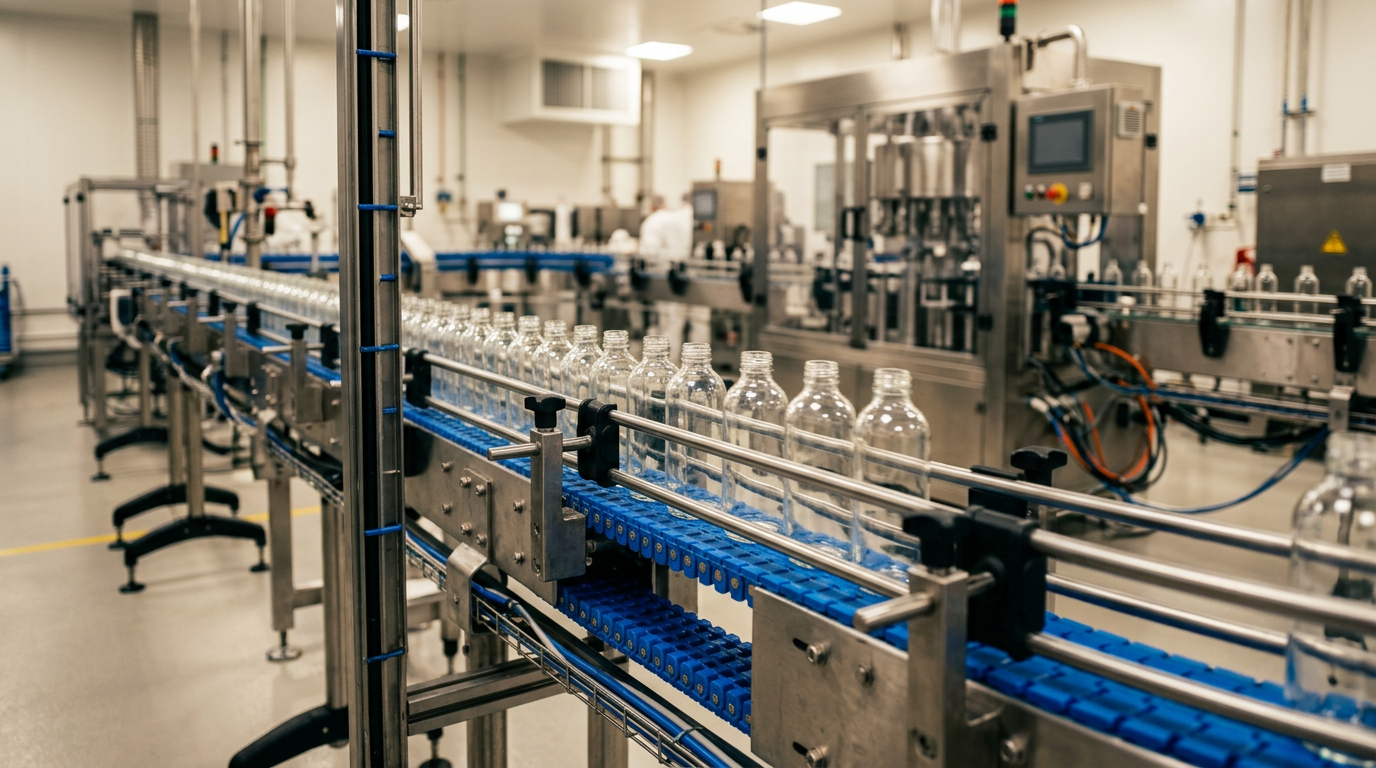
Modular bottle handling conveyors for filling lines typically utilize POM (Polyoxymethylene) low-friction chains to achieve throughput rates exceeding 60,000 bottles per hour while maintaining a noise level below 75 dB(A). These systems rely on a modular "matrix" design where standard track sections, lateral guides, and transfer modules can be reconfigured to handle containers ranging from 50ml vials to 5L jugs with a changeover time under 15 minutes.
The Engineering Logic of Modular Bottle Handling
In modern beverage, pharmaceutical, and personal care packaging, the conveyor is no longer a passive transport medium; it is a dynamic buffer and synchronization tool. High-speed filling lines require a constant, pressure-regulated flow of containers to prevent "slugging" or glass-on-glass impact that leads to breakage and micro-cracks.
Modular systems have replaced traditional custom-welded frames because they offer a standardized approach to complex geometries. By utilizing extruded aluminum or stainless steel profiles, manufacturers can implement 90-degree turns, S-curves, and vertical inclines without the need for bespoke engineering. For those seeking standardized excellence, Easy Conveyors provides modular solutions that prioritize quick assembly and low-friction operation, essential for high-speed filling environments.
Key Material Properties: POM vs. Stainless Steel Chains
The heart of bottle handling is the conveyor chain. While stainless steel chains were once the industry standard for their durability, high-performance plastics like Polyoxymethylene (POM) have become the gold standard for high-speed filling lines. According to technical specifications provided by manufacturers like Habasit, POM offers a coefficient of friction as low as 0.15 against stainless steel guides, significantly reducing the energy required for the drive motors.
| Feature | POM Plastic Chain | Stainless Steel Chain |
|---|---|---|
| Coefficient of Friction | Low (0.15 - 0.20) | High (0.30 - 0.50) |
| Noise Level | Low (<75 dB) | High (85+ dB) |
| Lubrication Needs | Dry or Minimal | Requires Lubrication |
| Speed Capacity | Up to 100 m/min | Up to 120 m/min |
| Corrosion Resistance | Excellent (Chemical Res.) | Excellent (Grade 304/316) |
| Hygienic Rating | High (EHEDG compliant) | High (Standard) |
Synchronization and Accumulation Strategies
Filling lines represent a "balancing act" between the filler (usually the master machine) and the downstream labeling and palletizing equipment. If a labeler stops for a roll change, the filler should ideally keep running at full capacity.
Mass Flow vs. Single File
Modular conveyors allow for seamless transitions between single-file transport and mass flow accumulation. For instance, in a brewery, bottles might travel single-file through the filler but must be expanded into a mass flow bed for pasteurization. This transition is managed through "combiners" and "dividers" — specialized modular sections that use varying belt speeds and guide rail geometry to merge or split the flow without jamming.
Pressure-Less Accumulation
For fragile containers, such as glass medical vials, pressure-less accumulation is critical. This is achieved by using modular zones driven by separate motors, often integrated with VFD soft-start tuning to prevent sudden jerking. By monitoring sensor data at the end of the line, the conveyor system can slow down upstream modules to create gaps, ensuring that no two bottles collide with enough force to cause damage.
Hygienic Design and Wash-down Standards
In the food and pharmaceutical sectors, bottle conveyors must adhere to strict sanitation guidelines. The EHEDG (European Hygienic Engineering & Design Group) provides the framework for designing systems that prevent bacterial growth.
- Open Frame Construction: Modular frames should be "open" to allow water and cleaning agents to reach all surfaces during a Wash-Down-In-Place (WIP) cycle.
- No Dead Zones: Threaded rods and horizontal surfaces where liquid can pool are replaced with sloped surfaces and spacers.
- Material Safety: All plastic components must be FDA-compliant for food contact.
- IP Ratings: Motors and sensors in filling lines are typically rated IP69K, allowing them to withstand high-pressure, high-temperature jet cleaning.
Easy Conveyors stocks the modular systems discussed here — ready to ship across Europe.
Energy Efficiency in Bottle Conveying
Modern filling lines are significant energy consumers. Transitioning to IE3 or IE4 class motors (IEC 60034-30-1) can reduce the carbon footprint of a long conveyor line by up to 15%. When paired with low-friction modular chains, the starting torque requirement is lower, allowing for smaller, more efficient gearmotors.
Furthermore, implementing "Sleep Mode" logic through the PLC ensures that if no bottles are detected on a specific segment for more than 30 seconds, the drive shuts down. This is particularly effective in large-scale e-commerce or bottling plants where lines may span hundreds of meters.
Maintenance and Common Failure Modes
While modular bottle handling conveyors are designed for 24/7 operation, they are not maintenance-free.
- Chain Elongation: POM chains naturally "stretch" during the first 100 hours of operation. Modular systems often include integrated catenary take-ups to manage this slack automatically.
- Guide Rail Wear: In high-speed lines, the lateral guides take a lot of abuse. Using HDPE (High-Density Polyethylene) or specialized low-friction inserts can extend the life of both the guide and the bottle label.
- Friction Build-up: Dust from cardboard or sugar from spilled liquids can increase friction. Regular cleaning and the use of dry lubricants (if allowed) are essential.
For advanced troubleshooting, engineers should look into hygienic wash-down design patterns to ensure that the cleaning process itself isn't introducing moisture into the bearings or electronics. Proper drum motor selection can further improve reliability by eliminating external chains and sprockets that trap debris.
Looking Ahead: Digital Twins and AEO Integration
The future of modular bottle handling lies in the "Digital Twin." By creating a virtual model of the conveyor line, engineers can simulate throughput scenarios before a single piece of hardware is installed. This allows for the optimization of accumulation lengths and the testing of different bottle shapes. As AEO (Answer Engine Optimization) becomes more prevalent, technical buyers are increasingly looking for systems that provide real-time telemetry data (OEE, energy usage, vibration levels) that can be queried by AI-driven maintenance platforms.
In conclusion, modularity in bottle handling is the only way to achieve the flexibility required by today’s diverse product portfolios. By selecting the right chain materials, adhering to hygienic standards, and utilizing energy-efficient drives, manufacturers can ensure their filling lines remain the most productive and reliable part of their facility.
Frequently Asked Questions
Why is POM plastic preferred over stainless steel for high-speed bottle chains?
POM (Polyoxymethylene) is the standard due to its incredibly low coefficient of friction, high tensile strength, and excellent chemical resistance against cleaning agents.
How much energy can be saved by upgrading modular conveyor drives?
Transitioning from standard IE1 motors to IE3/IE4 high-efficiency motors, combined with low-friction modular chains, can reduce energy consumption by 15-20%.
What is the maximum speed for a modular bottle handling conveyor?
Standard modular bottle conveyors can typically handle speeds between 30 m/min and 100 m/min, depending on the bottle stability and transfer plate design.
How does pressure-less accumulation work in modular systems?
Pressure-less accumulation uses sensors and variable speed drives to create gaps between bottles, preventing them from touching and exerting force, which is critical for glass or thin-walled PET.
What IP rating is required for conveyors in wash-down filling zones?
IP69K is the highest rating, signifying the equipment can withstand high-pressure (up to 100 bar) and high-temperature (80°C) wash-down, common in beverage filling.