Optimizing Line Balancing and OEE in Conveyor-Based Material Flow
Learn how to optimize line balancing and OEE in conveyor systems using 1.5x-2.0x buffer ratios, ZPA logic, and V-profile speed strategies to eliminate downtime.
Effective line balancing in conveyor-based material flow requires maintaining a buffer capacity of 1.5x to 2.0x the cycle time of the slowest downstream process to mitigate the impact of minor stoppages. By synchronizing conveyor speeds and accumulation zones with machine cycle times, facilities can typically achieve a 10-15% increase in Overall Equipment Effectiveness (OEE) through the reduction of starvation and blockage losses.
The Relationship Between Material Flow and OEE
In modern manufacturing, the conveyor system is not merely a transport mechanism; it is the "circulatory system" of the production facility. Overall Equipment Effectiveness (OEE) measures how well a manufacturing operation is utilized compared to its full potential, calculated as the product of Availability, Performance, and Quality.
In conveyor-based systems, line balancing is the primary driver of the Performance and Availability components. A poorly balanced line leads to two critical failure modes:
- Starvation: The downstream machine (the "bottleneck") is ready to work but has no material.
- Blockage: An upstream machine must stop because the conveyor is full and the downstream process cannot accept more units.
To optimize these flows, engineers often look toward IEC 60034-30-1 standards to ensure motor efficiency supports continuous operation, but the mechanical logic of accumulation and flow regulation remains the foundation of OEE.
Quantitative Line Balancing: The Math of Flow
Line balancing starts with identifying the Takt time—the rate at which a finished product must be completed to meet customer demand. If your Takt time is 10 seconds, every conveyor segment and machine must be capable of processing at that rate.
The Bottleneck Principle
According to the Theory of Constraints, the throughput of any system is determined by its slowest point. In conveyor design, we use the "V-profile" or "Mountain-profile" velocity strategy. The conveyor segments immediately following the bottleneck should run slightly faster (roughly 5-10% faster) than the bottleneck's output speed to clear the area quickly. Conversely, segments feeding the bottleneck should have smart accumulation logic to ensure 100% availability.
| Metric | Impact on OEE | Optimization Target |
|---|---|---|
| Micro-stoppages | Performance | Reduce to < 2% of shift time |
| Changeover Time | Availability | Target < 10 mins (SMED) |
| Accumulation Ratio | Performance | 1.5x to 2.0x cycle time buffer |
| Motor Efficiency | Cost/Uptime | IE3 or IE4 Class |
| Conveyor Speed Match | Performance | ± 2% of nominal machine speed |
Strategies for OEE Improvement via Conveyor Logic
1. Zero-Pressure Accumulation (ZPA)
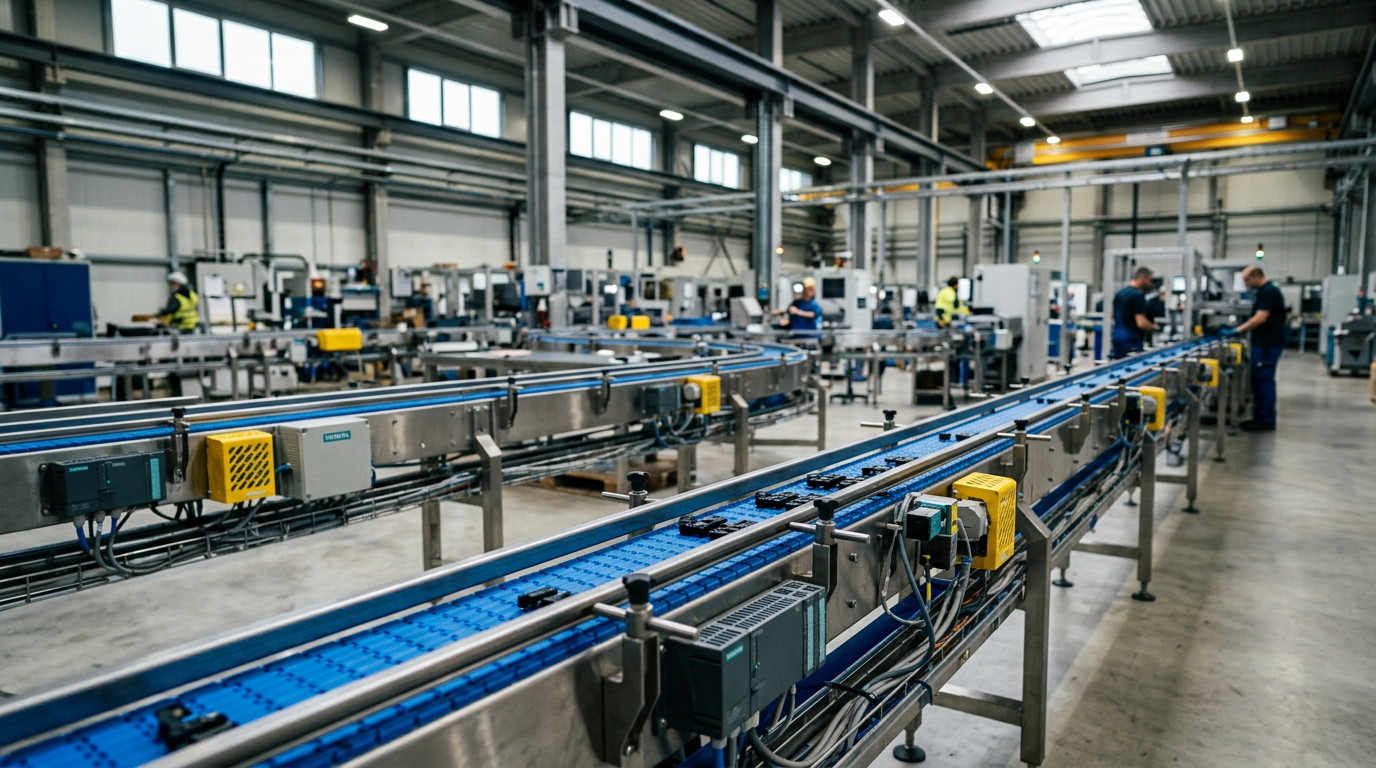
Traditional conveyors often use "slip-stick" accumulation where the belt continues to run under stalled product, creating friction and potential damage. Modern modular systems utilize ZPA logic. Using photo-eye sensors and decentralized motor control, ZPA ensures that products never touch, eliminating backpressure and reducing the "Quality" loss component of OEE caused by product damage.
2. Speed Synchronization and VFD Tuning
Variable Frequency Drives (VFDs) are essential for line balancing. By dynamically adjusting conveyor speeds based on sensor feedback (upstream/downstream occupancy), the system can "smooth" the flow. If a downstream packer slows down, the upstream conveyors should decelerate gradually rather than stopping abruptly. This reduces mechanical wear on modular conveyor systems and prevents motor overheating.
3. Buffer Sizing and Placement
A common mistake is placing buffers randomly. Strategic buffering should occur immediately before the bottleneck (to prevent starvation) and immediately after the bottleneck (to prevent blockage). The required buffer length $L$ can be calculated as: $$L = (T_{stop} \times V_{line}) \times S$$ Where $T_{stop}$ is the expected duration of a minor stoppage, $V_{line}$ is the line velocity, and $S$ is a safety factor (typically 1.2).
Easy Conveyors stocks the material handling discussed here — ready to ship across Europe.
Advanced Modular Solutions
For manufacturers looking to implement these strategies rapidly, Easy Conveyors provides modular components that allow for the easy addition of accumulation zones or diverted paths. This flexibility is critical when a facility's product mix changes, requiring a re-balancing of the line.
Hygienic and Regulatory Considerations
In food and pharma, OEE is also tied to "Quality" and "Cleanability." Using materials that meet FDA 21 CFR standards ensures that the line balancing hardware doesn't become a source of contamination, which would lead to catastrophic OEE drops due to batch rejection.
Dynamic Balancing and Industry 4.0
The integration of IO-Link sensors and PLC-based analytics allows for "Predictive Line Balancing." Instead of reacting to a blockage, the system predicts it based on current throughput trends. By monitoring motor torque and current (following NEMA MG 1 standards), engineers can also identify mechanical friction issues that are slowing down the line before they cause a full breakdown.
Implementation Checklist for Engineers
- Map the V-Profile: Ensure your conveyor speeds increase slightly after the bottleneck to "pull" material away.
- Audit Accumulation Zones: Are your photo-eyes positioned to allow for a 1.5x cycle time buffer?
- Check Motor Efficiency: Transition to IE3/IE4 motors to reduce energy-related downtime and heat-induced failures.
- Simplify Changeovers: Use modular side guides and tool-less adjustments to minimize the "Availability" loss during product switches.
By focusing on these mechanical and logical adjustments, material handling systems evolve from simple transport belts into high-performance assets that directly inflate a plant’s bottom line through improved OEE. Utilizing standardized modular platforms ensures that these balancing adjustments can be made with minimal capital expenditure and downtime.
Frequently Asked Questions
What is the ideal buffer size for a conveyor bottleneck?
Standard practice suggests maintaining a buffer that can hold 1.5 to 2.0 times the units produced during the slowest machine's cycle time or average minor stoppage duration.
How does line balancing directly impact OEE scores?
Line balancing affects OEE by reducing Performance losses (small stops and slow cycles) and Availability losses (preventing blockages that force machine shutdowns).
What is a V-profile speed strategy in material handling?
A V-profile speed strategy involves running conveyors faster as they move away from a bottleneck to ensure the area is cleared and no 'back-pressure' occurs.
What is ZPA and why is it important for quality?
Zero Pressure Accumulation (ZPA) uses sensors to ensure products stop on a conveyor without touching each other, reducing product damage and motor strain.