Mastering Line Balancing and OEE Improvement in Material Flow
Optimize OEE and material flow through professional line balancing. Learn how to eliminate bottlenecks and micro-stops using modular conveyor systems and VFD tuning.
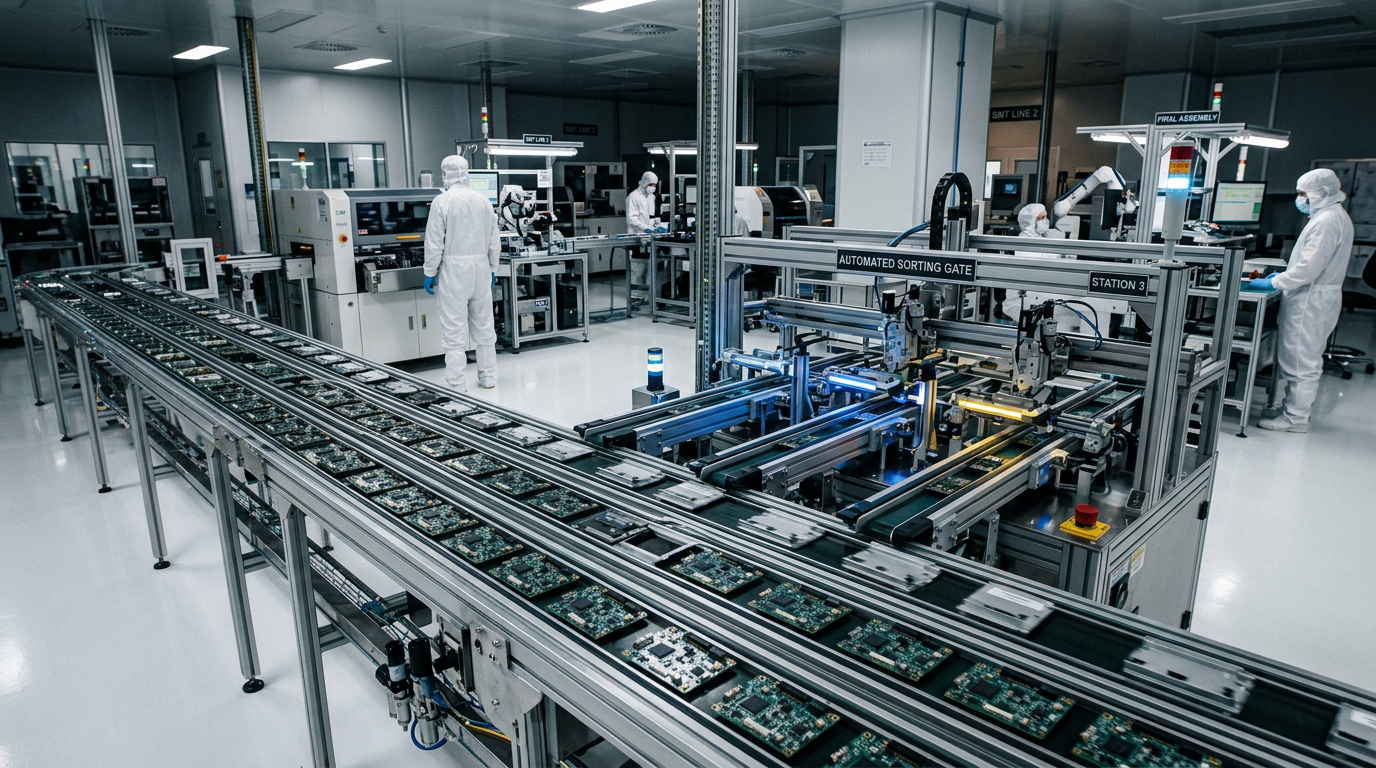
In modern automated manufacturing, line balancing for conveyor systems involves equalizing workload and cycle times across sequential workstations to ensure that no single module exceeds a 15% deviation from the takt time. By optimizing these material flow rates, facilities can typically recover 10% to 25% of lost Overall Equipment Effectiveness (OEE) by eliminating micro-stops and starving/blocking conditions.
The Relationship Between Line Balancing and OEE
To improve OEE (Overall Equipment Effectiveness), engineers must address the three core pillars: Availability, Performance, and Quality. In a conveyor-based system, line balancing sits at the intersection of Performance and Availability. A poorly balanced line leads to two primary inefficiencies:
- Blocking: Upstream processes stop because the downstream conveyor is full (accumulation limit reached).
- Starving: Downstream processes stop because the upstream equipment cannot deliver parts fast enough.
Both conditions are often recorded as "minor stoppages" or "idling," which directly degrade the Performance component of the OEE calculation. According to VDMA, optimizing material flow through precise throughput synchronization is essential for achieving Industry 4.0 efficiency standards.
Identifying the Bottleneck: Takt Time vs. Cycle Time
The first step in line balancing is defining the Takt Time—the rate at which a finished product must be completed to meet customer demand.
$$\text{Takt Time} = \frac{\text{Net Available Time for Production}}{\text{Customer Demand}}$$
If your Takt Time is 10 seconds, every modular workstation along the conveyor must be capable of processing a unit in 10 seconds or less. When a specific module, such as a palletizer or an inspection station, takes 12 seconds, it becomes the physical bottleneck.
The Role of Accumulation and Buffering
Line balancing doesn't always mean every machine runs at the same speed. It often requires strategic buffering. Dynamic accumulation systems allow the line to continue moving even if a downstream machine has a 30-second fault. Using modular solutions from European specialists like Easy Conveyors allows for the integration of multi-lane accumulation and roller-top belts that decouple processes, effectively "smoothing" the flow and protecting the OEE rating.
Strategies for Harmonizing Material Flow
1. Velocity Matching and VFD Tuning
Many OEE losses stem from constant "stop-start" cycles. Instead of running a conveyor at 30 m/min and stopping it every time a sensor is triggered, it is more efficient to use a Variable Frequency Drive (VFD) to run the conveyor at 22 m/min continuously. This reduces mechanical wear and power surges. Utilizing high-efficiency motors, such as those meeting the IE3 or IE4 standards (IEC 60034-30-1), ensures that even at variable speeds, the energy consumption remains optimized.
2. Modular Reconfiguration
One of the advantages of modular conveyor systems is the ability to physically rebalance the line. If a manual assembly station is too slow, the line can be split into parallel paths (workcells) using a diverter, then merged back.
| Feature | Low Integration (Fixed Line) | High Integration (Modular) |
|---|---|---|
| Flexibility | Rigid, difficult to scale | High, "plug-and-play" modules |
| OEE Impact | High risk of single-point failure | Redundancy possible via bypass |
| Response to Bottlenecks | Speed increase only | Parallel processing / Buffering |
| Maintenance | Long downtime for changes | Fast swap-out of sections |
| Flow Control | Binary (On/Off) | Proportional (VFD/Servo driven) |
Easy Conveyors stocks the material handling discussed here — ready to ship across Europe.
Impact on OEE Sub-metrics
Performance (Speed Loss)
Line balancing improves the "Actual Run Rate" vs. "Ideal Run Rate." When conveyors are synchronized, the "micro-stops" (stoppages under 2 minutes) are eliminated. In many high-speed packaging environments, these micro-stops account for up to 40% of total lost time.
Availability (Downtime Loss)
A balanced line experiences fewer mechanical failures. Constant stopping and starting puts immense strain on conveyor chains, drum motor selection, and drive sprockets. By maintaining a steady flow, the Mean Time Between Failures (MTBF) increases significantly.
Quality (Defect Loss)
In sectors like food processing or fragile electronics, sudden conveyor jolts caused by poor balancing can lead to product damage or "tipping." Ensuring a smooth transition between conveyor modules reduces the "Quality" loss portion of the OEE equation. Referencing EHEDG guidelines for hygienic design can also assist in ensuring that material flow doesn't compromise product integrity through contamination.
Advanced Techniques: Simulation and VFD Soft-start Tuning
To achieve 2026-era efficiency, engineers are increasingly using "Digital Twins" to simulate conveyor flow before physical implementation. This allows for the testing of different accumulation lengths and sensor placements. Once the physical line is set, VFD soft-start tuning is applied to ensure that the acceleration and deceleration ramps match the inertia of the loaded conveyor, preventing product slippage and maintaining the precision required for high OEE.
Summary of Best Practices
To maximize OEE through line balancing:
- Calculate the Takt time and compare it to the "Measured Cycle Time" of every automated module.
- Implement Zero Pressure Accumulation (ZPA) to prevent product collisions and backpressure.
- Standardize on modular components to allow for rapid physical rebalancing if product dimensions change.
- Use continuous flow over batching whenever possible to minimize peak-load stress on structural components.
By viewing the conveyor not just as a "transporter" but as a dynamic "buffer and synchronizer," operations managers can turn material handling from a source of downtime into a driver of performance. Improving line balance is a continuous process—regularly auditing the system for new bottlenecks as product mixes evolve is key to maintaining a world-class OEE.
Frequently Asked Questions
How does line balancing specifically affect OEE? Justice
A balanced line minimizes 'micro-stops' and 'starving/blocking' conditions, which are the primary causes of the Performance loss component in the OEE calculation.
What is the definition of a bottleneck in material handling?
The 'bottleneck' is the workstation or conveyor segment with the longest cycle time. It determines the maximum possible throughput of the entire system.
How does Zero Pressure Accumulation (ZPA) help with line balancing?
ZPA is a control methodology where individual conveyor zones only run if the zone ahead is clear. This prevents products from touching, reducing damage and backpressure.
Should I always run my conveyors at maximum speed to improve OEE?
In many cases, decreasing the speed to a continuous, slower rate is better than a high-speed 'stop-start' cycle, as it reduces mechanical wear and improves motor efficiency.
What is the difference between Takt Time and Cycle Time?
Takt time is the rate required to meet customer demand, whereas cycle time is the actual time it takes for a machine to complete one operation. Balancing aims to match cycle time to takt time.