Mastering Line Balancing and OEE Improvement in Conveyor-Based Material Flow
Optimize your material flow by mastering line balancing and OEE. Learn how VFD tuning, ZPA accumulation, and modular designs eliminate bottlenecks.
The Fundamentals of Line Balancing in Material Flow
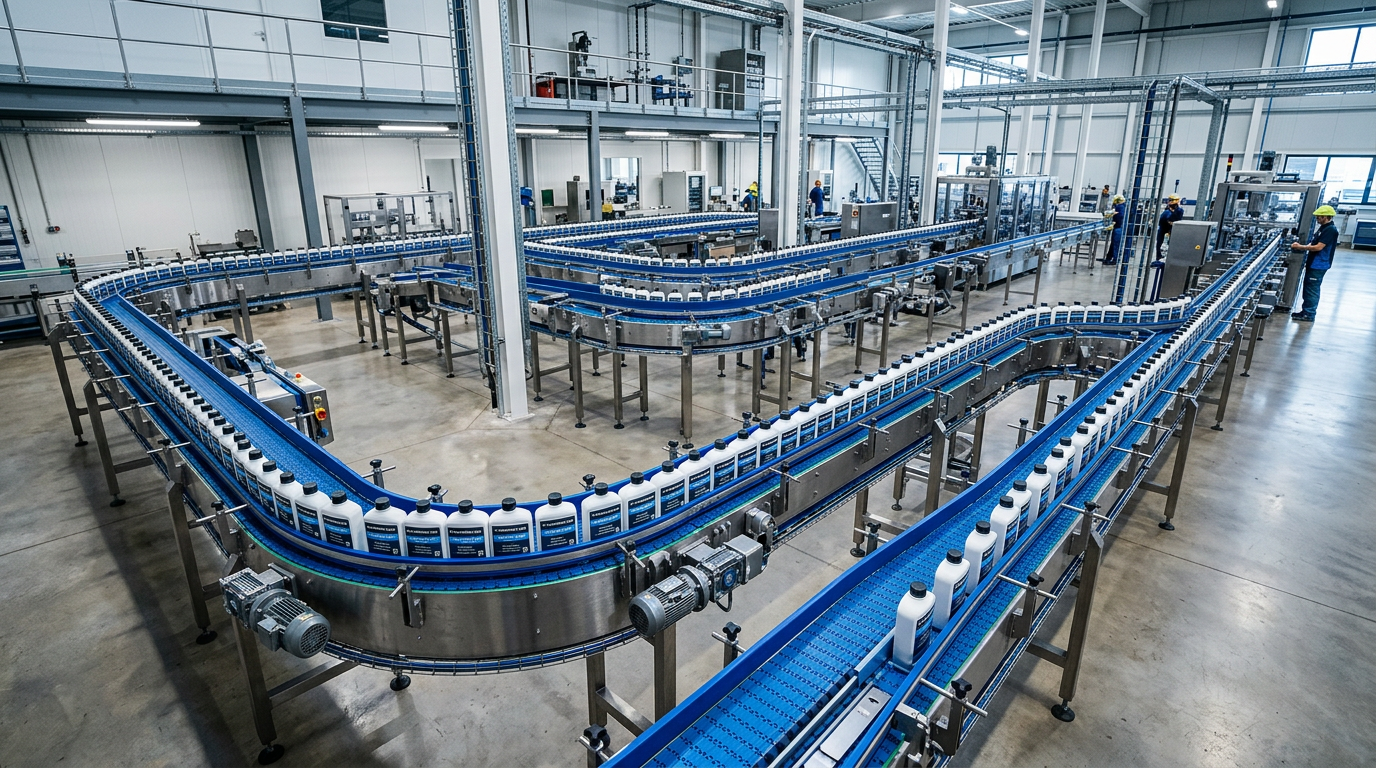
Line balancing is the process of distributing task loads evenly across all workstations and conveyor segments in a production sequence to ensure that no single stage becomes a bottleneck. In a perfectly balanced conveyor system, the cycle time of each modular segment matches the Takt time—the rate at which a finished product must be completed to meet customer demand.
When line balancing is neglected, the system suffers from two primary inefficiencies: "starving" and "blocking." Starving occurs when a downstream process is idle because an upstream bottleneck is failing to deliver parts. Blocking occurs when a downstream segment stops, forcing the upstream segments to halt because there is no accumulation space. Both scenarios directly penalize your Overall Equipment Effectiveness (OEE), specifically the Performance and Availability factors.
Calculating the Impact on OEE
OEE is the gold standard for measuring manufacturing productivity, calculated as: OEE = Availability × Performance × Quality
- Availability: Unbalanced lines lead to frequent micro-stops and longer changeover times. If a conveyor belt is not synchronized with the packer, the system trips, reducing the "Run Time."
- Performance: When buffers are full, motors may run at reduced speeds or enter "creep" modes. Even a 5% deviation from the ideal cycle time due to poor material flow significantly erodes the performance score.
- Quality: Inconsistent flow often leads to product damage. For example, excessive pressure in an accumulation zone (back-pressure) can crush fragile packaging, dropping the Quality ratio.
Mapping the Bottlenecks: VSM and Flow Analysis
Before hardware changes are made, engineers must conduct a Value Stream Mapping (VSM) exercise. By measuring the "Six Big Losses" associated with conveyor flow, you can identify where the mechanical throughput diverges from the theoretical capacity.
Key metrics to monitor include:
- Mean Time to Repair (MTTR): Often high in complex, non-modular systems.
- Small Stops: Frequent 30-second jams that don't trigger a maintenance call but devastate hourly output.
- Speed Loss: Running the conveyor slower than its rated IE3 motor capacity to prevent downstream overflows.
For facilities looking to modernize, Easy Conveyors provides modular sub-systems that allow for rapid reconfiguration, making it significantly easier to re-balance a line when product dimensions or Takt times change.
Strategies for Synchronizing Conveyor Speed
Achieving high OEE requires moving away from fixed-speed AC motors toward decentralized drive architectures. Variable Frequency Drives (VFDs) are the primary tool for line balancing.
VFD Soft-Start Tuning and Speed Matching
By utilizing VFD soft-start tuning, engineers can eliminate the "jerking" motion that causes product misalignment. In a balanced line, the conveyor speeds are graduated: upstream segments typically run 5-10% slower than downstream segments to "pull" the product through, creating a natural gap that prevents collisions.
Comparison: Drive Methods for Balanced Material Flow
| Feature | Fixed-Speed Gearmotors | VFD-Controlled Drives | Servo-Driven Modules |
|---|---|---|---|
| Speed Flexibility | None (Mechanical change only) | High (Software adjusted) | Precision Positioning |
| Efficiency Class | IE1 / IE2 | IE3 / IE4 | Ultra-High |
| OEE Impact | Low (High downtime for changes) | High (Dynamic balancing) | Very High (Zero-gap flow) |
| IP Rating | IP54 - IP65 | IP65 - IP69K | IP65+ |
| Maintenance | High (Mechanical wear) | Medium | Low (Solid state) |
Easy Conveyors stocks the material handling discussed here — ready to ship across Europe.
The Role of Accumulation in OEE Optimization
Accumulation is the "buffer" that protects your OEE when a downstream machine (like a labeler or palletizer) experiences a minor failure. Without accumulation, a 2-minute label roll change results in 2 minutes of total line downtime.
Zero Pressure Accumulation (ZPA)
Modern modular systems utilize Zero Pressure Accumulation. In ZPA systems, the conveyor is divided into zones, each with its own sensor and motor. When a product stops downstream, the upstream zones stop individually, preventing products from touching. This eliminates back-pressure and reduces motor wear, directly improving the "Quality" and "Availability" components of OEE.
Spiral and Vertical Buffers
In floor-space-constrained environments, vertical accumulation buffers or spiral conveyors allow for minutes of "buffer time" without increasing the factory footprint. This is essential for hygienic wash-down design in food and pharma, where floor space is at a premium and every square meter must be optimized for throughput.
Data-Driven Balancing: The IIoT Influence
To reach an OEE above 85% (World Class), gut feeling is insufficient. Integrated sensors (photoelectric, inductive, and ultrasonic) must feed real-time data into a PLC or SCADA system.
- Predictive Maintenance: By monitoring the current draw of a drum motor, the system can predict a bearing failure before it causes an unplanned stop. Referencing a drum motor selection guide ensures the motor is sized for the torque requirements, preventing over-current trips.
- Dynamic Speed Control: If the packer slows down due to a low-grade film issue, the conveyors upstream can automatically decelerate via the VFDs to prevent a "block" event, maintaining a smooth, albeit slower, flow rather than a hard stop.
Common Failure Modes in Conveyor Line Balancing
Despite best efforts, certain technical oversights frequently sabotage OEE:
- Inadequate Pitch: If the distance between products is too small, sensors cannot "clear" between items, leading to false jam alarms.
- Friction Surges: Using the wrong belt material (e.g., high-friction PVC where low-friction POM is needed) increases the load on the motor, leading to thermal trips.
- Sensor Misalignment: In high-vibration environments, sensors may shift, causing the PLC to think a zone is full when it is empty.
By focusing on modular components and intelligent control, manufacturers can transform their conveyor systems from static transport lanes into dynamic, self-balancing assets that drive OEE to new peaks. Improving material handling is not just about moving A to B; it is about ensuring the flow never stops.
Frequently Asked Questions
What is line balancing in conveyor systems?
Line balancing is the process of aligning the cycle times of all conveyor segments and machines to match the Takt time, ensuring a smooth flow without bottlenecks or idle time.
How does conveyor performance affect OEE?
OEE measures Availability, Performance, and Quality. Conveyor systems impact OEE by reducing unplanned stops (Availability), maintaining consistent speeds (Performance), and preventing product damage (Quality).
Why is Zero Pressure Accumulation (ZPA) important for OEE?
ZPA provides a buffer that allows upstream processes to continue running even if a downstream machine stops briefly, preventing a total line halt and preserving 'Availability' scores.
What role do VFDs play in line balancing?
VFDs allow for dynamic speed adjustments and soft starts, which prevent mechanical stress and allow the line to synchronize with varying production rates.
Sources & references
- [1]ISO 22400-2:2014 - Automation systems and integration — Key performance indicators (KPIs) for manufacturing operations management
- [2]Understanding OEE, Productivity, and Performance
- [3]Zero Pressure Accumulation (ZPA) Conveyor Technology
- [4]Line Balancing - Wikipedia
- [5]Variable Frequency Drives (VFD) for Conveyor Applications