Engineering Incline Conveyors with Cleated Belts for Bulk Goods促
Cleated belt incline conveyors allow for transport of bulk goods at angles up to 90 degrees. Learn about cleat selection, modular vs. fabric belts, and design rules.
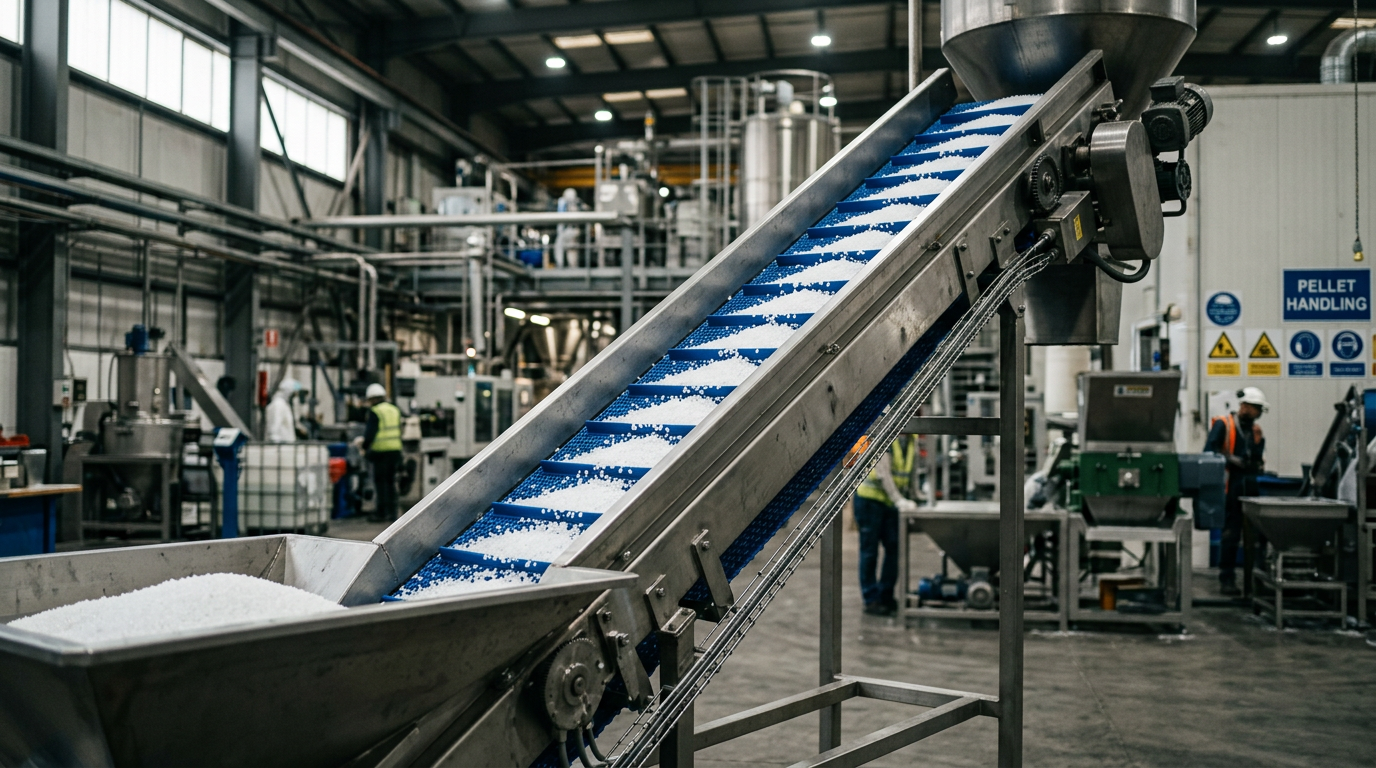
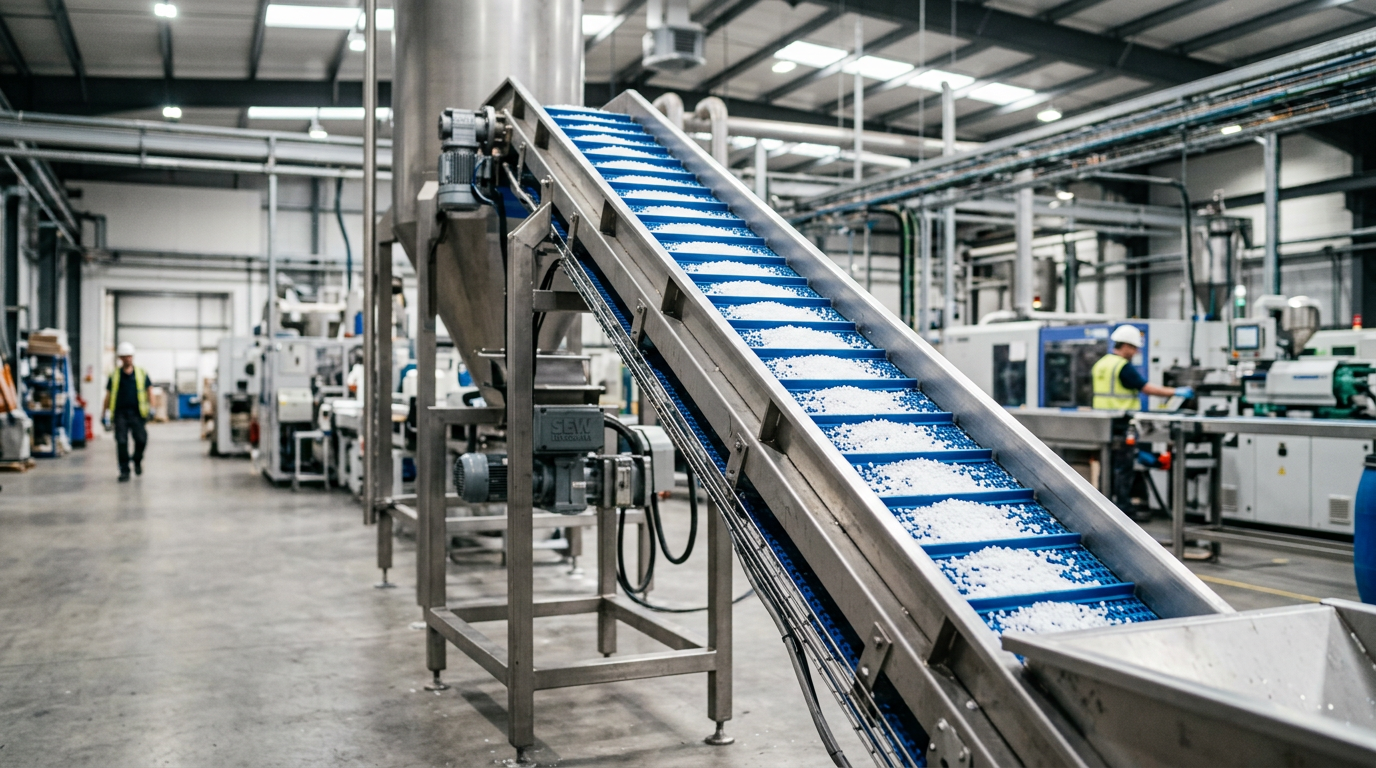
Incline conveyors with cleated belts utilize transverse flights (cleats) to overcome gravity, typically allowing for the vertical transport of bulk goods at angles up to 90 degrees while preventing product rollback or "slip." For most industrial bulk applications, steep-angle inclines (30° to 60°) require cleat heights at least 2.5 times the maximum particle size to maintain a volumetric efficiency of over 85%.
The Engineering Behind Cleated Incline Systems
When transporting bulk materials—ranging from plastic resin pellets and roasted coffee beans to heavy metal stampings—gravity is the primary adversary. Standard flat belts generally lose effective grip at angles exceeding 15° to 20°, depending on the material's coefficient of friction. To extend this range, engineers employ modular or fabric belts equipped with cleats, also known as flights or paddles.
The integration of these cleats transforms a standard conveyor into a pocketed transport system. By creating discrete compartments, the system can handle steep inclines and even vertical "Z-type" configurations. According to CEMA standards, the capacity of these systems is determined not just by belt speed, but by the volume of the "pocket" created between two successive cleats.
Cleat Geometry and Selection
Selecting the right cleat profile is critical for operational stability. High-torque applications or heavy bulk loads often require reinforced T-cleats or C-cleats to prevent bending under load.
- T-Cleats: The standard vertical flight, ideal for general-purpose inclines up to 40°.
- C-Cleats (Scoop Cleats): These feature a curved profile that "cups" the product. They are essential for steep inclines (up to 60°) as they prevent rounder bulk items from rolling back over the top of the flight.
- S-Cleats: Specifically designed for heavy-duty or abrasive bulk materials where impact resistance is paramount.
- Custom Indented Cleats: Used when the belt must run over return rollers or through tight tracking guides.
Technical Specifications: Cleated Belt Comparison
| Feature | Standard T-Cleat | Reinforced C-Cleat | Corrugated Sidewall Cleat |
|---|---|---|---|
| Max Incline Angle | 30° - 45° | 45° - 65° | 60° - 90° |
| Material Base | PVC / PU / PE | PU / Rubber | PVC / Polyester |
| Common Height | 20mm - 75mm | 30mm - 100mm | 40mm - 120mm |
| Typical Loading | Light (Grains/Parts) | Medium (Aggregates) | Heavy (Ores/Dense Bulk) |
| Minimum Pulley Ø | Small (60mm+) | Medium (100mm+) | Large (150mm+) |
Modular vs. Fabric Cleated Belts
The choice between a continuous fabric belt and a modular plastic belt often defines the system's maintenance lifecycle. Easy Conveyors specializes in modular belt systems that offer significant advantages for cleated incline applications, particularly regarding repairability and tracking.
Modular Plastic Belts (POM/PP)
Modular belts, often made from Polyoxymethylene (POM) or Polypropylene (PP), utilize interlocking segments. In an incline scenario, the cleats are molded directly into specific modules. If a single cleat breaks, only that module needs replacement, whereas a fabric belt would require a full vulcanized repair or belt replacement. Furthermore, modular belts are positively driven by sprockets, eliminating the belt slippage often seen in high-tension fabric incline systems.
Fabric and Reinforced PVC Belts
Fabric belts offer a smoother surface which can be beneficial for very fine powders that might otherwise migrate through the hinges of a modular belt. These belts often follow FDA/USDA guidelines for food contact, utilizing high-frequency welding to attach the cleats to the base belt, ensuring a crevice-free hygienic surface.
Easy Conveyors stocks the material handling discussed here — ready to ship across Europe.
Critical Design Considerations for Bulk Goods
1. The Angle of Repose
Every bulk material has a natural angle of repose—the steepest angle at which the material remains stable when piled. When designing an incline conveyor, if the conveyor's angle exceeds the material's angle of repose, cleats become mandatory. For example, dry sand has an angle of repose of roughly 34°. Attempting to move it at 40° on a flat belt will result in total backflow.
2. Sidewall Integration
For "steep-angle" or vertical conveying, cleats alone are often insufficient. Without sides, material can spill off the edges of the belt during the ascent. Corrugated sidewalls are frequently utilized in tandem with cleats to create a moving "bucket" that contains the product on all four sides. This is common in "Z-conveyors" where the belt moves from horizontal to vertical and back to horizontal.
3. Tension and Drive Systems
Incline conveyors require significantly higher torque than horizontal systems because they must constantly overcome the weight of the entire product load against gravity. Many modern systems incorporate drum motor selection strategies to maximize space and efficiency. Using an IE3-class motor ensures that the energy consumed in lifting heavy bulk loads is minimized, reducing the Total Cost of Ownership (TCO).
Maintenance and Common Failure Modes
Incline conveyors with cleated belts are subject to unique stresses. The most common failure modes include:
- Cleat Root Cracking: Occurs when the cleat is too rigid for the pulley diameter. Always ensure the minimum pulley diameter matches the belt manufacturer's specification.
- Material Carryback: Bulk goods can stick to the corners where the cleat meets the belt. In food-grade applications, this is a major hygiene risk. Using an hygienic wash-down design with radiused "easy-clean" cleats can mitigate this.
- Belt Tracking Issues: Off-center loading on an incline will cause the belt to shift laterally. Since cleats increase the vertical profile of the belt, mistracking can cause cleats to strike the conveyor frame, leading to catastrophic failure.
For complex sortation or high-speed bulk handling, integrating VFD soft-start tuning is essential to prevent "product bounce" when the incline starts under full load. A sudden jerk at 45 degrees can cause material to hurdle over the cleats, leading to significant spillage at the bottom of the incline.
Standards and Regulatory Compliance
When handling bulk food products (e.g., cereals, frozen vegetables), the entire assembly must adhere to EHEDG or 3-A Sanitary Standards. This implies that the cleats must be integrally bonded to the belt without gaps where bacteria can grow. For industrial bulk goods like chemicals or recycled plastics, ISO 2110 specifies the requirements for light conveyor belts, including those used on inclines.
Cleated belt systems represent the most efficient method for vertical space optimization in a facility. By understanding the relationship between cleat height, belt speed, and material properties, operations managers can ensure a reliable, spill-free bulk handling process.
Frequently Asked Questions
How high should cleats be for bulk materials?
The rule of thumb is that the cleat height should be at least 2 to 2.5 times the size of the largest particles being moved to prevent rollback.
At what angle do I need a cleated belt?
Standard flat belts lose efficiency at 15-20 degrees. For angles between 20 and 45 degrees, T-cleats or C-cleats are required. For angles above 45 degrees, corrugated sidewall belts or bucket elevators are recommended.
Why use modular plastic belts instead of rubber for inclines?
Modular belts are superior for inclines because they are positively driven by sprockets, eliminating belt slip, and individual damaged cleat modules can be replaced without replacing the entire belt.
Can a cleated belt conveyor run vertically at 90 degrees?
Yes, but it requires corrugated sidewall belts and T-cleats to create a fully enclosed pocket, effectively turning the conveyor into a vertical lift.