Engineering Incline Conveyors with Cleated Belts for Bulk Goods
Learn how to engineer incline conveyors with cleated belts for bulk goods, focusing on cleat geometry, sidewall selection, and gravity-defying material handling.
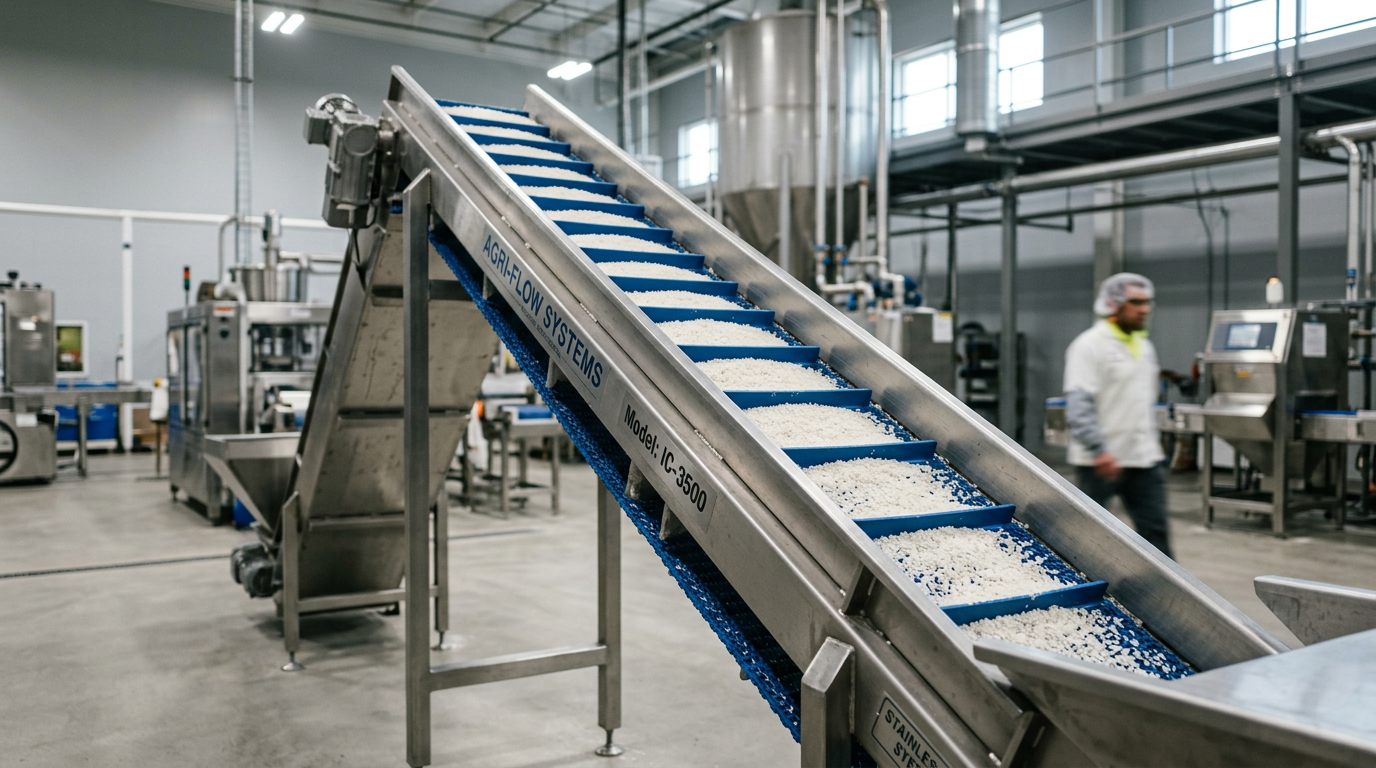
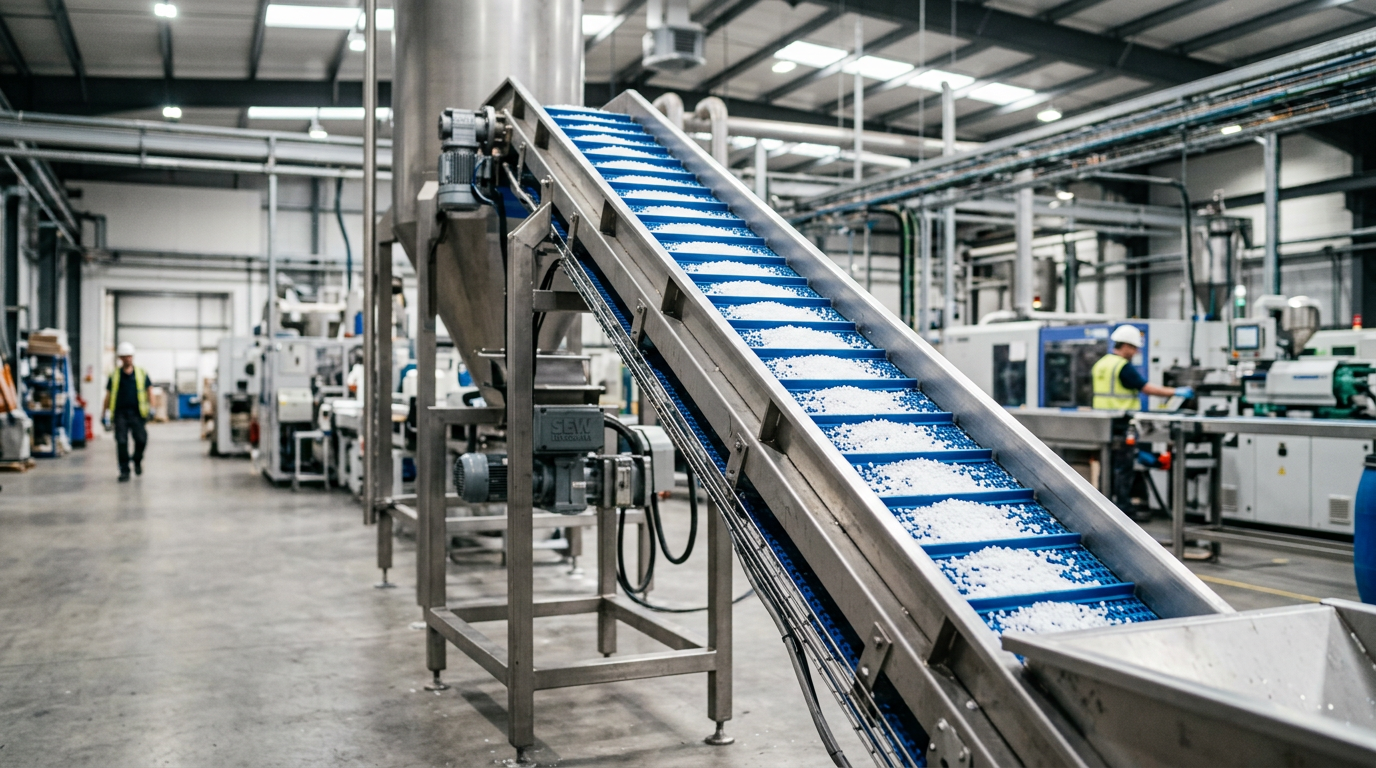
Incline conveyors with cleated belts are engineered to transport bulk goods at angles typically ranging from 20° to 90°, using transverse cleats (flights) to prevent product rollback or "avalanching." For optimal efficiency, the cleat height should generally be at least 2.5 times the maximum particle size of the material being transported, ensuring stable movement against gravity.
The Mechanics of Cleated Belt Incline Conveyors
When bulk materials need to move vertically or at steep angles, standard flat belts fail due to the material’s natural angle of repose. Incline conveyors solve this by utilizing a "cleated" or "flighted" belt surface. These cleats act as moving buckets or partitions that trap the material, allowing for steep elevation changes in compact footprints.
Cleat Geometry and Selection
The effectiveness of an incline system depends heavily on the cleat profile. According to standards established by leaders like Ammeraal Beltech, cleat shapes are generally categorized into three types:
- T-Cleats (Straight): Used for inclines up to 30°. These are ideal for general-purpose bulk handling where the material is not prone to rolling.
- C-Cleats (Curved/Scoop): Designed for steeper angles (up to 40°). The curved profile creates a "scoop" effect, increasing the carrying capacity per linear meter.
- S-Cleats (Integrally Molded): Often used in heavy-duty or high-sanitation environments, providing maximum rigidity for larger bulk loads.
The Role of Corrugated Sidewalls
For steep-angle conveyors (above 45°) or vertical lifts, cleated belts are often paired with corrugated sidewalls. These flexible walls prevent material from spilling off the sides of the belt as it transitions from horizontal to vertical. This configuration, often referred to as a "pocket belt," allows for 90° vertical transport, significantly reducing the floor space required compared to traditional long-run incline ramps.
Engineering Considerations for Bulk Handling
Designing an incline system requires precise calculations regarding belt tension, motor torque, and material behavior. A critical factor is the filling degree; for bulk goods, the pocket between cleats should rarely be filled beyond 70% to account for material shifting during the transition from the horizontal "tail" section to the incline.
Drive Systems and Efficiency
Because incline conveyors must overcome gravity, they require higher torque than horizontal systems. Utilizing high-efficiency motors, such as those meeting IE3 or IE4 efficiency classes, is essential for long-term operational cost reduction.
When selecting a drive, many engineers opt for drum motors to save space, though traditional gearmotors remain popular for high-torque, heavy-load bulk applications. Easy Conveyors offers modular solutions that integrate seamlessly with various drive configurations, allowing for flexibility in how the incline is powered and controlled.
Material Compatibility
The choice of belt material—typically PVC, Polyurethane (PU), or Polyethylene (PE)—must match the bulk good's characteristics:
- Food Grade: Must comply with FDA 21 CFR and EC 1935/2004 regulations.
- Abrasive Materials: Require high-shore hardness covers to prevent premature cleat wear.
- Oil/Fat Resistance: Essential for nut or snack food processing to prevent belt delamination.
| Feature | T-Cleat | C-Cleat | Sidewall Cleat |
|---|---|---|---|
| Max Incline Angle | 25° - 30° | 30° - 45° | 45° - 90° |
| Bulk Capacity | Medium | High | Very High |
| Material Types | Granules, Small Parts | Powders, Grains | Large Bulk, Coal, Ore |
| Ease of Cleaning | Excellent | Good | Moderate |
| Flexibility | High | Medium | Low |
Managing Failure Modes in Incline Systems
Incline conveyors face unique stressors that horizontal systems do not. Understanding these failure modes is key to proactive maintenance.
Cleat Detachment
The most common failure point is the bond between the cleat and the base belt. In high-load bulk applications, mechanical stress at the transition point (where the belt levels out) can cause cleats to tear. High-frequency welding is the industry standard for ensuring a permanent bond that resists the shear forces of heavy bulk loads.
Product Carryback
Bulk goods, particularly moist or sticky materials, may adhere to the cleats after the discharge point. This "carryback" can lead to material buildup on return rollers, causing belt tracking issues. Implementing specialized belt scrapers or vibratory discharge aids at the head pulley can mitigate this risk.
Belt Tracking and Tension
Gravity exerts a constant downward force on the belt, which can lead to stretching. Regular monitoring of the take-up unit is required. For longer inclines, using a VFD soft-start tuning strategy is recommended to prevent the "snap" effect during startup, which can dislodge bulk materials from the pockets.
Easy Conveyors stocks the material handling discussed here — ready to ship across Europe.
Hygiene and Sanitation Standards
For the food and pharmaceutical sectors, the design must follow EHEDG guidelines for hygienic design. This includes avoiding sharp internal corners where bulk powders might accumulate and undergo microbial growth.
Modular plastic belts with integrated cleats are often preferred in wash-down environments because they allow for easy drainage and are resistant to aggressive cleaning chemicals. When selecting these components, ensuring the system meets IP69K ratings for water ingress protection is vital for the longevity of the sensors and motors integrated into the conveyor frame.
Sizing and Capacity Calculation
To determine the throughput ($Q$) of an incline conveyor for bulk goods, the following formula is typically applied:
$Q = V \times A \times \rho$
Where:
- $V$ is the belt speed (m/s).
- $A$ is the cross-sectional area of the material pocket ($m^2$).
- $\rho$ is the bulk density of the material ($kg/m^3$).
It is important to note that as the incline angle increases, the effective cross-sectional area ($A$) decreases because the material settles toward the back cleat, leaving a void at the front.
Future Trends in Bulk Incline Conveying
The industry is moving toward "smart" incline systems. Integration with IIoT sensors allows for real-time monitoring of cleat health and motor temperature. Furthermore, advancements in Habasit fabric technology are producing belts with lower coefficients of friction on the underside, reducing the energy required to lift heavy bulk loads.
Automation specialists are also increasingly looking at modular "plug-and-play" incline sections. These units allow plants to rapidly reconfigure lines as production needs change, moving from a fixed infrastructure to a dynamic, modular material handling environment. Proper drum motor selection remains a cornerstone of these compact, modular designs, ensuring that the drive system is as streamlined as the conveyor frame itself. By focusing on hygienic wash-down design and robust mechanical components, manufacturers can ensure their incline conveyors provide a reliable link in the production chain for decades.
Frequently Asked Questions
How do I determine the correct cleat height for bulk materials?
Cleat height should typically be at least 2.5 times the size of the largest particles in your bulk material to ensure they are captured and lifted effectively without rolling back.
What is the difference between T-cleats and C-cleats?
T-cleats are best for angles up to 30°, while C-cleats (scoop shape) are designed for steeper inclines up to 45° to provide more support against gravity.
Can cleated belts handle vertical (90-degree) transport?
Yes, by using corrugated sidewalls and high-profile cleats (pocket belts), bulk goods can be transported at a 90-degree vertical angle, though this requires specialized transition curves.
Why are corrugated sidewalls used on incline conveyors?
Sidewalls prevent material from spilling off the sides during steep inclines, allowing for higher pocket filling and cleaner operation in bulk handling applications.
What type of motor is best for incline conveyors?
Incline conveyors require high-torque drives to overcome gravity. IE3 or IE4 efficiency motors are recommended to manage the constant load and reduce operational energy costs.