Engineering Incline Conveyors with Cleated Belts for Bulk Goods
Master the engineering of incline conveyors with cleated belts. Learn about cleat profiles, volumetric efficiency, and motor sizing for bulk material handling.
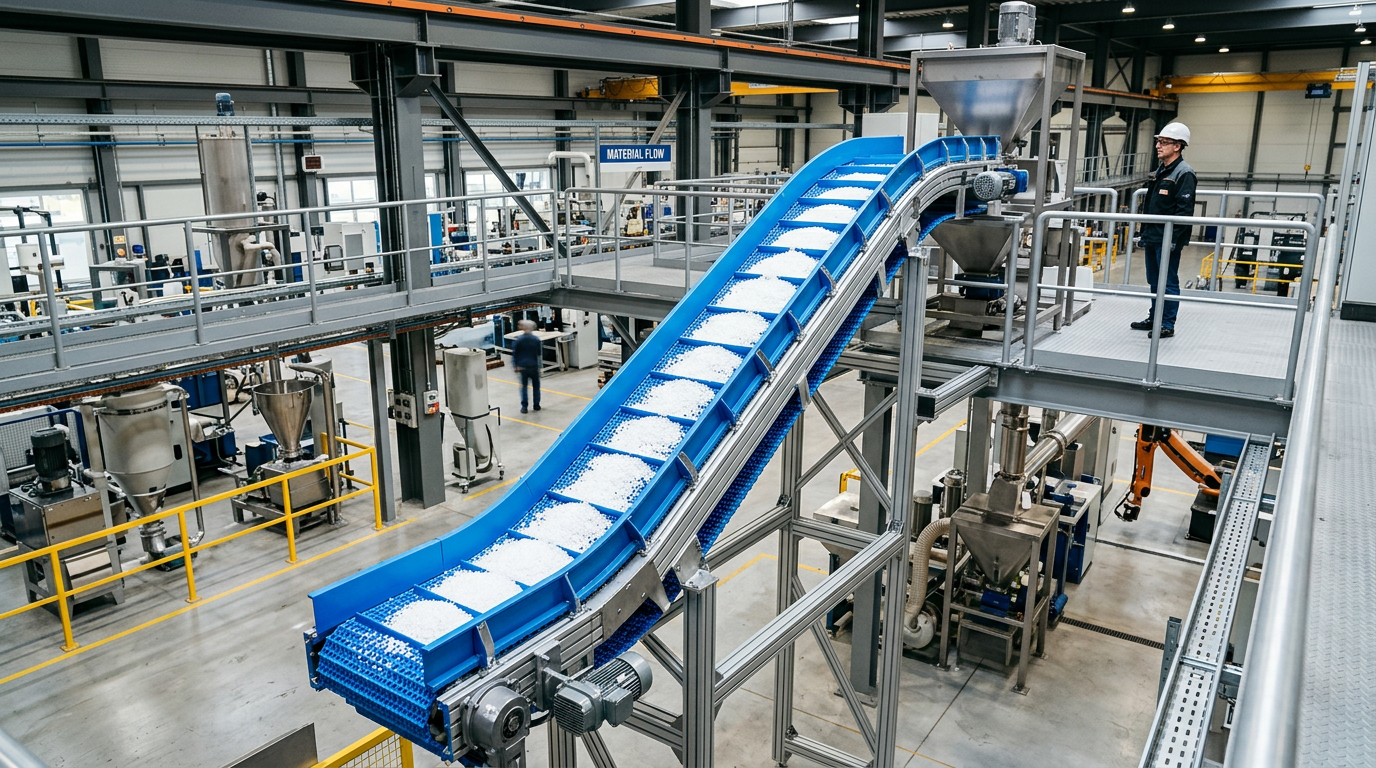
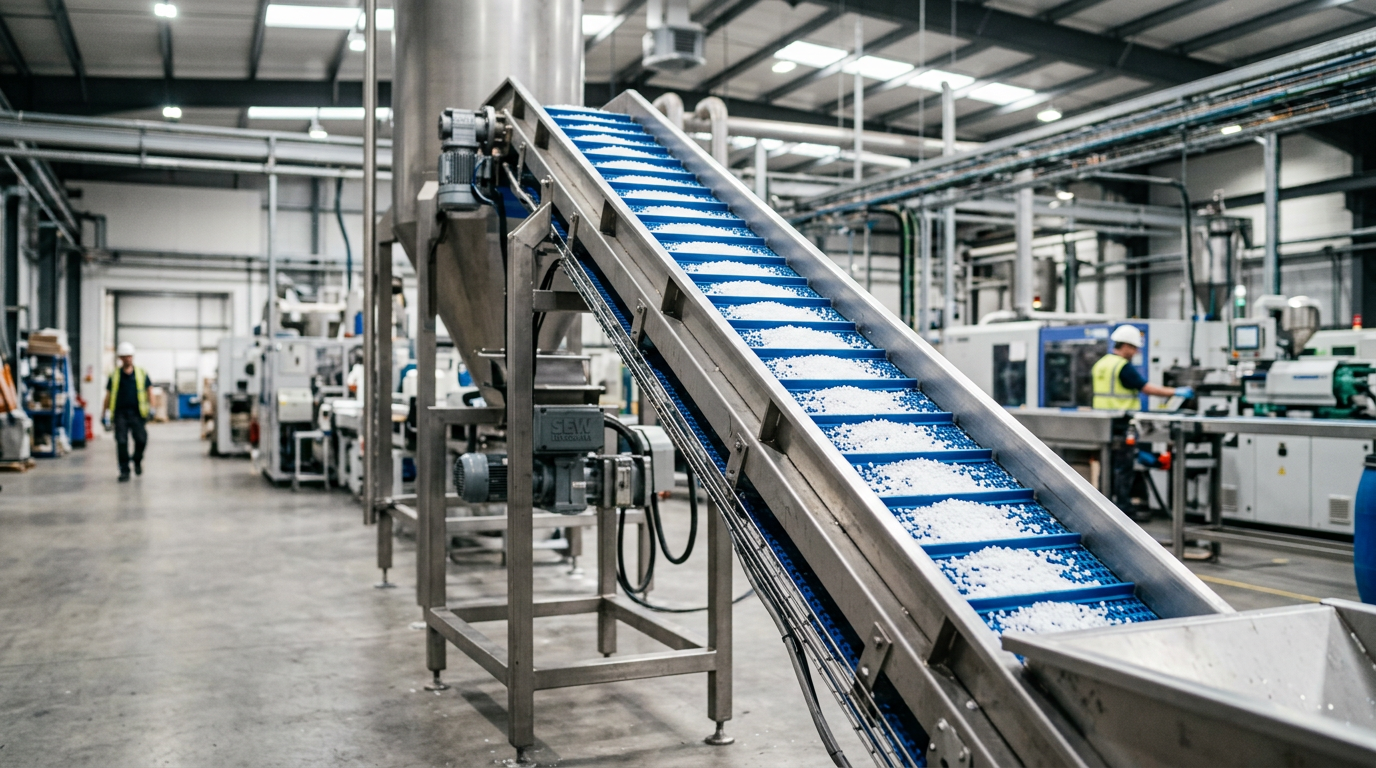
Incline conveyors with cleated belts for bulk goods are engineered to transport loose materials at angles up to 90 degrees by utilizing transverse flights (cleats) that prevent product rollback and maintain a volumetric throughput efficiency often exceeding 95% compared to flat belts. These systems are governed by steep-angle conveyance physics, where cleat height is typically sized at 1.5 to 2.5 times the maximum particle diameter to ensure stable containment during vertical transitions.
The Engineering of Steep-Angle Conveyance
When transporting bulk goods—such as grains, plastic resins, pharmaceutical powders, or metal fasteners—gravity becomes the primary adversary once the angle of inclination exceeds the material's natural angle of repose. For most dry bulk solids, this limit is between 20° and 30°. Beyond this threshold, standard friction-based conveyance fails.
Cleated belts, often referred to as "flighted belts," solve this by creating individual pockets or "buckets" on the belt surface. These cleats act as mechanical barriers. According to CEMA (Conveyor Equipment Manufacturers Association) standards, the selection of cleat profile and spacing is the most critical factor in determining the system's "fill factor."
Cleated Belt Geometry and Material Selection
The performance of an incline conveyor is heavily dependent on the interaction between the belt material and the bulk good. Modern modular systems utilize several types of cleats:
- I-Cleats (Vertical): Standard for medium inclinations (30°–45°). They provide excellent support for non-rolling materials.
- T-Cleats: Feature a reinforced base, ideal for heavier bulk loads or abrasive materials.
- Scoop/C-Cleats: These have a forward-leaning profile. They are essential for steep inclines (up to 90°) because they cradle the product, effectively acting like a continuous bucket elevator.
- V-Cleats: Often used for centering products or handling materials that tend to migrate toward the edges.
Material Properties: The belt carcass is typically made of PVC, PU (Polyurethane), or modular plastic (POM/PP). For food-grade applications, the FDA (U.S. Food and Drug Administration) requires materials that are non-porous and resistant to microbial growth. In heavy industrial settings, such as moving recycled glass or minerals, high-shore hardness PU is preferred for its abrasion resistance.
Comparative Analysis: Cleated Belt Configurations
| Feature | I-Cleat (Standard) | C-Cleat (Scoop) | Corrugated Sidewall |
|---|---|---|---|
| Max Incline Angle | 45° | 60° - 75° | Up to 90° |
| Product Containment | Moderate | High | Excellent |
| Cleanability | High | Medium | Low (folds trap dust) |
| Typical Energy Class | IE3 (IEC 60034-30-1) | IE3 | IE3 - IE4 |
| Primary Use Case | Packaging/Sorters | Bulk Grains/Pellets | Steep Vertical Lift |
| Material Build | PVC/PU | PU/Modular | Rubber/Fabric |
System Design Considerations: Sidewalls and Feeders
While cleats handle the vertical lift, lateral containment is equally vital. Without corrugated sidewalls or integrated skirt boards, bulk goods can spill over the edges during the transition from horizontal to incline.
For high-capacity modular systems, manufacturers like Easy Conveyors offer specialized lateral guides and "swan-neck" (Z-type) configurations. These frames allow the belt to transition from a horizontal lo
Easy Conveyors stocks the material handling discussed here — ready to ship across Europe.
ading zone to a steep incline and back to horizontal for discharge—all within a single continuous belt run. This eliminates the need for transfer points, which are common sources of product degradation and dust emission.
Overcoming Common Failure Modes
- Cleat Separation: In high-tension environments, cleats can "peel" from the base belt. Modern induction welding or mechanical fastening in modular plastic belts (using pins/hinges) significantly reduces this risk compared to simple cold-glued cleats.
- Product Carryback: Fine powders often stick to the belt surface or the base of the cleat. Implementing a motorized brush cleaner or a "thumper" roller at the discharge point is standard practice for bulk solids handling.
- Belt Tracking: The asymmetric loads common in bulk handling can cause the belt to drift. Using V-guides on the bottom of the belt is a proven method for maintaining center-tracking under heavy loads.
Dynamic Loading and Motor Sizing
Calculating the power requirements for an incline conveyor is more complex than a horizontal line. The designer must account for:
- Static Lift: The energy required to move the mass against gravity.
- Friction: The resistance of the belt against the wear strips (especially significant with high-molecular-weight polyethylene liners).
- Surge Loading: The peak load when a hopper discharges onto the belt.
For these applications, IE3 efficiency class motors are often paired with Variable Frequency Drives (VFDs) to allow for "soft-starts." A soft-start is crucial because a fully loaded incline belt requires significant torque to overcome static friction; jumping to full speed instantly can cause belt stretch or mechanical shear of the cleats. Referencing SEW-Eurodrive's technical documentation, using a VFD also allows for "holding torque," preventing the belt from backsliding when stopped while loaded.
Hygiene and Washdown Requirements
In food and pharmaceutical sectors, the junction where the cleat meets the belt is a critical control point. The EHEDG (European Hygienic Engineering & Design Group) recommends large-radius "fillets" at these joints to prevent material buildup. Modular plastic cleated belts are often preferred here because individual modules can be replaced if damaged, and the open-hinge design allows for easier cleaning during high-pressure washdown cycles.
Integration with Upstream and Downstream Equipment
Effective bulk handling rarely involves a conveyor in isolation. It is part of a system.
- Feeders: Using a vibratory feeder or a "metering" screw ensures the cleat pockets are filled consistently. Overfilling leads to spillage; underfilling reduces "volumetric efficiency."
- Sensors: Inductive sensors or optical encoders are used to monitor belt speed, while ultrasonic sensors over the loading zone can detect "plugged" conditions where material backs up.
When designing your next facility, selecting the right incline conveyor with a cleated belt involves a balance of material physics, motor efficiency, and mechanical durability. By understanding the angle of repose and the specific needs of your bulk good, you can specify a system that maximizes uptime and minimizes mechanical wear. For further reading on drive systems, consider exploring our guides on drum motor selection or VFD soft-start tuning to optimize your incline performance.
Frequently Asked Questions
At what angle do I need to switch from a flat belt to a cleated belt?
Cleats are required when the conveyor angle exceeds the material's 'angle of repose,' typically between 20° and 30°. Beyond this, product will slide backward on a flat belt.
How do I determine the correct cleat height for my bulk product?
A general rule of thumb is that cleat height should be at least 2 to 2.5 times the size of the largest particle being transported to prevent rolling.
Can cleated belts handle a 90-degree vertical lift?
Yes, but it requires 'Swan-Neck' or Z-frame configurations and often corrugated sidewalls to ensure that product stays contained as the belt shifts from horizontal to vertical.
Are modular plastic belts better than fabric belts for food-grade incline applications?
Modular plastic belts are superior for washdown. Unlike PVC/PU belts where cleats are welded, modular units can be disassembled and the open-hinge design allows water to reach all surfaces easily.