Engineering Incline Conveyors with Cleated Belts for Bulk Goods
Learn how incline conveyors with cleated belts solve bulk material transport challenges. Explore cleat geometry, motor sizing, and material selection for steep inclines.
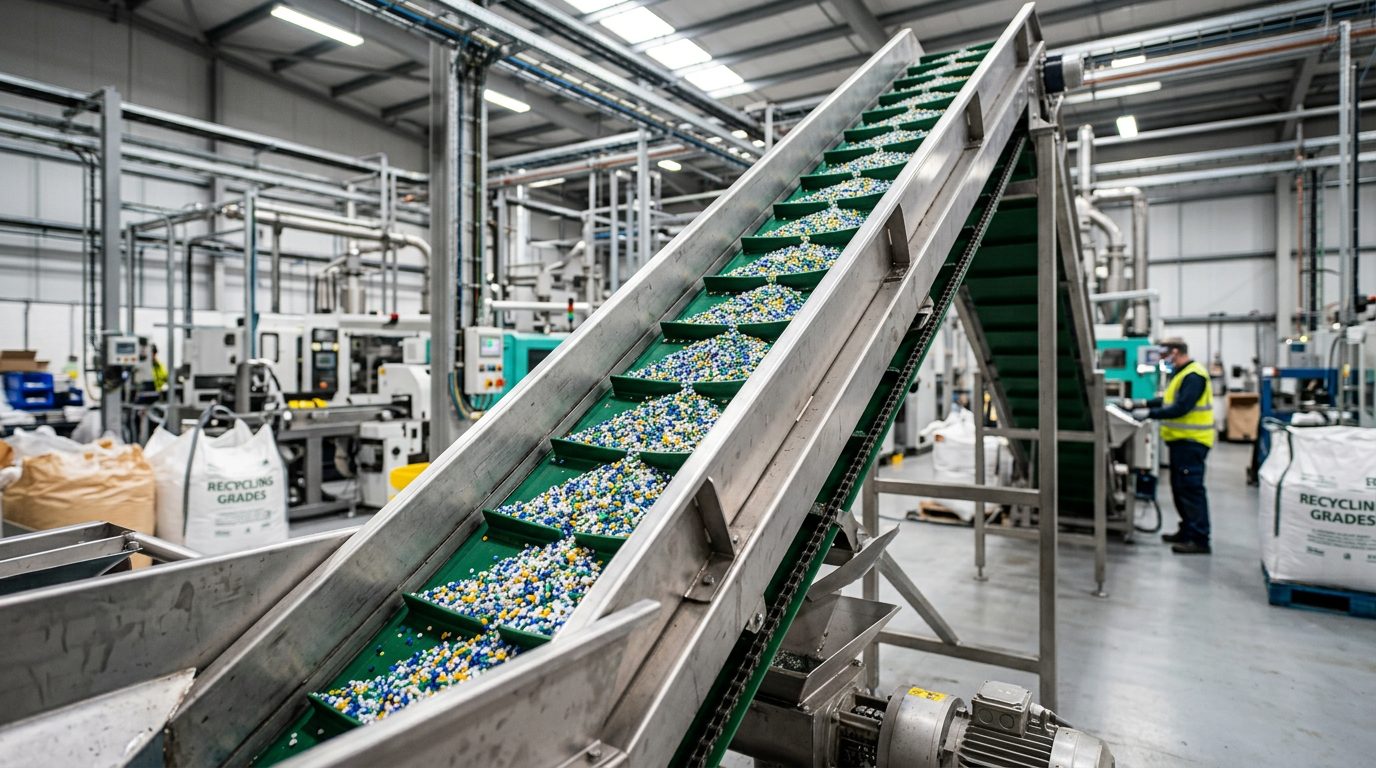
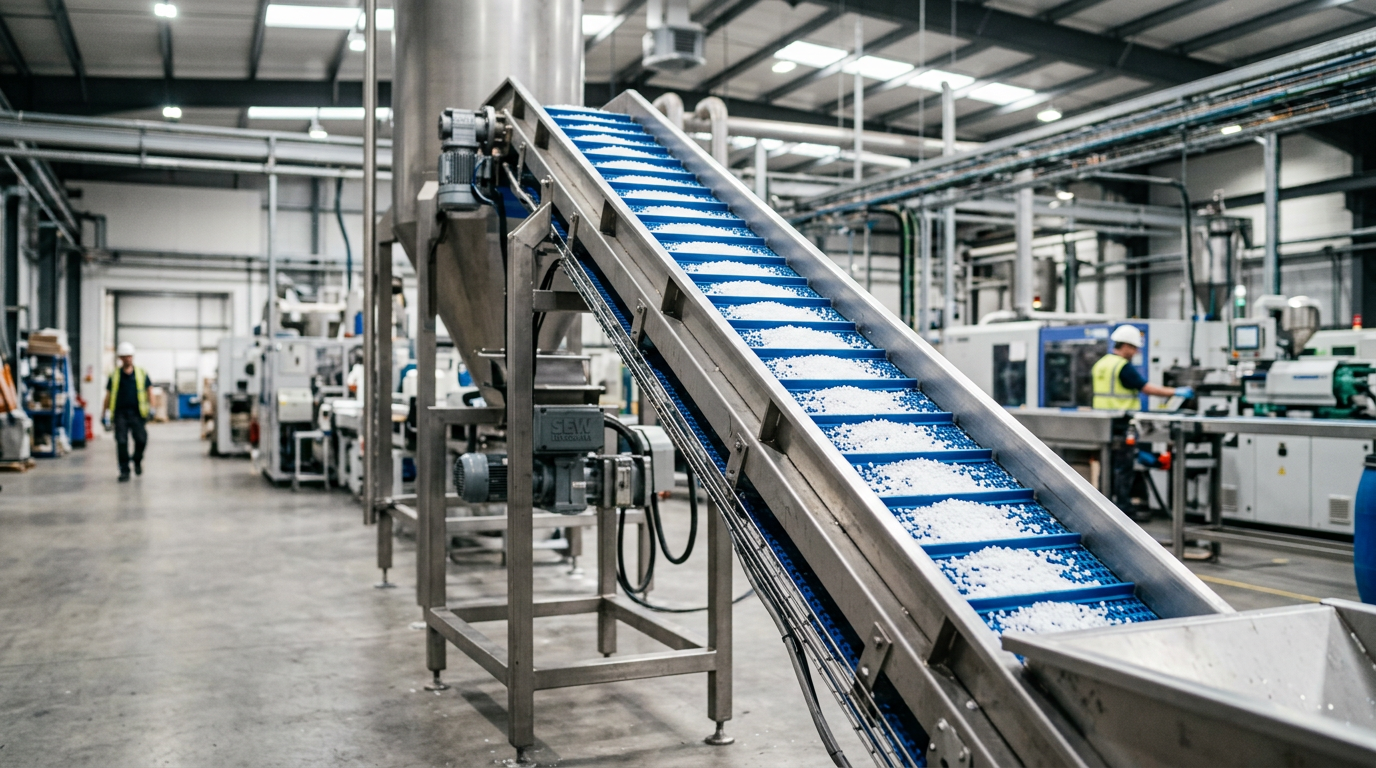
Incline conveyors with cleated belts are the primary metallurgical and food-grade solution for transporting bulk goods at angles exceeding 15 to 20 degrees, utilizing transverse profiles (cleats) to counteract the gravitational forces that cause "roll-back." High-performance systems typically utilize cleat heights ranging from 20mm to 75mm, depending on the material’s angle of repose and the required throughput per flight.
Fundamentals of Inclined Bulk Handling
Moving bulk goods—ranging from granular plastic resins and metal fasteners to frozen peas and coffee beans—up an incline requires more than just high friction. Once the angle of inclination exceeds the material's natural angle of repose, gravity becomes a primary barrier. Standard flat belts reach their functional limit at approximately 15° for most bulk materials.
To overcome this, cleated belts (also known as flighted belts) create mechanical "pockets" that trap the product. This transformation from a friction-based system to a bucket-like transport system allows for steep-incline conveying (up to 45° or 60°) and even vertical transport (90°) when combined with sidewalls and specialized "scoop" cleats.
Cleat Geometry and Selection
The choice of cleat or "flight" is dictated by the size and flowability of the bulk goods. Cleats are typically manufactured from the same material as the base belt (PVC, PU, or Polyethylene) and are joined via high-frequency welding or mechanical fastening.
- T-Cleats: The standard vertical cleat, suitable for light to medium-duty inclines.
- C-Cleats (Scoop): Feature a curved profile that increases the volume of the pocket, making them ideal for steeper inclines where material might otherwise tumble over the top of a straight cleat.
- I-Cleats: Often used for heavy-duty applications or where high impact resistance is required.
Technical Design Considerations
When engineering a modular conveyor for bulk inclines, several technical parameters must be harmonized to prevent mechanical failure or material loss.
1. The Angle of Incline and Cleat Pitch
The distance between cleats, known as the pitch, is a critical calculation. If the pitch is too wide, the material accumulates at the bottom of the flight, increasing the center of gravity and potentially causing the belt to track poorly. If the pitch is too narrow, cleaning becomes difficult, and the belt's flexibility around drive sprockets is reduced. A common rule of thumb for granulated bulk goods is a cleat pitch equal to 1.5 to 2 times the cleat height.
2. Side Walls and Product Containment
For bulk goods that are small or semi-fluid, cleats alone are insufficient. In these cases, corrugated sidewalls are added to the edges of the belt. These sidewalls flex around the conveyor's return rollers while providing a sealed edge that prevents "spillage" near the belt edges. This is particularly vital in food-grade environments where spilled product can lead to bacterial growth and safety hazards.
3. Motor Sizing and Torque
Lifting bulk goods requires significantly more torque than horizontal transport. Designers must account for the total weight of the product on the incline, the weight of the belt itself, and the friction coefficients of the slider bed. Utilizing an Easy Conveyors modular system allows engineers to integrate high-efficiency IE3-rated motors that provide the necessary starting torque to move a fully loaded belt from a dead stop.
Comparison: Cleated Belt Materials for Bulk Goods
| Feature | PVC Cleated Belts | PU (Polyurethane) | Modular Plastic (POM/PP) |
|---|---|---|---|
| Common Use | General logistics, agriculture | Food processing, pharma | Heavy bulk, wash-down |
| Flexibility | High | High | Low (hinged) |
| Max Temp | 60°C - 80°C | 80°C - 100°C | 90°C (PP) to 130°C (PA) |
| Abrasion Resistance | Moderate | High | Very High |
| Chemical Resistance | Moderate | High | Excellent |
| IP Rating Capability | IP65 (Standard) | IP69K (Hygienic) | IP69K |
Easy Conveyors stocks the material handling discussed here — ready to ship across Europe.
Integration with Automation Systems
Inclined conveyors rarely stand alone. In a modern facility, they are the bridge between a floor-level hopper and a high-level weighing or packaging machine.
VFD Soft-Start Tuning
Because cleated belts carry "pockets" of weight, sudden stops and starts can cause product to surge or jump out of the flights. Integrating Variable Frequency Drives (VFDs) with specific RAMP-UP and RAMP-DOWN parameters ensures a smooth transition. This is often discussed in the context of VFD soft-start tuning to prevent mechanical shock to the belt's tension members.
Material Flow Control
Level sensors are frequently installed at the discharge head of the incline conveyor. Using ultrasonic or laser sensors, the automation system can detect if the downstream hopper is full and signal the incline conveyor to stop. This prevents the "over-feeding" of bulk goods, which is a common cause of jams in vertical sortation systems.
Maintenance and Operational Longevity
The primary failure mode for cleated conveyors in bulk handling is cleat detachment or "peeling." This occurs when the belt travels around a pulley diameter that is too small for the cleat height, causing excessive stress at the weld point.
- Pulley Diameter: Always ensure the drive drum or sprocket meets the minimum diameter requirements specified by the belt manufacturer for a given cleat height.
- Slider Bed Friction: Bulk goods can be dusty. If fines (small particles) get between the belt and the slider bed, they act as sandpaper. Regular cleaning and the use of low-friction UHMW-PE wear strips are essential for hygienic wash-down design compliance.
For those moving away from traditional belt systems towards modular links, the same principles apply. Modular plastic belts with integrated flights offer the advantage of "individual link replacement." If a single cleat is damaged by a heavy metallic bulk object, only that specific module needs to be swapped, rather than the entire belt. This drastically reduces the Mean Time To Repair (MTTR) in high-volume production environments.
Sizing for Throughput
To calculate the capacity ($C$) of an incline cleated conveyor, use the following formula: $C = V \times A \times \rho \times 3600$ Where:
- $V$ = Belt Speed (m/s)
- $A$ = Cross-sectional area of the material in one flight ($m^2$)
- $\rho$ = Bulk density of the material ($kg/m^3$)
Engineering for bulk goods requires a "worst-case scenario" mindset, particularly regarding the bulk density of the material, which can change based on humidity and settling. Always size the drive system for the maximum possible density to avoid mid-incline stalling. High-torque drum motor selection is often preferred for these applications due to their space-saving design and high IP ratings.
Frequently Asked Questions
What is the maximum angle for a conveyor without cleats?
A standard flat belt typically fails to move bulk goods reliably once the incline angle exceeds 15 degrees. Cleated belts are required for angles between 20 and 60 degrees.
When should I use C-cleats instead of standard T-cleats?
C-cleats or scoop cleats are curved to prevent bulk goods from rolling back or tumbling over the flight, making them the preferred choice for steep inclines (above 35 degrees).
How does a modular plastic cleated belt differ from a PVC cleated belt?
Modular plastic belts allow for the replacement of individual damaged flights rather than the whole belt. They also offer better drainage and air circulation for specific bulk goods.
How do I calculate motor power for an inclined bulk conveyor?
Calculate the weight of the material in every pocket on the incline simultaneously, plus the weight of the belt. Apply a 1.5x safety factor for starting torque to overcome static friction and gravity.
Can cleated belts be used for vertical 90-degree transport?
Yes, by combining tall cleats with flexible corrugated sidewalls, systems can achieve 90-degree vertical transport for many types of bulk materials.
Sources & references
- [1]Conveyor Belt: Specialized Belts
- [2]ISO 21183-1:2020 Light conveyor belts - Part 1: Principal characteristics and applications
- [3]Intralox Cleated Belting Solutions for Bulk Handling
- [4]Habasit Cleats and Flights for Fabric Conveyor Belts
- [5]SEW-EURODRIVE: Driving Force for Conveyor Systems and Steep Inclines