Engineering Guide: Conveyor Bearings and Shaft Seals for Hygienic Applications
Hygienic conveyor bearings and shaft seals must meet IP69K and EHEDG standards to withstand 100 bar washdowns and prevent bacterial growth in food processing.
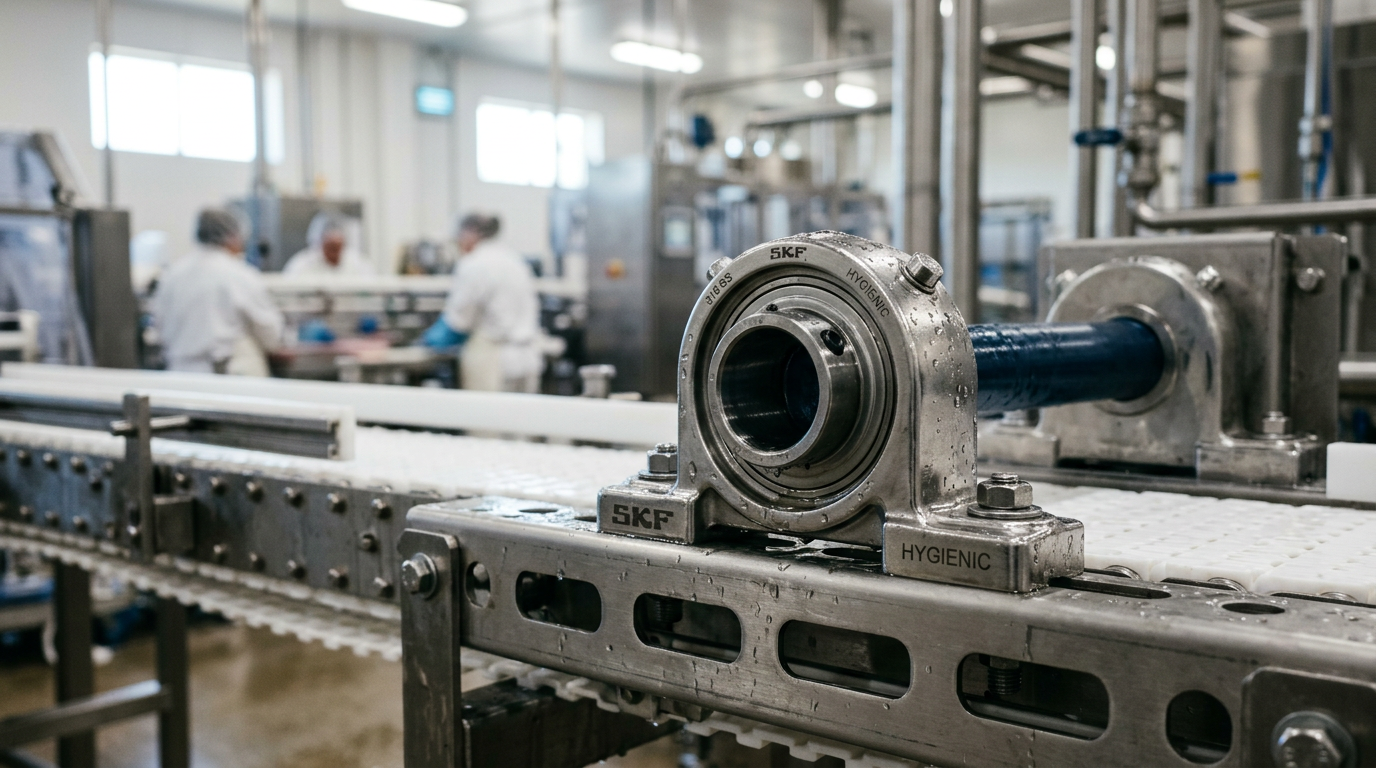
In high-hygiene environments, such as dairy, meat processing, and pharmaceutical manufacturing, conveyor bearings and shaft seals must prevent bacterial ingress and withstand high-pressure washdowns of up to 100 bar (1,450 psi). The primary engineering standard for these components is a combination of IP69K ingress protection and EHEDG-compliant housing geometry, which eliminates 90% of potential harborage points compared to standard industrial mounted bearings. Selecting the right combination of stainless steel inserts and specialized sealing systems is critical to preventing the catastrophic failure of both the component and the food safety protocol.
The Engineering Logic of Hygienic Bearings
Standard industrial bearings are often the "weakest link" in a food-grade conveyor system. While a frame might be constructed from 304 or 316-grade stainless steel, a standard bearing housing often contains "dead zones"—small crevices, exposed bolt threads, or sharp 90-degree angles where organic material can accumulate. Once trapped, this material undergoes microbial growth, which cannot be reached by standard Clean-in-Place (CIP) chemicals.
Hygienic bearings, by contrast, are designed according to EHEDG (European Hygienic Engineering & Design Group) guidelines. These guidelines mandate smooth surface finishes (typically Ra < 0.8 μm) and the use of "blue" food-grade elastomers that are easily detectable by optical inspection systems if they happen to fragment.
Material Selection: Stainless vs. Thermoplastic
The choice between stainless steel and high-performance thermoplastic housings depends largely on the mechanical load and the frequency of chemical exposure.
- Stainless Steel Housings (AISI 316): These offer the highest mechanical strength and resistance to corrosive "quat" (quaternary ammonium) sanitizers. They are preferred in heavy-load sections of the conveyor, such as the drive end where motor torque is highest.
- Thermoplastic Housings: Often reinforced with glass fiber, these are naturally corrosion-proof and typically feature a completely solid base. A solid base is superior to a hollow-back design because it eliminates the air pocket between the bearing and the conveyor frame, a notorious site for Listeria growth.
Advanced Shaft Seal Technologies
The seal is the frontline defense for the bearing's internal rolling elements. In washdown environments, the seal must perform two roles: keeping lubrication in and keeping caustic cleaning fluids out.
The IP69K Standard
The ISO 20653 standard defines IP69K as the highest level of protection against high-pressure, high-temperature water jets. For a bearing to achieve this, it typically employs a multi-stage sealing system:
- Flinger Shields: A rotating shield that uses centrifugal force to throw water away from the shaft entry point.
- Triple-Lip Seals: Three distinct contact points made of NBR (Nitrile Butadiene Rubber) or FKM (Viton) that provide redundant barriers.
- End Covers: Snap-on covers that fully enclose the protruding shaft, often featuring a drainage hole at the lowest point to prevent internal condensation.
The Role of Lubrication
Even with the best seals, the choice of grease is a safety requirement. Under FDA 21 CFR 178.3570, lubricants with incidental food contact (H1 grade) must be used. These lubricants are formulated to be tasteless, odorless, and safe for human consumption in concentrations up to 10 parts per million. Modern hygienic bearings often come "Lubricated for Life," meaning they are factory-sealed to prevent the over-greasing that frequently displaces seals and leads to premature failure.
Integration with Modular Conveyor Systems
When designing a production line, the integration of these components requires a holistic approach. For example, Easy Conveyors utilizes these hygienic principles in their modular systems, ensuring that bearing placements are accessible for inspection while maintaining the structural integrity of the stainless steel frames.
Effective integration also involves considering the shaft alignment. Misaligned shafts exert uneven pressure on the seals, creating gaps that allow water ingress. Utilizing self-aligning bearing inserts, which can accommodate 2 to 3 degrees of misalignment, is a standard practice to extend seal life in modular conveyor configurations.
Easy Conveyors stocks the conveyor components discussed here — ready to ship across Europe.
Comparison: Standard vs. Hygienic Bearing Units
| Feature | Standard Industrial Bearing | Hygienic/Washdown Bearing |
|---|---|---|
| Housing Material | Cast Iron (Painted) | 316 Stainless or Solid Polymer |
| Ingress Protection | IP65 | IP69K |
| Lubrication | Mineral-based Grease | H1 Food-Grade Synthetic |
| Geometry | Hollow back, 90° angles | Solid base, Radiused corners |
| Seal Type | Single Lip / Dust Shield | Triple Lip + Flinger + End Cover |
| Chemical Resistance | Low (Corrodes with acid/alkali) | High (Resistant to CIP chemicals) |
Common Failure Modes in Washdown Environments
Understanding why these components fail is essential for proactive maintenance.
- Chemical Embrittlement: High concentrations of chlorine-based cleaners can cause standard NBR seals to harden and crack. In these cases, upgrading to FKM (Viton) seals is necessary.
- Thermal Shock: If a bearing is running hot and is suddenly hit with cold washdown water, a vacuum effect can be created, "sucking" water past the seals. IP69K-rated units are specifically tested to resist this pressure differential.
- Over-Greasing: Applying too much pressure via a grease gun can blow out the internal seals. In hygienic zones, it is often better to use sealed-for-life units to eliminate this human error.
Selection Criteria for Engineering Teams
When specifying bearings for a new line, engineers should prioritize "total cost of ownership" (TCO) over initial purchase price. A standard cast-iron bearing might cost 70% less than a 316 stainless hygienic unit, but the cost of a single product recall due to bacterial contamination—or the downtime associated with replacing a rusted bearing every three months—far outweighs the initial savings.
For high-speed sortation or heavy-duty pallet handling within food facilities, ensure the dynamic load rating (Cr) of the hygienic bearing matches the requirements of the modular belt tensioning specs. Often, stainless steel inserts have a slightly lower load rating (approx. 20% less) than chrome steel equivalents, which must be factored into the initial conveyor design and motor sizing.
Maintenance and Inspection Protocols
Maintaining hygienic integrity requires a move toward predictive maintenance. Sensors that monitor vibration and temperature can be integrated into the bearing housing, though these must also meet IP69K standards.
- Visual Inspection: Look for "bleeding" of grease, which indicates a failed seal.
- Swab Testing: Periodically swab the underside of bearing housings to ensure the CIP process is effectively reaching all surfaces.
- Torque Check: Ensure that mounting bolts—ideally using stand-off spacers to allow cleaning behind the bearing—are torqued to ISO standards to prevent vibration-induced seal gaps.
By strictly adhering to these hygienic design principles, manufacturers can significantly reduce the risk of biological contamination while extending the operational life of their conveyor components in the harshest washdown environments.
Frequently Asked Questions
What does the IP69K rating mean for conveyor bearings?
IP69K is a rating that ensures a component can withstand high-pressure (up to 100 bar) and high-temperature (up to 80°C) water jets, which is a standard requirement for food-grade washdown environments.
Should I choose stainless steel or thermoplastic housings for hygienic bearings?
Stainless steel (316) is preferred for high-load applications and maximum chemical resistance, whereas thermoplastic housings are ideal for lightweight applications and offer a solid-base design that eliminates bacterial harborage.
What is the importance of H1 lubrication in bearings?
H1 lubricants are 'food-grade' lubricants approved for incidental contact with food products. They are mandatory in hygienic conveyors to prevent toxic contamination in the event of a seal failure.
How do I identify a failing bearing in a washdown zone?
Common signs include visible rust, grease 'bleeding' past the seals, unusual noise during operation, or excessive heat. In hygienic zones, any sign of seal leakage requires immediate replacement to prevent contamination.