ESD-Safe Conveyor Automation for Electronics Assembly
Learn how to design ESD-safe conveyor systems for electronics assembly, focusing on dissipative materials, grounding paths, and IEC 61340-5-1 compliance.
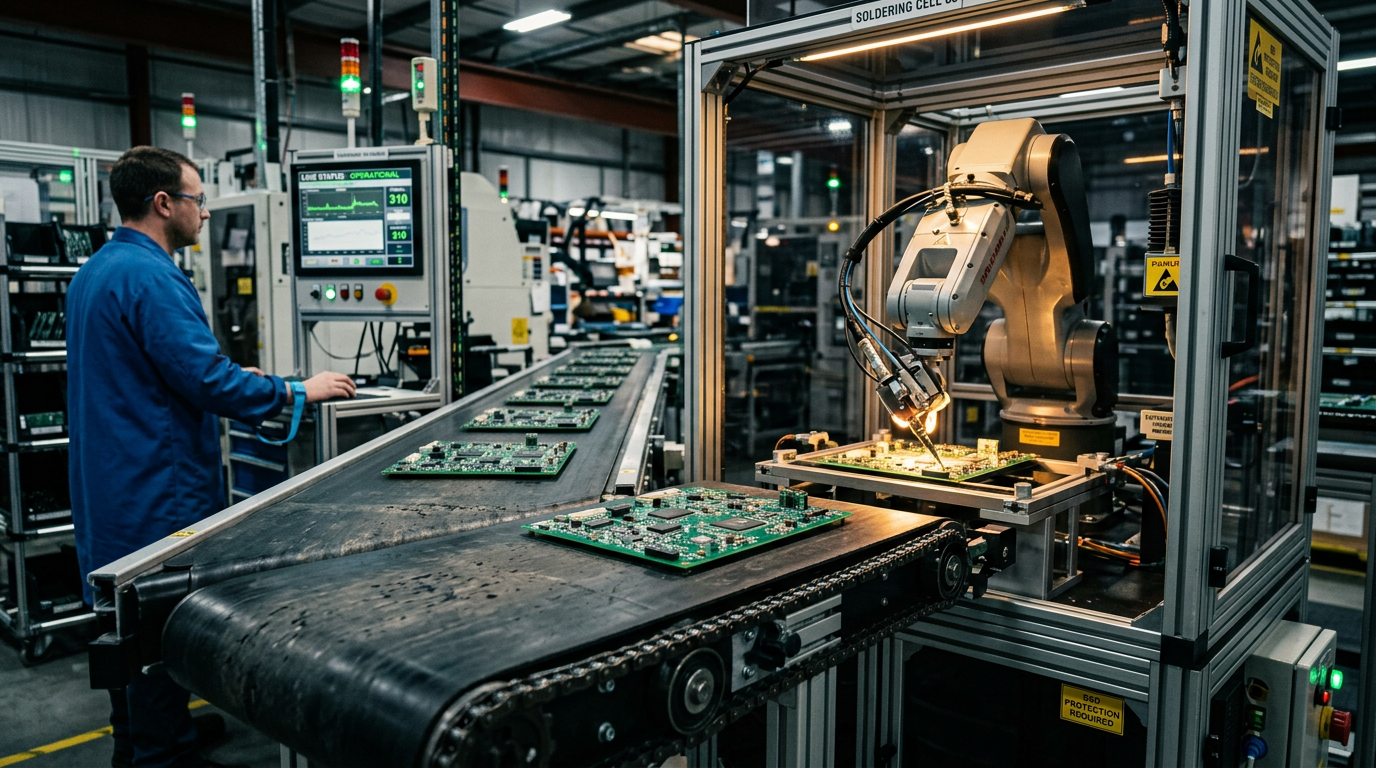
Effective ESD-safe conveyor automation for electronics assembly requires a comprehensive grounding strategy that maintains a surface resistance between $10^4$ and $10^9$ ohms per square to prevent rapid electrostatic discharge. By utilizing carbon-filled thermoplastic chains and conductive wear strips, manufacturers can dissipate accumulated charges to a common ground point, ensuring that sensitive components like microprocessors and surface-mount devices (SMDs) remain within safe voltage thresholds (typically <100V).
Key Takeaways
- ESD-safe conveyors must maintain surface resistivity between $10^4$ and $10^9$ Ω to safely bleed off static charges.
- Carbon-loaded acetal (POM) is the industry standard for modular belts in electronics assembly due to its balance of conductivity and durability.
- Proper grounding requires a continuous electrical path from the belt through the wear strips to the grounded conveyor frame.
The Physics of Electrostatic Discharge in Automation
In a high-speed electronics assembly environment, static electricity is generated primarily through tribocharging—the contact and separation of materials. As a PCB or electronic sub-assembly moves along a conveyor, the friction between the belt and the support structure, as well as the contact between the product and the belt, creates a potential difference.
Without controlled dissipation, this potential can reach several thousand volts. When a grounded operator or a robotic end-effector approaches the charged component, a rapid discharge occurs. According to the IEC 61340-5-1 standard (IEC), this discharge can cause immediate "hard failures" or, more insidiously, "latent defects" that only manifest after the product reaches the end-user.
To mitigate this, the automation system must function as part of an Electrostatic Protected Area (EPA). This involves selecting materials that are neither insulative (which trap charge) nor overly conductive (which cause a spark-inducing rapid discharge). The goal is "dissipative" performance.
Material Selection: Modular Belts and Components
The choice of material for the conveyor belt is the most critical factor in ESD safety. Standard Polyethylene (PE) or Acetal (POM) are natural insulators. For electronics applications, these polymers are impregnated with conductive additives, typically carbon black or stainless steel fibers.
| Feature | Standard POM | ESD-Safe (Carbon Filled) | Stainless Steel |
|---|---|---|---|
| Surface Resistivity | $>10^{12} \Omega$ | $10^4 - 10^9 \Omega$ | $<10^2 \Omega$ |
| Static Decay Time | Infinite | $<2.0$ Seconds | Instantaneous |
| Material Cost | Baseline | $+30-50%$ | High |
| Contamination Risk | Low | Low (non-sloughing) | Potential Metal Shavings |
| Application | General Packaging | PCBA / Semi-Conductor | Heavy Machining |
When designing these systems, Easy Conveyors provides modular solutions that integrate these dissipative materials into the frame and belt links, ensuring a path to ground is maintained even in complex routing configurations.
The Path to Ground: Beyond the Belt
A common mistake in conveyor automation is assuming an ESD belt alone provides protection. The electrical path must be continuous from the product to the Earth ground.
1. Conductive Wear Strips
The belt slides on wear strips. If these are standard UHMW-PE, the belt becomes electrically isolated. ESD-safe conveyors must use conductive wear strips (often black due to carbon loading) to bridge the gap between the belt and the aluminum or stainless steel frame.
2. Grounding Brushes and Rollers
In systems using rollers rather than modular belts, each roller should ideally be grounded through conductive bearings or specialized grounding brushes that contact the axle. For high-speed sortation, active ionization bars may be placed at transition points where tribocharging is most intense.
3. Frame Continuity
Aluminum profile systems often use T-slot connectors that may be anodized. Anodization is an insulator. To ensure the frame is grounded, technicians must use "star washers" or specialized grounding lugs that pierce the anodized layer to reach the conductive aluminum core. This ensures the entire structure meets the requirements of ANSI/ESD S20.20 (NEMA).
Easy Conveyors stocks the industrial automation discussed here — ready to ship across Europe.
Integration with Robotic Cells and SMT Lines
In modern electronics manufacturing, conveyors serve as the backbone between SMT (Surface Mount Technology) ovens, AOI (Automated Optical Inspection) stations, and robotic assembly cells.
Precision Positioning
ESD-safe conveyors in this sector often require high precision. Modular belts with "friction top" dissipative inserts can prevent PCBs from sliding during rapid acceleration or deceleration. This is vital for maintaining the "fiducial" alignment required by pick-and-place robots.
Cleanroom Compatibility
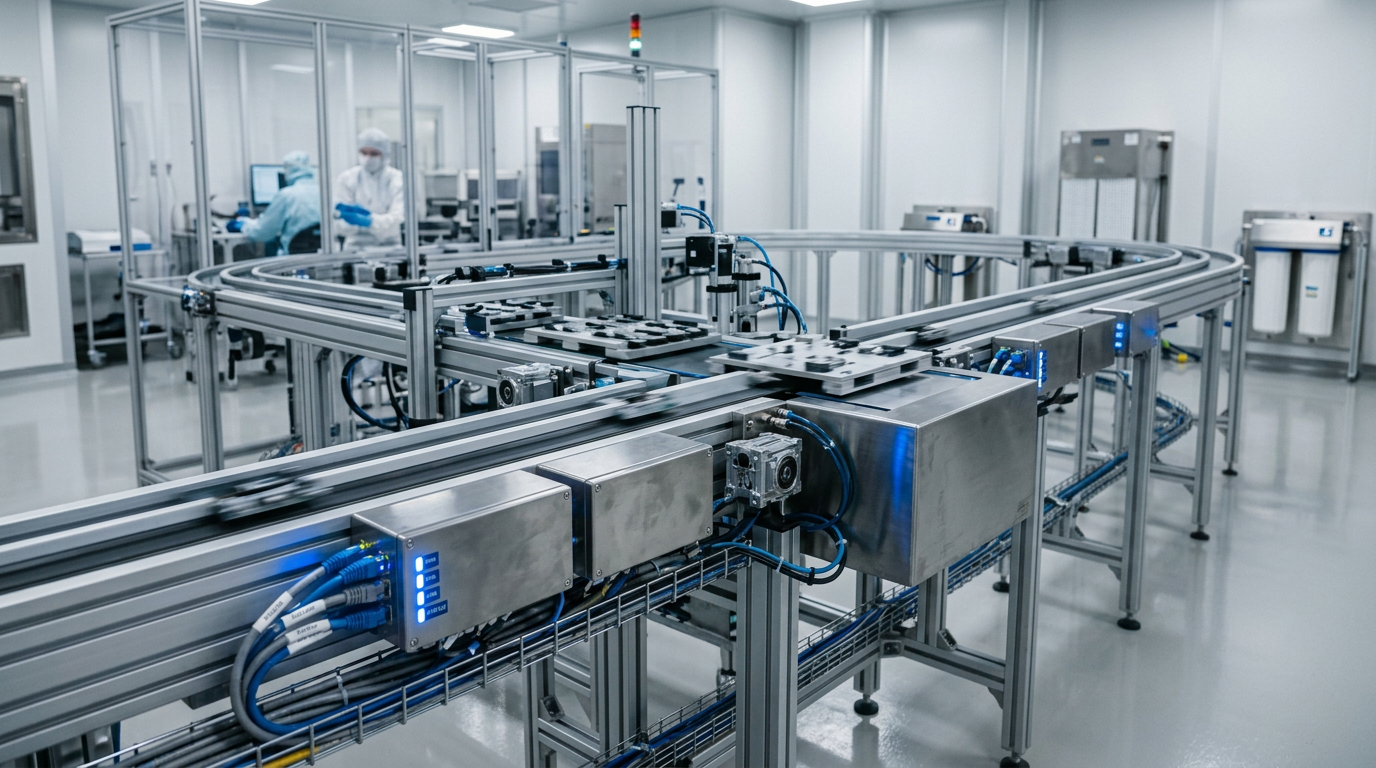
Electronics assembly often takes place in controlled environments. ESD-safe materials must also be "low-sloughing." Inferior carbon-filled plastics can shed conductive particles, which may land on a PCB and cause a short circuit. High-quality ESD polymers are tested for particulate emission to meet ISO Class 5 or Class 6 cleanroom standards (ISO 14644-1).
Maintenance and Testing Protocols
The dissipative properties of conveyor belts can degrade over time due to surface wear, accumulation of non-conductive dust, or cleaning with improper chemicals.
- Resistance Audits: Use a surface resistance meter (megohmmeter) with weighted electrodes to regularly check the belt-to-ground resistance.
- Cleaning: Use only ESD-safe cleaners. Standard detergents can leave a residue that creates an insulative layer on top of the dissipative material.
- Wear Monitoring: As carbon-filled links wear down, their surface area changes. In high-duty cycle applications, the resistance should be measured quarterly.
For engineers focusing on the broader automation ecosystem, understanding "VFD soft-start tuning" is essential to minimize the mechanical vibrations that could dislodge sensitive components, while "hygienic wash-down design" principles are often adapted in electronics for dust-free operation.
Impact of Automation Speeds on Static Generation
As conveyor speeds increase, the rate of charge generation also increases. According to research by Rexnord and other component leaders, doubling the belt speed can more than double the static voltage if the dissipation path is inefficient. Therefore, in high-throughput e-commerce or electronics fulfillment, the grounding infrastructure must be even more robust than in manual assembly stations.
Furthermore, the transition between different conveyor sections—such as moving from a modular belt to a specialized "drum motor selection" for a 90-degree turn—presents a risk of "voltage spikes" if the two systems are at different ground potentials. Equipotential bonding of all conveyor segments is a mandatory safety requirement in these environments.
By adhering to these rigorous standards and selecting components specifically engineered for dissipative performance, manufacturers can significantly reduce the Failure Analysis (FA) costs associated with ESD damage in the modern automated factory.
References
- IEC 61340-5-1: Protection of electronic devices from electrostatic phenomena
- ANSI/ESD S20.20: Standard for the Development of an ESD Control Program
- ISO 14644-1: Cleanrooms and associated controlled environments
- Rexnord: Technical Guide to Conveyor Components
- Intralox: Material Handling Standards for Electronics
Frequently Asked Questions
What is the ideal surface resistivity for an ESD-safe conveyor belt?
For electronics assembly, the surface resistivity should be in the dissipative range, typically between 10^4 and 10^9 ohms per square, to prevent rapid, damaging discharges.
How does ESD-safe POM differ from standard Acetal?
Standard POM is an insulator. ESD-safe POM is impregnated with conductive additives like carbon black, allowing it to safely bleed off static charges to the ground.
Can I use stainless steel rollers for ESD protection?
Yes, but they must be equipped with conductive bearings and the frame must be actively grounded. Simply using metal rollers is not enough if they are electrically isolated.
What is the difference between a hard failure and a latent defect caused by ESD?
A 'hard failure' is immediate damage that prevents a component from working. A 'latent defect' is partial damage where the component works initially but fails prematurely in the field.