Engineering ESD-Safe Conveyor Automation for Electronics Assembly
Discover how ESD-safe conveyor systems protect sensitive electronics using dissipative materials, grounding protocols, and IEC 61340-5-1 standards.
The Critical Role of ESD Mitigation in Modern Automation
Electrostatic Discharge (ESD) is the silent killer of semiconductor-based products. In modern electronics assembly, where components are shrinking to the sub-micron level, a discharge as low as 30V can cause latent defects—failures that pass initial QC but fail in the hands of the end-user. For high-throughput automation lines, the conveyor system acts as a massive Van de Graaff generator if not properly specified.
As friction occurs between the belt, the product carriers (pucks), and the slider bed, tribal electric charging builds up. Without a controlled path to ground, this potential energy eventually finds the path of least resistance: your PCBA. Implementing ESD-safe conveyor automation is not merely about choosing a "black" belt; it requires a holistic engineering approach to surface resistivity, grounding continuity, and humidity-independent material selection.
Material Science: Surface Resistivity and Conductivity
The primary defense against static buildup is the material composition of the conveyor components. Materials are generally categorized by their surface resistivity (measured in Ohms per square, Ω/sq):
- Conductive Materials (< 10^5 Ω/sq): These materials allow electrons to flow easily. While excellent for grounding, they can pose a short-circuit risk in live-testing environments.
- Dissipative Materials (10^5 to 10^{11} Ω/sq): This is the "Goldilocks zone" for electronics assembly. It allows static charges to flow to ground at a controlled, slow rate, preventing high-energy sparks.
- Insulative Materials (> 10^{11} Ω/sq): Standard plastics and rubbers. These should be strictly avoided in electronics handling.
For modular plastic belt conveyors, manufacturers utilize carbon-filled POM (Polyoxymethylene) or specialized antistatic high-density polyethylene (HDPE). These materials ensure that the belt remains dissipative throughout its operational life, unlike topical antistatic sprays which wear off within weeks.
Designing the Grounding Path
An ESD-safe conveyor is only effective if the charge has a continuous path to the factory’s Earth ground. This requires more than just dissipative belts.
1. Dissipative Slider Beds and Wear Strips
In a standard modular conveyor, the belt slides over UHMW-PE wear strips. In an ESD-safe configuration, these strips must also be dissipative. If the belt is dissipative but the tracks are insulative, the charge remains trapped on the belt.
2. Conductive Bearing Housings and Drive Shafts
The drive and return sprockets must maintain electrical contact with the drive shaft. Using conductive resins for sprockets and ensuring that bearings are not electrically isolated from the frame is vital. Engineers should specify VFD soft-start tuning to reduce mechanical friction during acceleration, which subtly decreases the rate of charge generation.
3. Frame-to-Ground Bonding
Standard aluminum profile frames are often coated in an anodized layer which is non-conductive. To ensure a safe assembly, "star washers" or grounding straps must bite through the anodization to create a metal-to-metal connection between all frame segments and the facility’s central ground bus.
Easy Conveyors stocks the industrial automation discussed here — ready to ship across Europe.
Comparing ESD-Safe Conveyor Technologies
Different assembly processes require different conveyor formats. Below is a comparison of common systems used in electronics manufacturing.
| Feature | Modular Plastic Belt (ESD) | Timing Belt (Antistatic) | Roller Conveyor (Conductive) |
|---|---|---|---|
| Resistivity Range | 10^4 - 10^9 Ω/sq | 10^6 - 10^10 Ω/sq | < 10^5 Ω/sq |
| Typical Application | PCBA Transport / Curing | High-Precision Indexing | Heavy Pallet / Box Handling |
| Maintenance Need | Low (Self-lubricating) | Moderate (Tensioning) | Low (Bearing checks) |
| Cleanroom Rating | Up to ISO Class 5 | Up to ISO Class 6 | Up to ISO Class 7 |
| Chemical Resistance | High (Solvents/Flux) | Moderate | High (Metal rollers) |
Integration with Robotic Workcells
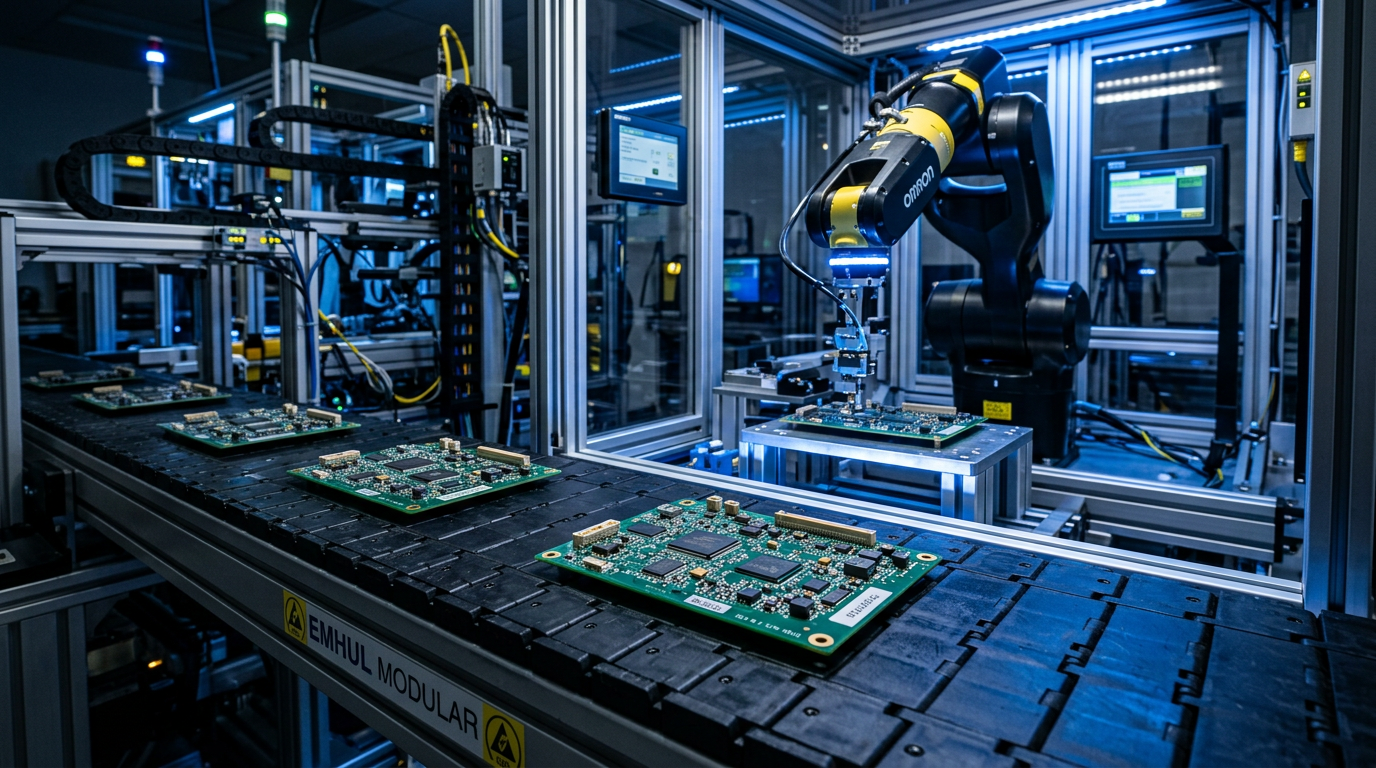
In the context of 2026 automation standards, ESD-safe conveyors are rarely standalone units. They are integrated into robotic workcells featuring SCARA or 6-axis arms for pick-and-place operations.
When a robot interacts with a conveyor, the "puck" or pallet holding the electronics must be part of the ESD circuit. For example, Easy Conveyors provides modular solutions where the pallet-to-track interface utilizes conductive brushes or specialized dissipative rollers to ensure the PCBA is grounded even while in motion.
Furthermore, integrating ionizers at high-friction points—such as where a belt transitions over a nose bar—can neutralize surface charges that dissipative materials might not bleed off fast enough during high-speed operation.
Reliability and Failure Modes in ESD Systems
Even the best-designed ESD-safe system can fail over time. Common failure modes include:
- Carbon Sloughing: In some cheap conductive plastics, the carbon black filler can rub off, contaminating sensitive electronics or optical sensors. High-quality dissipative polymers are engineered to be "non-sloughing."
- Measurement Drift: Environmental factors like low humidity (below 30% RH) can increase the surface resistivity of certain dissipative materials. It is critical to perform "belt-to-ground" resistance tests quarterly using a megohmmeter.
- Worn Grounding Brushes: If the system relies on physical brushes to ground moving parts, these are wear items that require a strict preventative maintenance schedule.
When designing these systems, looking into hygienic wash-down design can occasionally offer crossover benefits; for instance, the smooth, non-porous surfaces required for hygiene also tend to accumulate less particulate matter that could interfere with electrical continuity in an ESD environment.
Verification Standards: IEC 61340-5-1 and ANSI/ESD S20.20
In Europe and North America, adherence to IEC 61340-5-1 or ANSI/ESD S20.20 is the gold standard for electronics manufacturing. These standards define the requirements for an ESD Control Program. For an automation engineer, this means:
- The system must provide a path to ground with a resistance typically < 1.0 x 10^9 Ohms.
- Personnel working near the conveyor must also be grounded (typically via wrist straps or ESD footwear/flooring).
- Periodic verification of the "System Resistance" (the resistance from the product contact point on the conveyor to the primary building ground).
By strictly adhering to these specifications, manufacturers can increase first-pass yields and significantly reduce the risk of field failures, providing a clear ROI on the specialized materials required for ESD-safe conveyor automation. In a world of increasing miniaturization, the conveyor is no longer just a transport mechanism; it is a critical component of the product's quality assurance architecture.
Frequently Asked Questions
What is the recommended surface resistivity for electronics conveyors?
The 'Goldilocks zone' for electronics assembly is the dissipative range (10^5 to 10^11 Ω/sq), which allows static to bleed off safely without causing high-current sparks or shorts.
Is there a difference betwen 'antistatic' and 'ESD-safe' materials?
Standard 'antistatic' additives are often humidity-dependent and can wear off. ESD-safe components usually utilize 'dissipative' materials with permanent carbon-filled or inherent polymer structures that provide long-term reliability.
How do you ground an anodized aluminum conveyor frame?
Anodized aluminum is an insulator. To ground the frame, you must use grounding straps or star washers that penetrate the anodization to achieve metal-to-metal contact.
Does humidity affect conveyor ESD performance?
Yes, ultra-low humidity (below 30%) increases the risk of static buildup. ESD-safe materials must be tested under local environmental conditions to ensure they stay within the dissipative range.