Maximizing Production Efficiency with IE3 and IE4 Conveyor Drives
Discover how IE3 and IE4 efficiency class motors reduce energy consumption by up to 30% in conveyor systems while improving thermal performance and longevity.
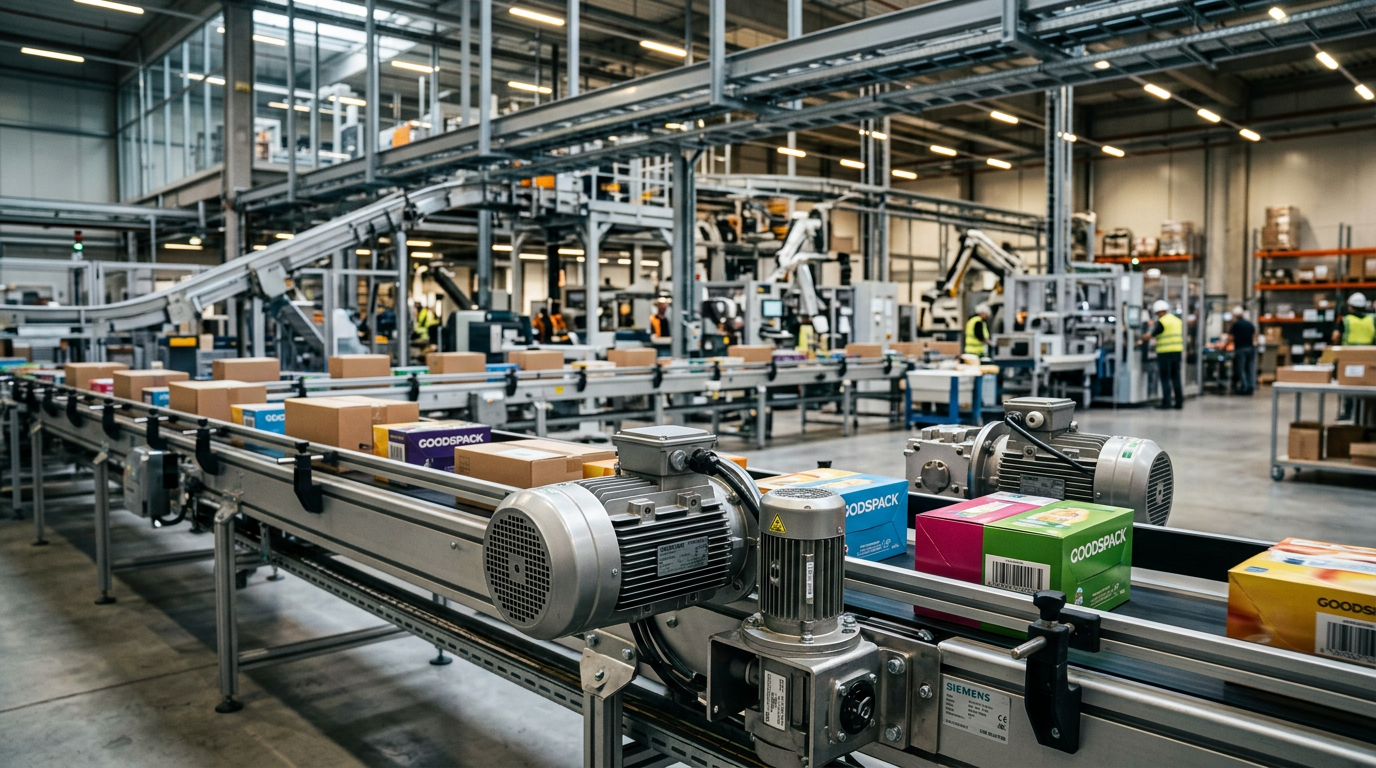
Modern conveyor systems can achieve up to 30% reduction in total energy consumption by transitioning from IE1/IE2 motors to IE3 (Premium Efficiency) and IE4 (Super Premium Efficiency) classes, as defined by the IEC 60034-30-1 standard. For high-duty cycle applications operating over 4,000 hours annually, the payback period for the price premium of an IE4 motor is typically under 18 months due to lower heat loss and optimized electromagnetic design.
The Regulatory Framework: IEC 60034-30-1 Standards
The shift toward higher efficiency in material handling is not merely a preference but a regulatory requirement in many jurisdictions. The International Electrotechnical Commission (IEC) established the IEC 60034-30-1 standard to harmonize the efficiency classes of line-up (mains-operated) three-phase cage-induction motors.
| Efficiency Class | Designation | Typical Efficiency (7.5kW Motor) | Relative Loss Reduction |
|---|---|---|---|
| IE1 | Standard Efficiency | 87.2% | Base |
| IE2 | High Efficiency | 89.4% | ~15% improvement |
| IE3 | Premium Efficiency | 90.4% | ~30% improvement |
| IE4 | Super Premium | 92.6% | ~45% improvement |
| IE5 | Ultra Premium | >94% | >55% improvement |
Since July 2023, European Union regulations (EU 2019/1781) have mandated that motors between 75 kW and 200 kW meet the IE4 level, while motors between 0.12 kW and 1000 kW must generally meet at least IE3. This logic applies directly to conveyor drives, where small-to-medium motors dominate the landscape.
Technical Advantages of IE3 and IE4 in Conveyor Design
The primary distinction in IE3/IE4 motors lies in their reduced internal losses—specifically stator resistance losses (I²R), rotor losses, and friction/windage losses. In a modular conveyor environment, these improvements translate to more than just a lower electricity bill.
1. Thermal Management and Component Longevity
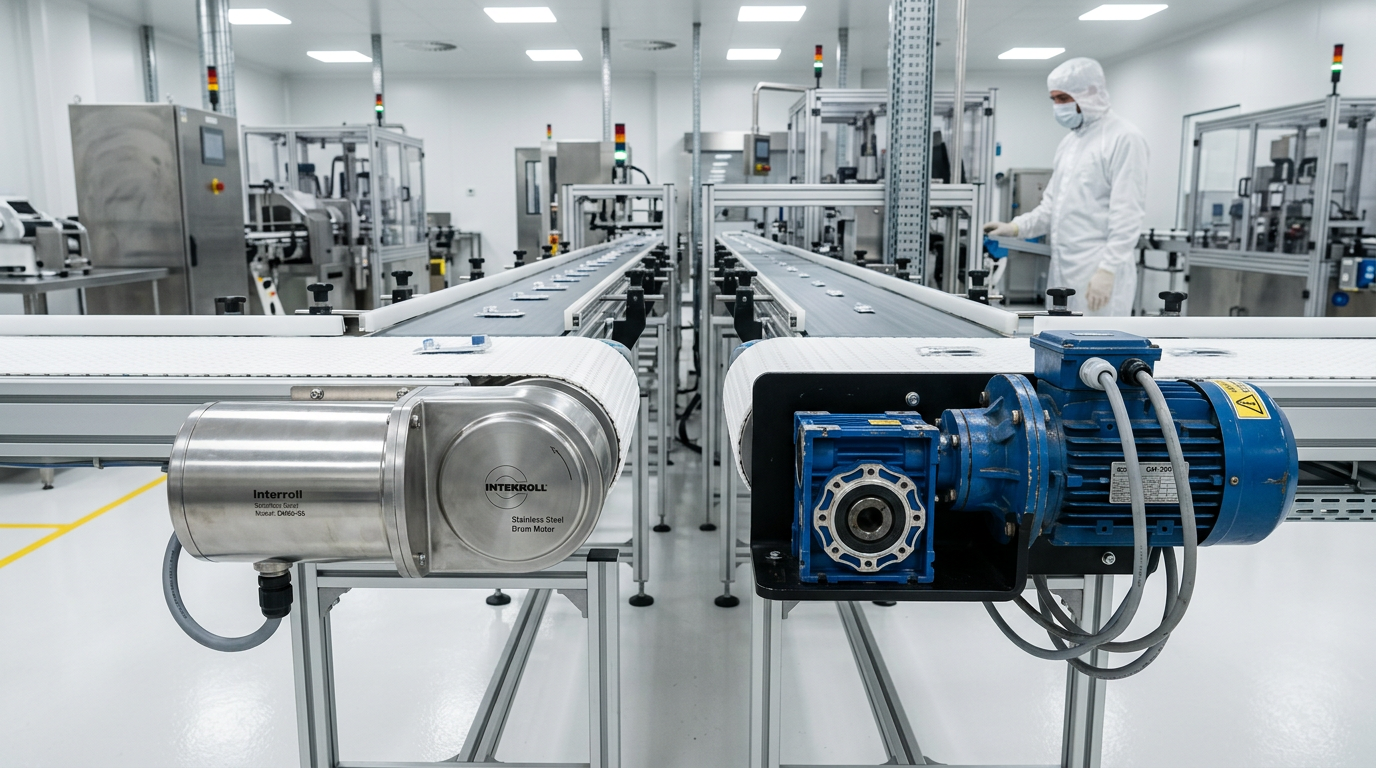
Higher efficiency means that less electrical energy is converted into waste heat. An IE4 motor runs significantly cooler than its IE2 predecessor. This lower thermal load extends the lifespan of internal windings and bearing lubricants. For engineers specifying drum motor selection, a cooler-running motor allows for safer operation in ambient-sensitive environments, such as cold storage or hygienic food processing lines.
2. High Starting Torque and Load Handling
Conveyors often start under full load. IE3 and IE4 motors are designed with high-quality magnetic steel laminations and optimized rotor geometries. This ensures that even with the increased mass of modular belts, the drive can provide sufficient break-away torque without causing the excessive heat spikes typical of less efficient motors.
3. VFD Compatibility and Part-Load Efficiency
While IE3/IE4 ratings are measured at 100% load, many conveyors operate at varying speeds or partial loads. Modern high-efficiency motors maintain a flatter efficiency curve than standard motors. When paired with a VFD soft-start tuning strategy, an IE4 motor can maintain high efficiency even when the throughput requires the system to run at 50% or 60% of its rated speed.
Comparing Technology: Induction vs. PM Motors
While IE3 is the standard for asynchronous induction motors, hitting IE4 levels often requires a transition to Permanent Magnet (PM) or Synchronous Reluctance (SynRM) technology.
- Asynchronous Induction (IE3/IE4): Robust, cost-effective, and easy to maintain. They are the workhorses of the industry.
- Permanent Magnet Motors (IE4/IE5): Use rare-earth magnets to eliminate rotor copper loss. These are more compact and provide higher torque density, making them ideal for space-constrained modular frames.
For manufacturers like Easy Conveyors, integrating these high-efficiency drives into a modular system ensures that the end-user benefits from reduced Total Cost of Ownership (TCO). Modular components allow for the easy swap of motor stages without redesigning the entire belt framework, facilitating retrofits from IE2 to IE4 as energy prices fluctuate.
Easy Conveyors stocks the conveyor components discussed here — ready to ship across Europe.
Calculation of Energy Savings and ROI
To justify the investment in an IE4 drive over an IE3, engineers should use the following formula for annual savings:
Savings = [Power (kW) x Hours x Load Factor] x [ (1/Eff_old) - (1/Eff_new) ] x Energy Cost
For a standard 1.5 kW conveyor drive running 16 hours a day (4,000 hours/year) at 75% load:
- IE2 (84.1%): Consumption ~5,350 kWh/year
- IE4 (88.5%): Consumption ~5,084 kWh/year
- Annual Savings: ~266 kWh per drive.
In a large distribution center with 200 drives, this equates to 53,200 kWh saved annually, significantly impacting the corporate carbon footprint and operational budget.
Design Considerations for IE3/IE4 Integration
When upgrading to IE3 or IE4 motors, mechanical and electrical engineers must account for several physical changes.
Higher Starting Currents (Inrush)
High-efficiency motors often exhibit higher inrush currents due to lower internal resistance. This may require an audit of the protective switchgear (fuses, circuit breakers) and contactors to prevent nuisance tripping. Utilizing VFD soft-start tuning effectively mitigates this issue by controlling the acceleration ramp.
Weight and Dimensions
Because IE3 motors require more active material (copper and high-grade steel), they can sometimes be slightly larger or heavier than IE1/IE2 motors of the same power rating. However, the industry has largely successfully compressed these designs into standard IEC frame sizes to ensure backward compatibility.
Gearbox Match and Efficiency
It is a common mistake to pair an IE4 motor with an inefficient worm gearbox. To maximize the energy-saving potential, engineers should specify helical, bevel-helical, or planetary gears, which typically offer >95% efficiency. A high-efficiency motor paired with a 70% efficient worm gear negates most of the energy gains. Transitioning to hygienic wash-down design gearmotors often involves using these more efficient gearing types by default.
Future Trends: Towards IE5 and Digital Twins
The industry is already looking toward the IE5 "Ultra-Premium" efficiency class. These drives will increasingly integrate IOT sensors to provide real-time vibration and temperature data directly to maintenance teams. This transition aligns with the shift toward predictive maintenance in automated warehouses, where a motor failure can halt the entire sortation process.
By selecting IE3 or IE4 drives today, facilities are future-proofing their operations against rising energy costs and upcoming climate regulations. The combination of modularity and high-efficiency drive technology represents the current state-of-the-art in sustainable material handling.
Frequently Asked Questions
What is the main difference between IE3 and IE4 motors?
IE3 is 'Premium Efficiency,' whereas IE4 is 'Super Premium Efficiency.' IE4 motors generally reduce energy losses by another 15% to 20% compared to IE3 models, often by utilizing higher-grade steel or permanent magnet technology.
Are IE4 motors mandatory?
In the European Union, most motors between 0.12 kW and 1000 kW must meet IE3. Motors between 75 kW and 200 kW must meet IE4 as of July 2023. Similar regulations apply in the US under NEMA standards.
Do IE3/IE4 motors fit into existing conveyor frames?
Generally, yes. Most manufacturers maintain standard IEC frame sizes for IE3 and IE4 motors to allow for direct 'drop-in' replacements during retrofits.
Do I need to change my electrical protection for IE4 motors?
Yes. High-efficiency motors often have lower internal resistance, leading to higher starting currents. It is essential to check if your circuit breakers and contactors can handle the peak inrush.
Can I use a VFD with IE4 motors?
Yes, IE3 and IE4 motors maintain a wider efficiency peak, making them excellent candidates for VFD control, provided the VFD is rated for the motor's specific technology (Induction vs. Permanent Magnet).