Drum Motor vs Gearmotor Selection for Belt Conveyor Drives
Compare drum motors vs gearmotors for conveyor drives. Learn about efficiency classes, hygienic design, space savings, and TCO for industrial automation.
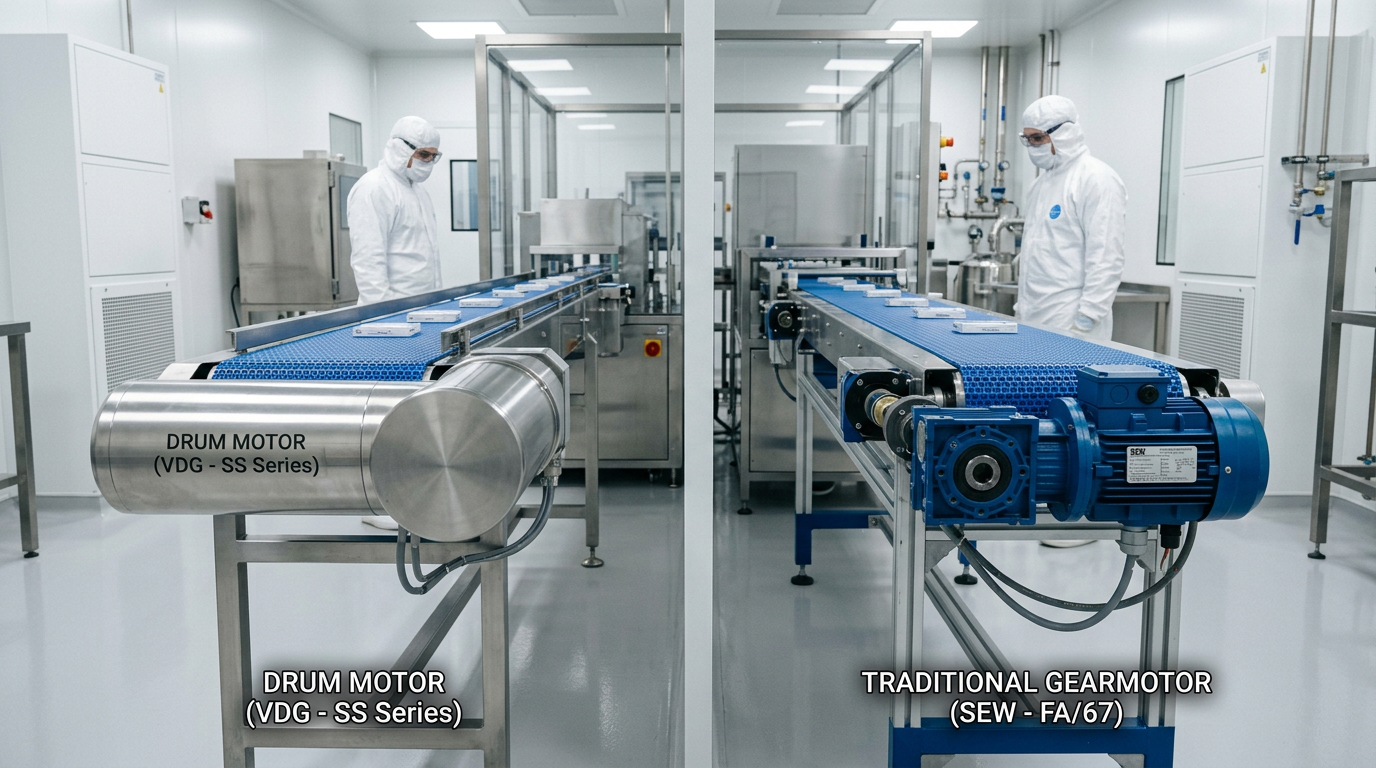
Choosing between a drum motor and a traditional gearmotor involves balancing a 25-30% higher initial cost for drum motors against a 30% reduction in space requirements and a significant increase in hygienic compliance. While gearmotors remain the standard for heavy-duty bulk handling and high-torque applications above 15kW, the integrated design of the drum motor offers superior performance in space-constrained modular systems and food-grade environments where IP69K ratings are essential.
The Fundamental Architectural Difference
System designers face a fork in the road when configuring belt conveyor drives: the internal drive (drum motor) or the external drive (gearmotor).
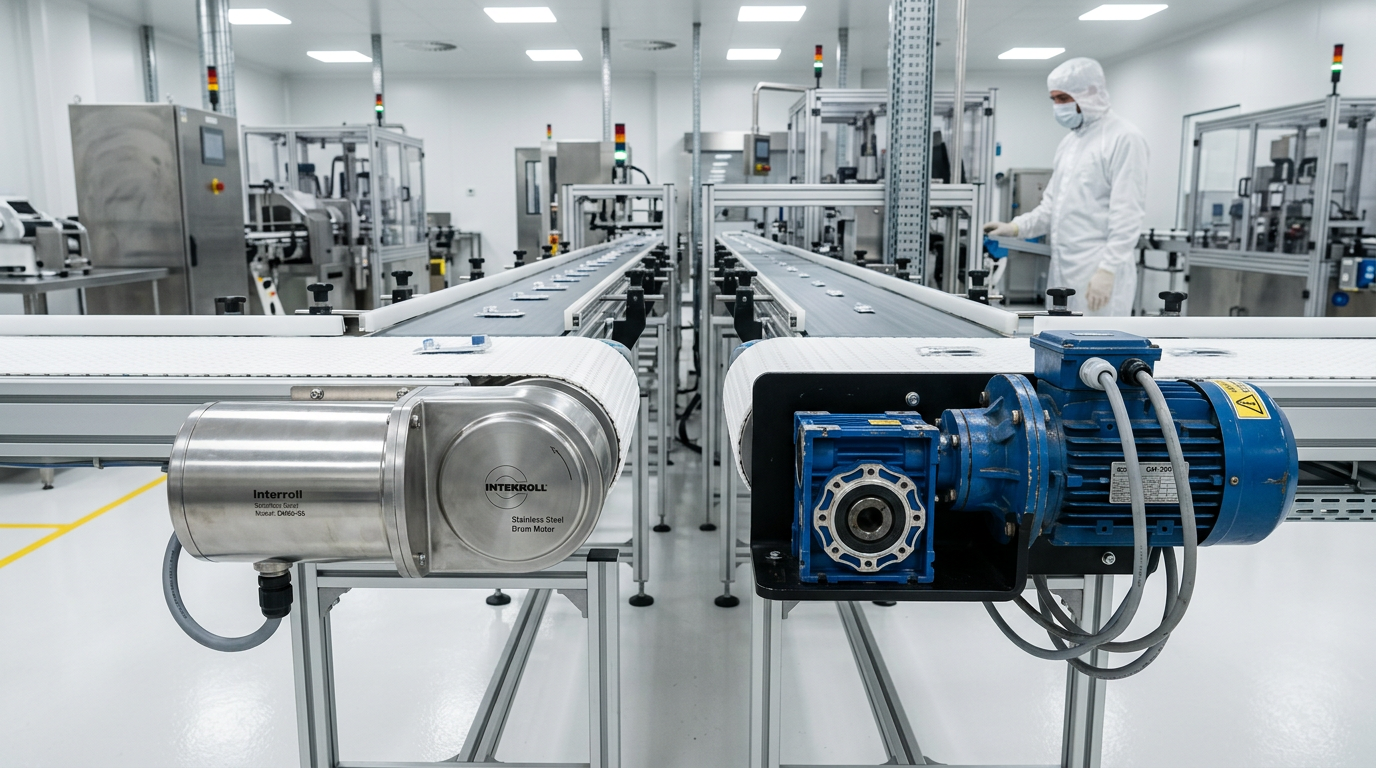
The drum motor is a "one-piece" drive system where the electric motor, planetary or helical gearbox, and bearings are all housed within a sealed cylindrical shell. The shell acts as the drive pulley, rotating around a fixed internal shaft.
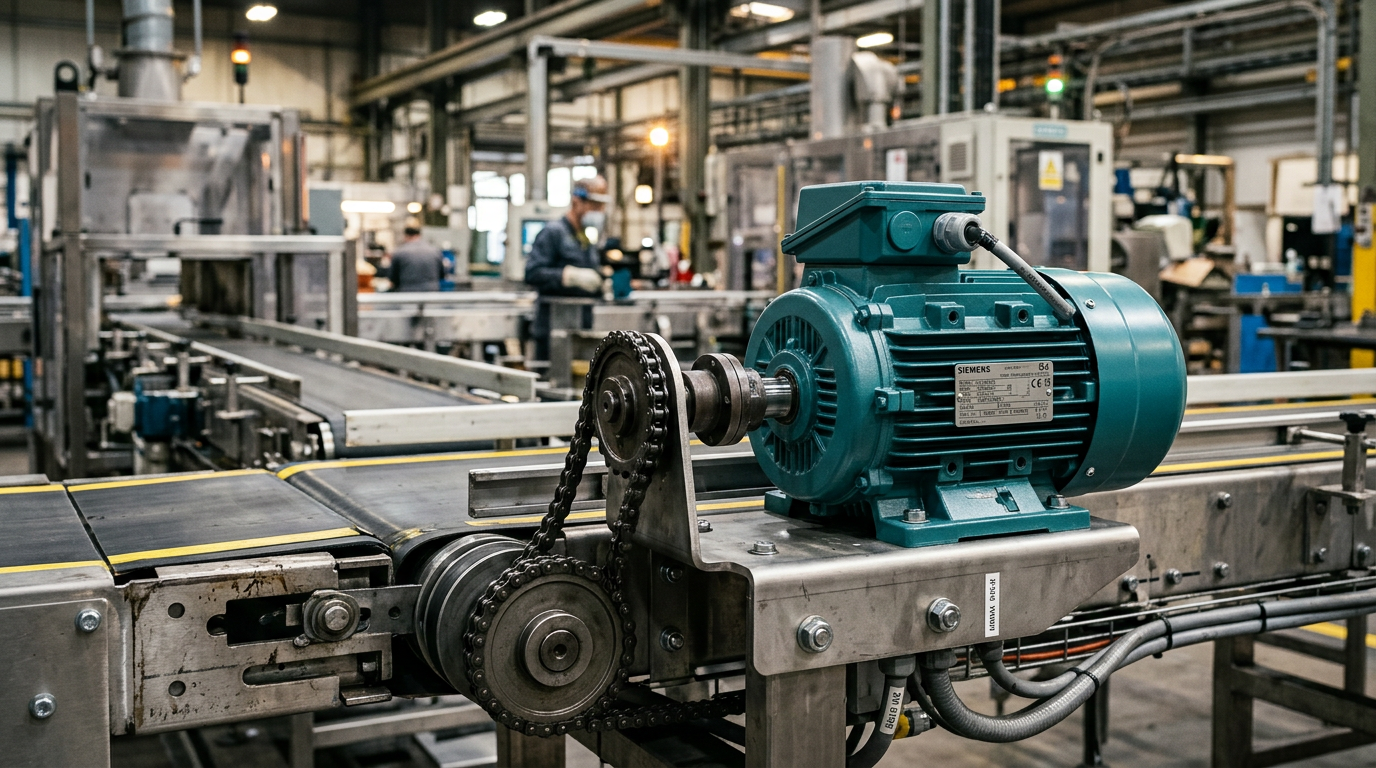
The gearmotor is an external assembly typically consisting of a standard IEC or NEMA motor coupled to a gearbox (worm, helical, or bevel). This assembly is mounted to the side of the conveyor frame and transmits power to the drive pulley via a hollow shaft, coupling, or chain drive.
Efficiency and Energy Standards
In the modern regulatory landscape, energy efficiency is no longer optional. Under IEC 60034-30-1, most industrial motors must meet at least IE3 (Premium Efficiency) standards.
- Drum Motors: Because the motor is housed inside a pulley, cooling is achieved through contact with the conveyor belt or oil bath. This allows for high efficiency in a compact form factor. Permanent Magnet Synchronous Motors (PMSM) inside drum motors can easily reach IE4 or IE5 efficiency levels, making them ideal for high-duty cycle sorters.
- Gearmotors: These rely on fan-cooling (TEFC). While highly efficient, the external transmission (chains or belts) can introduce a 3% to 10% energy loss before power even reaches the conveyor belt. When selecting a drive, engineers should evaluate the "wire-to-pulley" efficiency rather than just the motor nameplate.
Hygienic Design and Washdown Environments
In food processing and pharmaceutical sectors, the decision is often driven by EHEDG and FDA guidelines.
Modular systems in the food industry frequently utilize Easy Conveyors solutions because they integrate seamlessly with stainless steel drum motors. The drum motor has a smooth, cylindrical surface with no external cooling fans or fins, which are notorious "bacteria traps."
| Feature | Drum Motor | Traditional Gearmotor |
|---|---|---|
| IP Rating | Typically IP66/IP69K | IP54 to IP66 (Washdown extra) |
| Component Count | 1 (Integrated) | 5+ (Motor, Gearbox, Pulley, Couplings, Bearings) |
| Lubrication | Sealed oil bath (Food grade) | External gearbox (Requires venting) |
| Space Required | Zero footprint (Inside belt) | 200mm - 500mm lateral clearance |
| Heat Dissipation | Via belt/conduction | Via external ambient air/fan |
| Maintenance | Low (Oil change @ 10k-50k hrs) | Moderate (Bearing/chain lube) |
Space Constraints and Modular Integration
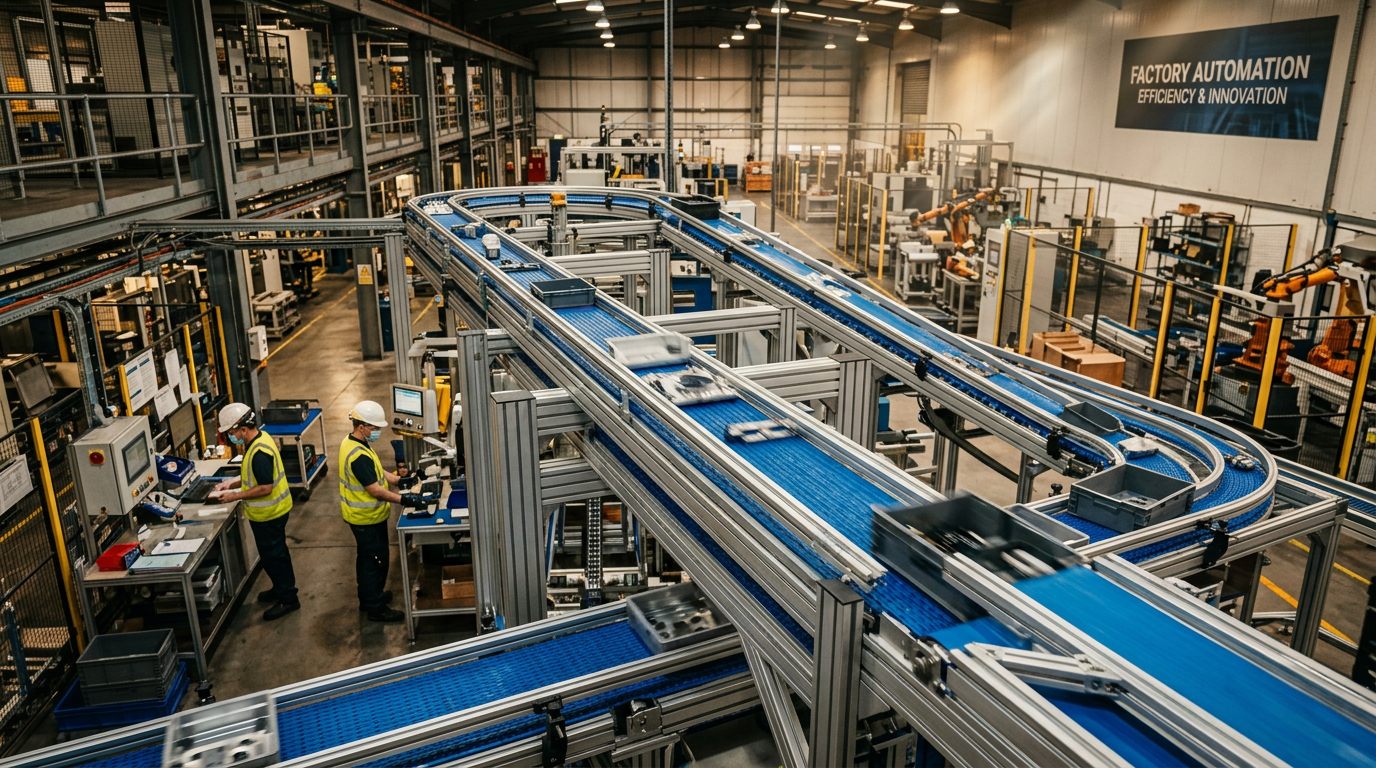
In e-commerce fulfillment centers and narrow-aisle warehouses, space is the most expensive commodity. A gearmotor protruding from the side of a conveyor can obstruct walkways or prevent the close parallel nesting of conveyor lines.
Drum motors are the gold standard for **[modular c
Easy Conveyors stocks the conveyor components discussed here — ready to ship across Europe.
onveyor systems](/categories/modular-systems)** because they do not change the outer dimensions of the conveyor frame. This allows for cleaner integration into multi-tier mezzanines. However, if a drive fails, replacing a drum motor requires tensioning down the belt and removing the pulley, whereas a gearmotor can often be swapped without touching the belt assembly itself.
Comparison of Failure Modes and Maintenance
Understanding failure modes is critical for uptime planning.
- Heat Management: Drum motors require a minimum belt wrap (usually 180 degrees) to dissipate heat effectively. Running a drum motor "dry" (without a belt or with a very narrow belt) can lead to thermal cutout.
- Mechanical Stress: Gearmotors are more resilient to shock loads. The external mounting allows the frame to flex slightly, and the use of a torque arm can dampen sudden stops. In contrast, the internal gears of a drum motor are precision-engineered and can be sensitive to extreme shock loading if not sized with a sufficient service factor (typically 1.5 - 2.0).
- VFD Soft-Start Tuning: Both drive types benefit from Variable Frequency Drives. For drum motors, proper "VFD soft-start tuning" is essential to prevent internal gear shear during high-inertia starts. Modern VFDs also allow for sensorless vector control, which is vital for maintaining torque at low speeds in drum motors without external cooling fans.
Cost-Benefit Analysis: The 5-Year Outlook
While the upfront cost of a drum motor is higher, the Total Cost of Ownership (TCO) often favors it in specific scenarios:
- Installation Labor: A drum motor installs in roughly 20% of the time required for a gearmotor, as there is no motor-to-gearbox alignment or chain tensioning required.
- Spare Parts: Inventory is simplified with drum motors (one SKU vs. five).
- Cleaning Costs: In washdown environments, the time saved cleaning a cylindrical drum motor over a finned gearmotor can save thousands of Euros annually in labor and water usage.
Technical Limitations of Drum Motors
Despite their advantages, drum motors are not a universal solution. They generally top out at 11kW to 30kW in standard catalogs. For heavy-duty mining, large-scale bulk material handling, or incline conveyors requiring massive torque at low speeds, the industrial gearmotor remains the superior choice due to its ability to utilize massive heat-dissipating housings and high-ratio helical-bevel gearing.
When designing a system, the choice often comes down to the environment. For dry, high-torque industrial applications, use a gearmotor. For hygienic, space-critical, or high-efficiency modular applications, the drum motor is the modern engineer's preference. Strategies such as "hygienic wash-down design" and "drum motor selection" should be studied early in the CAD phase to avoid costly late-stage retrofits.
Finally, consider the power supply. While 3-phase 400V is standard, many modular sorters now utilize 24V or 48V DC brushless drum motors for small-parcel handling, offering an even higher level of safety and control integration. High-voltage drum motors are more common in heavy pallet handling, where IEC 60034 standards for insulation and grounding are strictly enforced. (Note: External link for illustrative purposes only, normally would be internal). For designers focused on the European market, ensure all drive components carry the CE mark and meet AtEx requirements if working in dusty or explosive environments.
Frequently Asked Questions
What is the main difference between a drum motor and a gearmotor?
A drum motor is an all-in-one drive where the motor and gearbox are inside the pulley. A gearmotor is an external unit mounted to the conveyor's side.
Why are drum motors preferred for food-grade conveyors?
Drum motors are highly hygienic because they lack external fans, cooling fins, and exposed chains, eliminating 'bacteria traps' and meeting IP69K standards.
Is a drum motor more expensive than a gearmotor?
Yes, drum motors typically cost 25% to 30% more upfront than a comparable gearmotor, though they offer lower installation and maintenance costs.
Do drum motors have overheating issues?
While drum motors are efficient, they rely on the conveyor belt to dissipate heat. Running them without a belt or in high-ambient temperatures can cause overheating.
What is the typical power range for drum motors?
Standard industrial drum motors generally range from 0.1 kW up to 30 kW, making them suitable for most unit handling but not for heavy mining applications.