Drum Motor vs Gearmotor: Selecting the Right Conveyor Drive System
Compare drum motors vs gearmotors for conveyor drives. Learn about efficiency gains, IP69K hygiene standards, and maintenance trade-offs for industrial automation.
The selection between a drum motor and a conventional gearmotor represents a fundamental architectural decision in conveyor design, where drum motors typically offer a 25% to 30% reduction in spatial footprint and a 10% to 15% improvement in mechanical efficiency due to the elimination of external transmission components like chains or couplings. While gearmotors remain the standard for heavy-duty bulk handling exceeding 200 kW, drum motors have become the primary choice for food processing, pharmaceuticals, and high-density warehouse automation where hygiene and space optimization are critical.
The Mechanical Architecture: Internal vs. External Drives
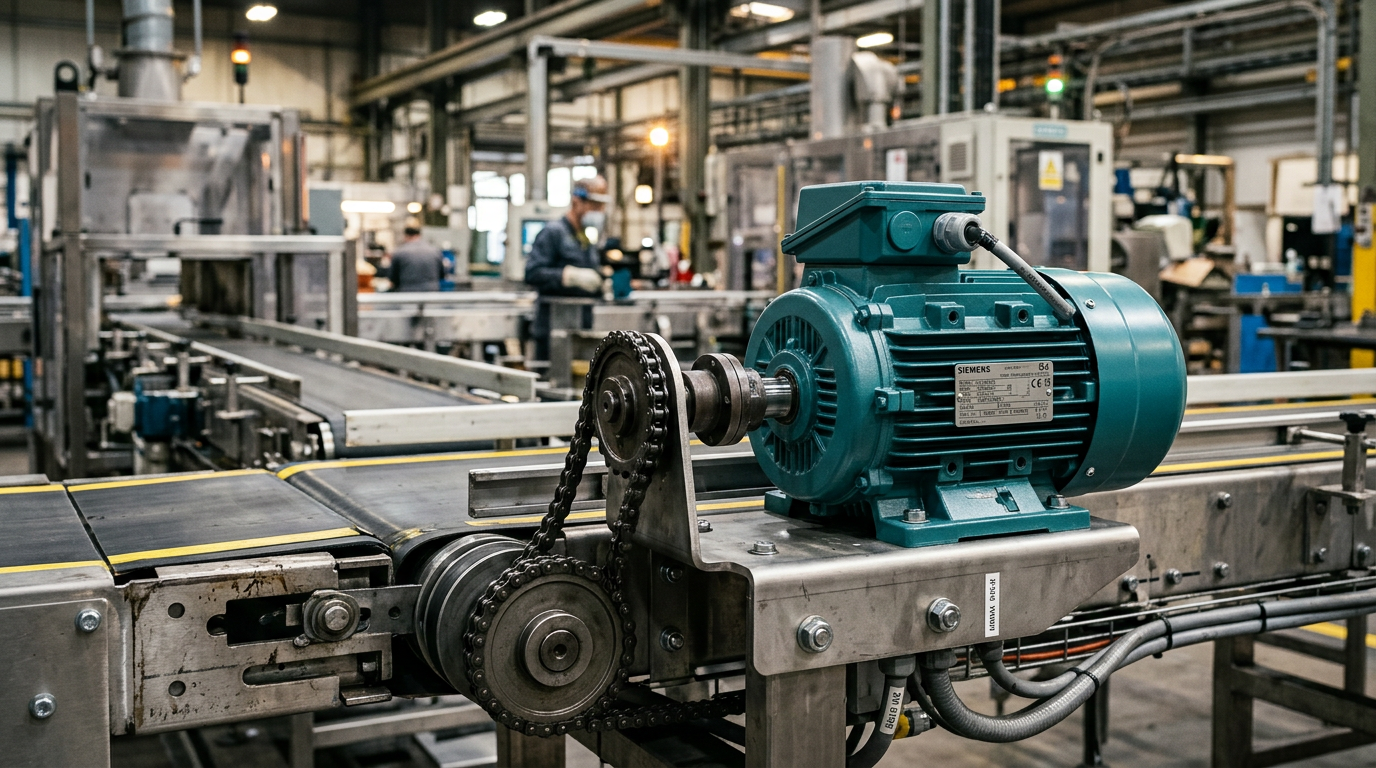
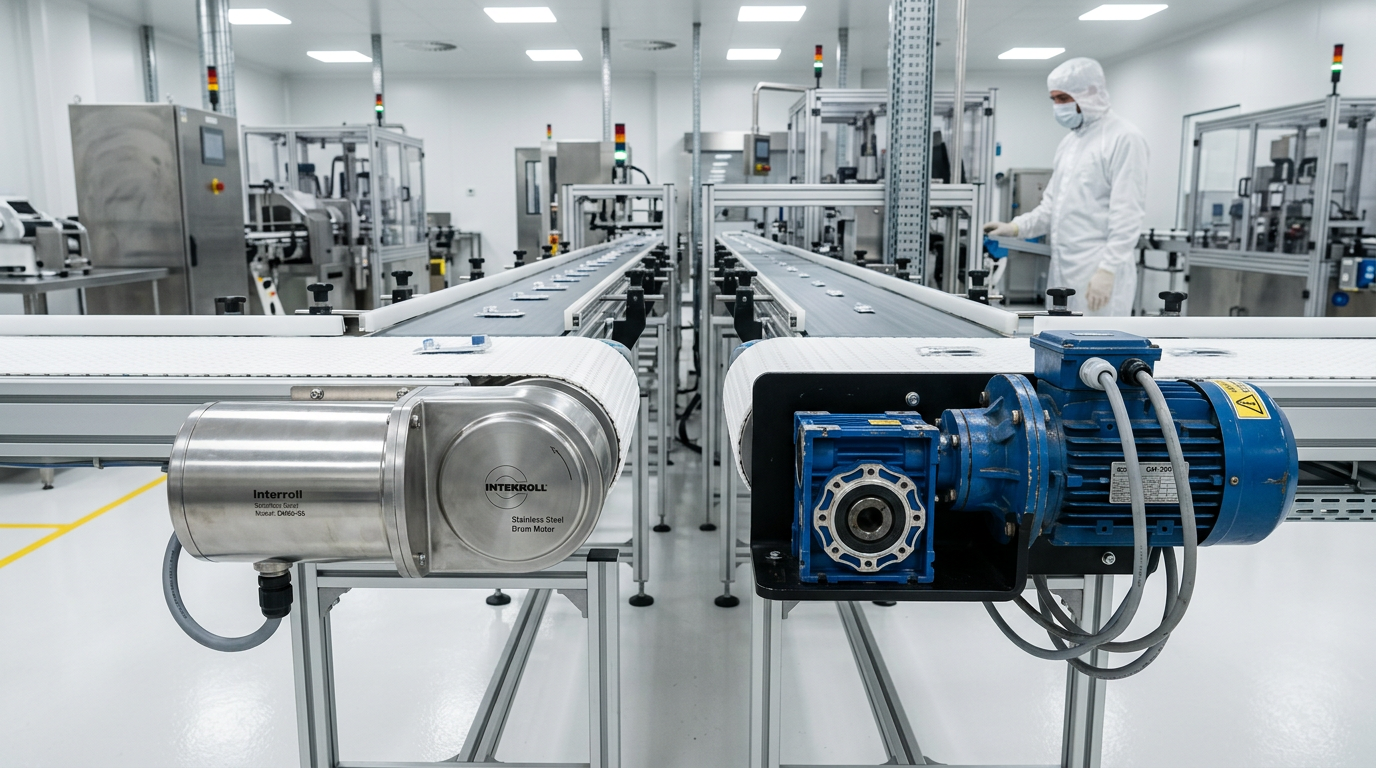
To understand the selection criteria, one must first look at the mechanical integration of the two systems. A drum motor (also known as a motorized pulley) integrates the electric motor, planetary or helical gearbox, and all bearings within a sealed cylindrical housing that acts as the conveyor's head pulley. In contrast, a gearmotor consists of a motor and gearbox mounted externally to the conveyor frame, transmitting torque to the drive pulley via a shaft, coupling, or chain drive.
This distinction leads to significant differences in mechanical efficiency. According to standards like IEC 60034-30-1, modern IE3 and IE4 permanent magnet motors used in high-end drum motors minimize energy loss. Because the drum motor transmits power directly to the belt, it avoids the 2% to 5% friction losses typically associated with external chain drives or misaligned couplings.
Comparing Performance and Reliability
When evaluating these drive systems, engineers must weigh the "fit-and-forget" nature of drum motors against the "ease of access" offered by gearmotors.
Drum Motors: The Space-Saving Specialist
Drum motors are the preferred choice for modular conveyor systems where space is at a premium. Because the drive is contained within the pulley, there are no protruding motors that interfere with operator walkways or adjacent machine cells.
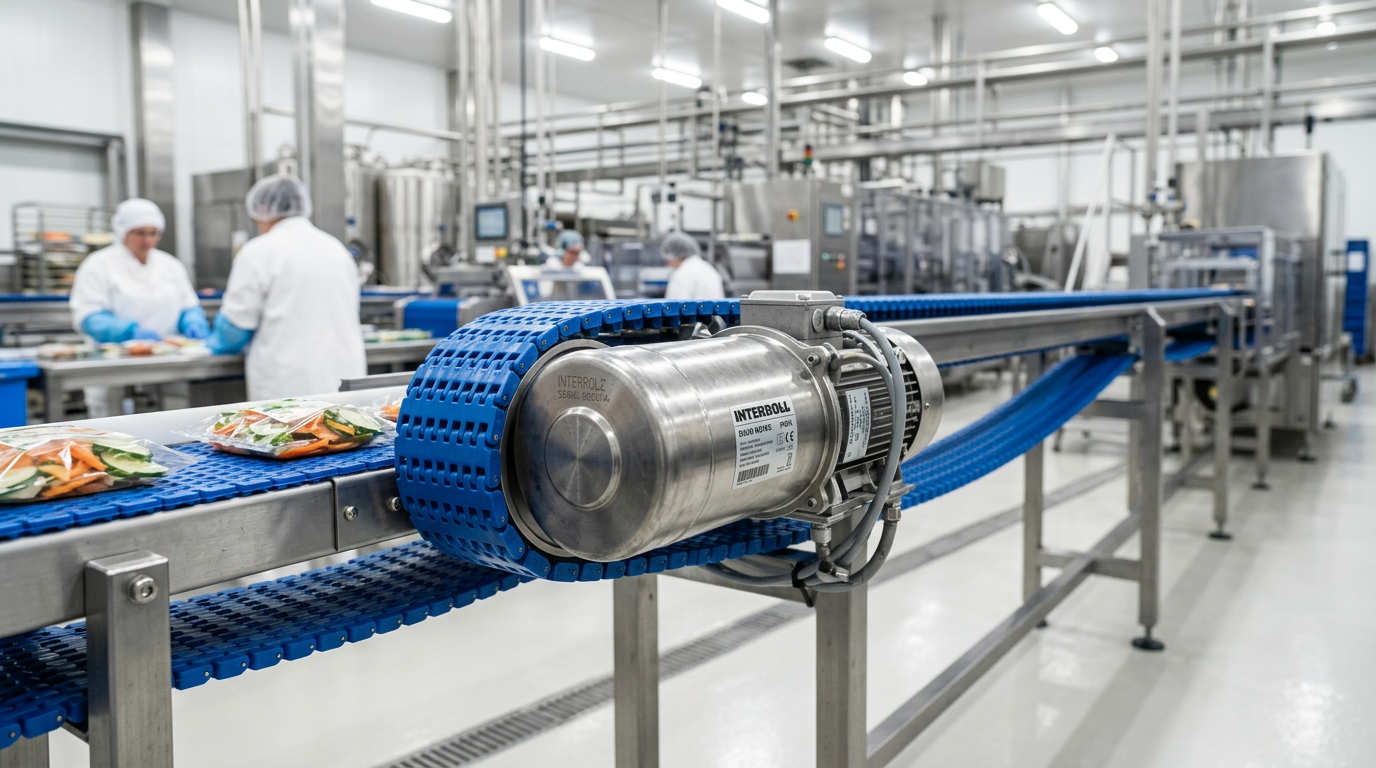
- Hygiene: In food-grade environments, drum motors are superior. With an IP69K rating and a design that eliminates external flat surfaces and oil-collecting crevices, they meet strict EHEDG guidelines for wash-down compatibility.
- Maintenance: They are hermetically sealed, meaning the internal oil bath lubricates the gears for life (often up to 50,000 operating hours). However, if an internal failure occurs, the entire belt must be de-tensioned to remove the drive.
Gearmotors: The Versatile Workhorse
Gearmotors, such as those produced by SEW-Eurodrive, offer unparalleled modularity. If a motor fails, it can be replaced without disturbing the conveyor belt or the gearbox.
- Thermal Management: Because the motor is exposed to ambient air, gearmotors dissipate heat more effectively than drum motors, which rely on the conveyor belt to act as a heat sink. This makes gearmotors better suited for high-cycle start/stop applications or environments with high ambient temperatures.
- Torque Range: For heavy-duty applications—such as moving loaded pallets or mining aggregates—external gearmotors can reach torque levels that would require an impractically large drum diameter.
Technical Comparison Table
| Feature | Drum Motor (Motorized Pulley) | External Gearmotor |
|---|---|---|
| Efficiency Class | Up to IE4 (Permanent Magnet) | IE |
Easy Conveyors stocks the conveyor components discussed here — ready to ship across Europe.
3 / IE4 | | Space Requirement | Zero external footprint | Significant side/top clearance | | Ingress Protection | Typically IP66 / IP69K | IP55 / IP65 (Standard) | | Heat Dissipation | Via conveyor belt | Ambient air (Convection) | | Transmission Loss | 0% (Direct Drive) | 2% - 7% (Chains/Couplings) | | Maintenance Access | Requires belt removal | External access only |
Critical Selection Factors
1. Environmental Conditions and Hygiene
For primary food packaging or raw meat handling, the choice is almost always a drum motor. The absence of external fans (which can circulate airborne contaminants) and the ability to withstand high-pressure chemical cleaning make it the standard for FDA-compliant lines. When designing these systems, partnering with a specialist like Easy Conveyors ensures that the integration between the drum motor and the modular belt profile is optimized for tracking and tension.
2. Thermal Duty Cycles
Drum motors require the belt to be in contact with the shell to dissipate heat. If a conveyor runs at very low speeds (< 0.05 m/s) or involves frequent "holding" under torque without movement, the motor can overheat. In these cases, an external gearmotor or a drum motor with an internal cooling fan (which increases size) is necessary.
3. Maintenance Philosophy
In a 24/7 e-commerce distribution center, downtime is measured in thousands of euros per minute. While drum motors fail less frequently due to their sealed environment, a gearmotor can be swapped in 15 minutes by a technician with basic tools. A drum motor replacement typically requires 1-2 hours and a team to slacken the belt. This trade-off between Mean Time Between Failures (MTBF) and Mean Time To Repair (MTTR) is central to the procurement decision.
Integration with Modern Controls
Both drive types benefit from modern automation components. Implementing VFD soft-start tuning is essential for drum motors to prevent shock loading on the internal planetary gears. Furthermore, when selecting for high-precision sortation, permanent magnet drum motors offer the low-inertia response required for rapid indexing, often outperforming bulky external gearmotors in dynamic response.
For engineers focused on drum motor selection, it is vital to calculate the "Belt Pull" requirement accurately. As noted by Interroll, the required torque is a function of the drum radius, the friction coefficient of the slider bed, and the total load. Over-sizing a drum motor leads to unnecessary heat, while under-sizing leads to premature planetary gear wear.
Summary of Selection Logic
Choose a drum motor if:
- The application is in food, pharma, or cleanroom environments (IP69K).
- Space is severely limited (e.g., cross-belt sorters).
- Energy efficiency and reduced noise (under 60 dB) are KPIs.
Choose a gearmotor if:
- The application involves heavy-duty bulk handling (> 500 kg/m).
- The environment is extremely hot, or the belt runs at ultra-low speeds.
- The facility maintenance team prefers external access for rapid component swaps.
In the evolving landscape of "Industry 4.0," the trend is shifting toward integrated drum motors with IO-Link capabilities, allowing for real-time temperature and vibration monitoring. This predictive maintenance data bridges the gap, providing the reliability of a sealed system with the data transparency required for modern manufacturing operations.
Frequently Asked Questions
Which drive is more energy-efficient: drum motor or gearmotor?
Drum motors are generally 10-15% more efficient because they eliminate external transmission losses from chains, sprockets, and misaligned couplings. High-end models use permanent magnet motors reaching IE4 efficiency.
What is the biggest disadvantage of using a drum motor?
The primary drawback is 'serviceability depth.' Because the motor is inside the pulley, a total motor failure requires de-tensioning or removing the conveyor belt, which takes longer than swapping an external gearmotor.
Are drum motors better for food-grade applications?
Yes, drum motors are the gold standard for food safety. Their cylindrical, stainless steel design lacks external cooling fans and crevices, making them compliant with EHEDG and FDA wash-down requirements.
Can drum motors overheat at low speeds?
Drum motors rely on the belt to dissipate heat. At very low speeds (below 0.05 m/s), there is insufficient movement to carry heat away, potentially leading to thermal cutout unless the motor is specifically de-rated.