Drum Motor vs Gearmotor: Selection Guide for Conveyor Drives
Compare drum motors vs gearmotors for conveyor drives. Learn about efficiency, maintenance, hygiene (IP69K), and space savings for industrial automation.
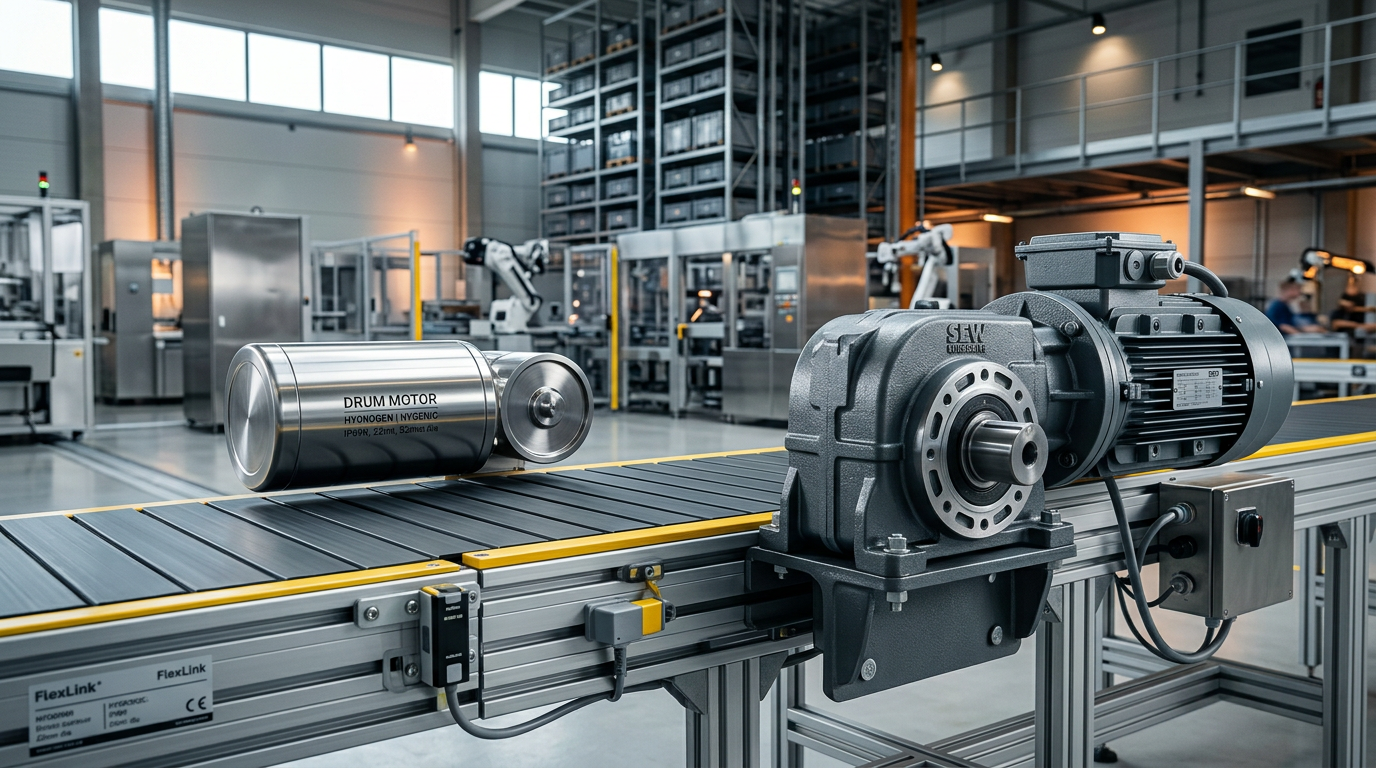
The choice between a drum motor and a traditional gearmotor for belt conveyor drives typically hinges on a 25-30% difference in space requirements and a significant gap in maintenance cycles, with drum motors offering a hermetically sealed, "fit-and-forget" solution. Selecting the right drive requires balancing the high initial capital expenditure of motorized pulleys against the lower purchase cost but higher complexity and footprint of external gearmotors.
The Standard vs. The Integrated: A Technical Overview
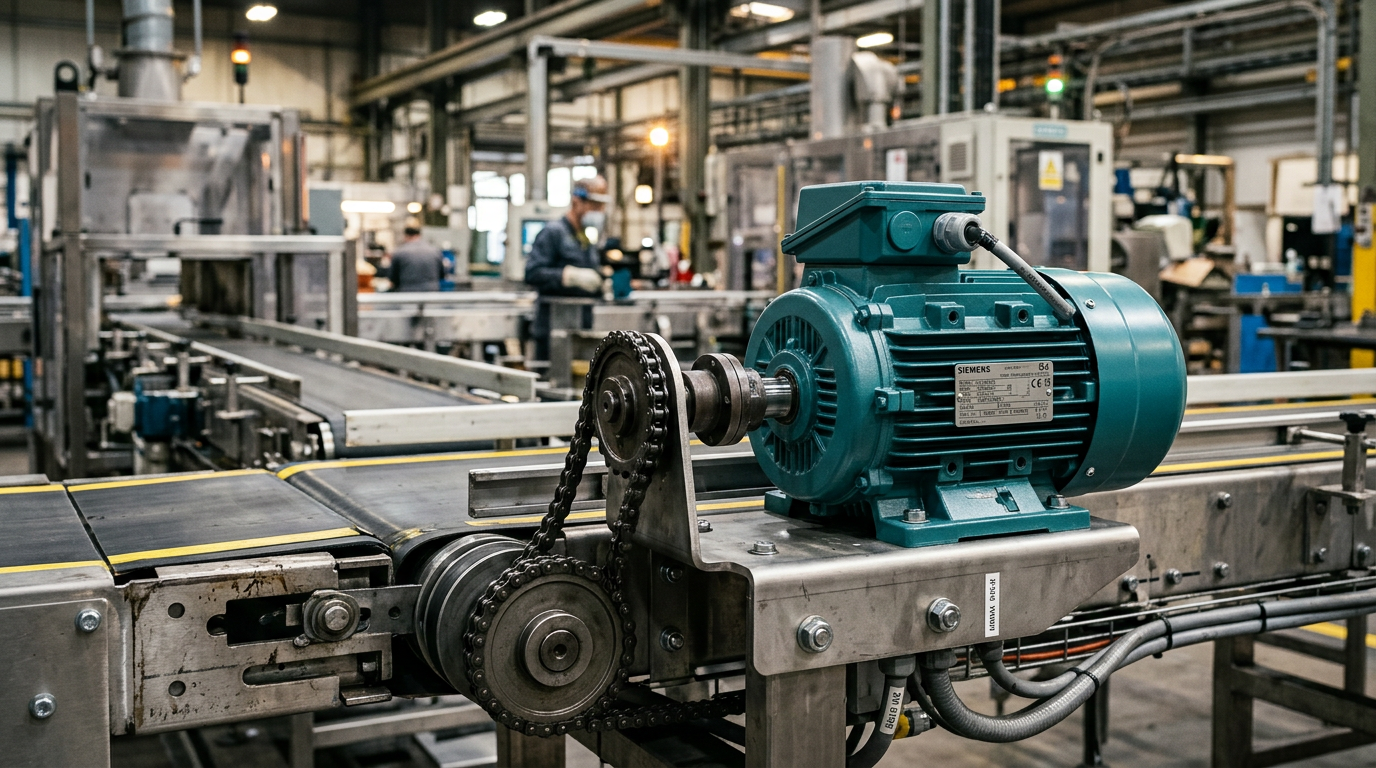
In the world of material handling, the drive unit is the heart of the system. Historically, the external gearmotor—consisting of a separate motor, gearbox, and often a drive chain or belt—was the industry standard. However, the emergence of the drum motor (or motorized pulley) has shifted the design paradigm by integrating the motor, gearbox, and bearings directly inside the conveyor roller.
When evaluating drum motor vs gearmotor selection, engineers must look beyond the initial price tag. The decision influences everything from the conveyor's mechanical footprint to its IP rating (Ingress Protection) and its compliance with food safety standards like EHEDG or FDA.
Comparative Performance Metrics
To make an informed decision, it is essential to compare these two technologies across standardized industrial metrics.
| Feature | Drum Motor (Motorized Pulley) | External Gearmotor |
|---|---|---|
| Efficiency | 95-97% (Mechanical) | 85-92% (Includes transmission loss) |
| IP Rating | Standard IP66/IP67/IP69K | Standard IP54/IP55 (Higher is extra) |
| Footprint | Zero external footprint | Requires 200-400mm lateral clearance |
| Maintenance | Sealed oil bath (50k hours) | Requires chain tensioning/greasing |
| Cooling | Product/Belt contact (Heat sink) | Ambient air (Fan cooled) |
| Cost | 1.4x - 2.0x higher initial CAPEX | Lower upfront CAPEX |
When to Select a Drum Motor
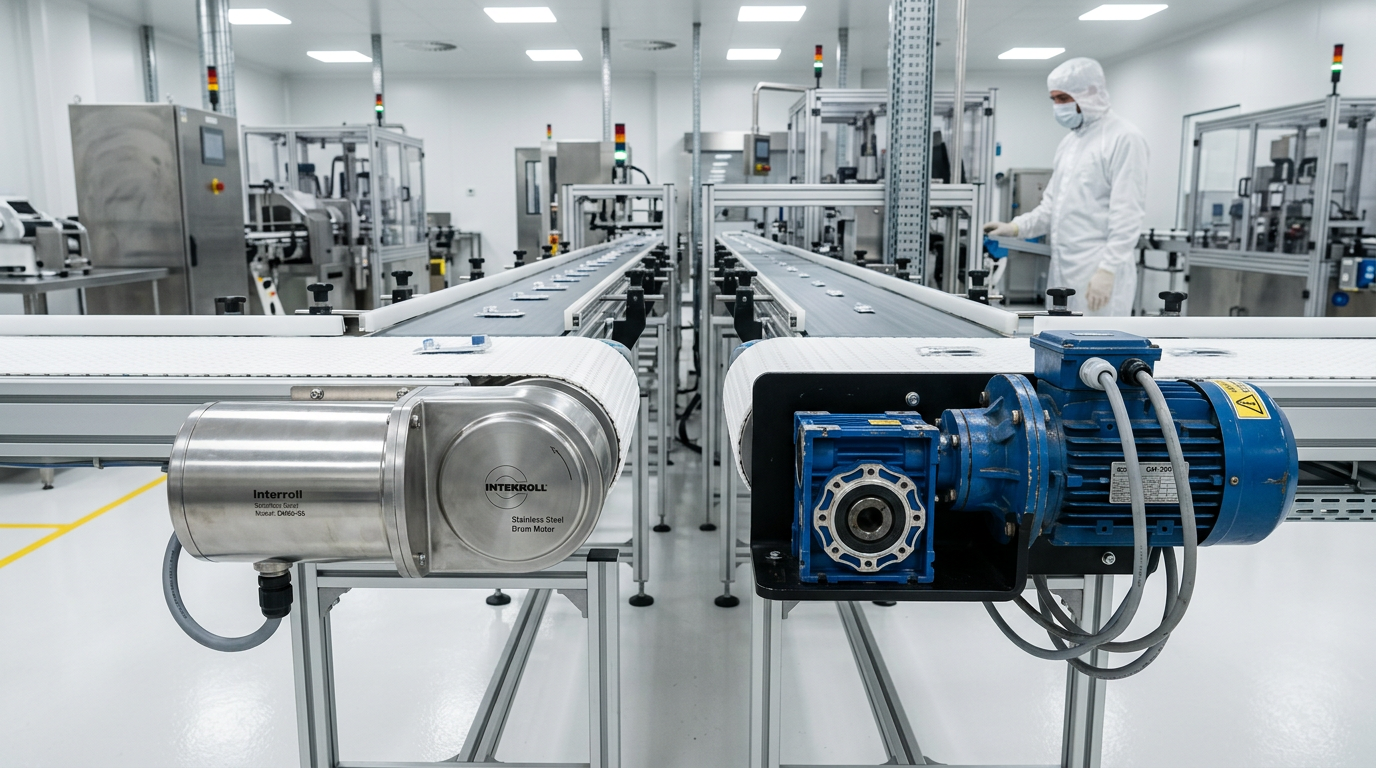
Drum motors are the preferred choice for applications where hygiene, space, and safety are paramount. Because the drive is internal, there are no rotating external parts, effectively eliminating the need for safety guards around drive chains or sprockets.
- Hygienic Environments: In food processing and pharmaceutical sectors, the absence of external grease points and cooling fans (which can circulate airborne contaminants) makes drum motors ideal. Stainless steel variants are common in hygienic wash-down design.
- Space-Constrained Facilities: In e-commerce sortation or airport baggage handling, every centimeter of floor space is valuable. A drum motor allows conveyors to be placed side-by-side with almost zero gap.
- High-Efficiency Operations: Modern drum motors often utilize IE3 or even IE4 permanent magnet synchronous motors (PMSM). Because there is no external drive train, the mechanical efficiency is significantly higher than a gearmotor coupled with a chain and sprocket.
For engineers looking to integrate these high-efficiency drives into a larger logistics framework, working with an experienced European specialist like Easy Conveyors can ensure the
Easy Conveyors stocks the conveyor components discussed here — ready to ship across Europe.
drive is correctly sized for the specific modular belt or roller system being deployed.
When to Select a Traditional Gearmotor
Despite the advantages of integration, the external gearmotor remains a staple in heavy-duty and variable-speed applications for several reasons:
- Thermal Management: If a conveyor runs at very low speeds without a VFD (Variable Frequency Drive) designed for low-frequency cooling, a drum motor may overheat because it lacks an internal fan and relies on the belt to dissipate heat.
- Ease of Repair: If a gearmotor fails, an off-the-shelf motor can often be swapped out in minutes. If a drum motor's internal gearing fails, the entire unit must be removed from the conveyor frame, which often involves de-tensioning the belt.
- Extreme Torque Requirements: For heavy bulk handling or steep inclines where high starting torque is required, large-frame external gearboxes (like helical-bevel units) offer a broader range of ratios and higher service factors.
Technical Sizing and Design Trade-offs
Selecting the drive requires a deep dive into the drum motor selection process. The primary calculation involves the tangential force ($F_t$) required to move the load, calculated as: $$F_t = (\mu \times g \times (m_{load} + m_{belt})) \times \cos(\alpha) + (g \times m_{load} \times \sin(\alpha))$$ Where $\mu$ is the friction coefficient and $\alpha$ is the angle of incline.
With a gearmotor, you have more flexibility to change the "final drive" ratio by simply swapping a sprocket. With a drum motor, the speed is fixed by the internal gear ratio. Therefore, using a VFD soft-start tuning strategy is critical for drum motors to prevent sudden mechanical shocks to the internal planetary gears.
Maintenance and Lifecycle Considerations
One of the most overlooked aspects of the drum motor vs gearmotor debate is the Total Cost of Ownership (TCO). While the drum motor is more expensive at purchase, the reduction in labor hours for maintenance is substantial. An external gear motor requires periodic checks of the chain tension, lubrication of the pillow block bearings, and cleaning of the cooling fans. In contrast, a high-quality drum motor operates in a sealed oil bath that typically only requires an oil change every 20,000 to 50,000 operating hours.
Common Failure Modes to Avoid
- Inadequate Belt Tension: For drum motors, the belt provides the primary heat dissipation. If the belt is too loose (slipping) or too tight (overloading bearings), it can lead to premature motor winding failure.
- Improper VFD Parameters: Running a drum motor below 15Hz for extended periods without high-grade insulation or external cooling can cause heat soak. Always consult the manufacturer's torque/frequency curve.
- Misalignment: External gearmotors are susceptible to sprocket misalignment, which accelerates wear. Drum motors eliminate this, but requires precise squaring of the conveyor frame to ensure the internal bearings aren't side-loaded.
By understanding these nuances, plant managers can choose the drive technology that best aligns with their operational goals—choosing between the rugged simplicity of the gearmotor or the streamlined efficiency of the drum motor. Typical ROI on the drum motor's higher cost is often realized within 18 to 24 months through energy savings and reduced maintenance downtime.
Frequently Asked Questions
Which drive is more energy-efficient?
Drum motors are generally 5-10% more energy-efficient than gearmotors because they eliminate secondary transmission losses from chains, sprockets, or external couplings.
Can I use a drum motor for very low-speed applications?
The external gearmotor is superior for heat dissipation in low-speed, high-torque settings because it features an independent cooling fan, whereas drum motors rely on the conveyor belt to act as a heat sink.
Are drum motors better for food safety?
Yes, drum motors are the gold standard for food grade conveyors because their sealed, cylindrical design (often IP69K rated) eliminates "dirt pockets" and prevents lubricant leakage into the product zone.
What is the main disadvantage of a drum motor?
The primary disadvantage is the 'integrated' nature; if an internal component fails, the entire drive unit must be removed and often sent to a specialist for repair, leading to potentially longer downtime if a spare isn't on hand.
Is there a difference in the gearing technology used?
While motor technology is similar, drum motors use compact planetary or helical gearing inside the shell, whereas external units can use larger helical-bevel or worm gearboxes with higher service factors for shock loads.
Sources & references
- [1]ISO 14159:2002 - Safety of machinery — Hygiene requirements for the design of machinery
- [2]Conveyor Drum Motors vs. Conventional Gearmotors: Efficiency and Hygiene Comparison
- [3]Hygienic Design of Gearmotors for Food and Beverage Applications
- [4]Hygienic Design Principles: EHEDG Guideline Doc 8
- [5]Conveyor System Drive Mechanisms: Gearmotors and Drum Motors