Line Balancing and OEE Improvement in Conveyor-Based Material Flow
Optimize conveyor flow and OEE through professional line balancing. Learn to eliminate bottlenecks, tune VFDs, and use modular accumulation to maximize throughput.
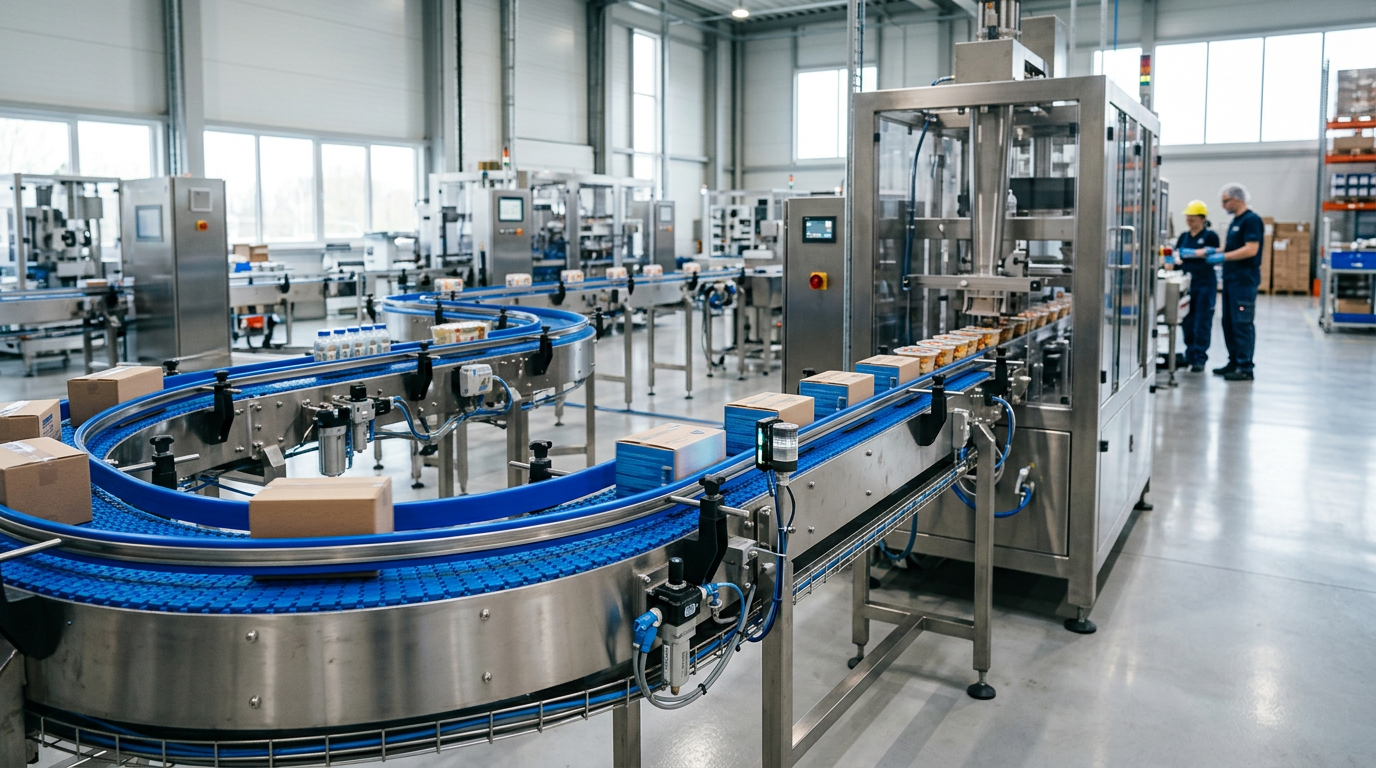
In modern automated manufacturing, line balancing involves the precise synchronization of cycle times across sequential conveyor modules to ensure that no single station exceeds a 90% utilization rate, which prevents the formation of "bottleneck transients" that can degrade Overall Equipment Effectiveness (OEE) by up to 15%. To achieve optimal flow, engineers must align the takt time of individual process zones with the conveyor’s linear velocity, typically maintaining a buffer capacity of 1.5 to 2.0 times the average cycle time to absorb minor micro-stops.
The Relationship Between Line Balancing and OEE
Overall Equipment Effectiveness (OEE) is the gold standard for measuring manufacturing productivity, calculated as the product of Availability, Performance, and Quality. In a conveyor-based system, line balancing is the primary lever for improving the Performance component.
When a line is imbalanced, certain sections of the conveyor experience "starvation" (waiting for product) while others experience "blockage" (accumulating product). These states represent idle time that is often masked by the continuous motion of the motor, yet they drastically reduce the total throughput potential. By utilizing modular conveyor sections with variable speed drives (VFDs), operators can fine-tune transport speeds to match the actual output of the slowest machine (the constraint), thereby stabilizing the flow and reducing mechanical wear caused by frequent start-stop cycles.
Identifying Bottlenecks in Conveyor Flow
The first step in line balancing is identifying the constraint. In a complex material handling system, the constraint isn't always the slowest machine; it can be a poorly configured merge point or a high-friction curve module.
Quantitative Analysis of Flow Disruption
To quantify imbalance, engineers look at the "Buffer Occupancy Ratio." If a conveyor segment between two machines is consistently 100% full, the downstream process is the bottleneck. If it is consistently empty, the upstream process is lagging.
| Metric | Ideal Target | Impact on OEE |
|---|---|---|
| Station Utilization | 85% - 90% | High (Performance) |
| Buffer Occupancy | 40% - 60% | Medium (Availability) |
| Micro-stop Frequency | < 2 per hour | High (Availability) |
| Standard Deviation of Cycle Time | < 5% | High (Quality/Performance) |
Strategies for Sub-Process Synchronization
Achieving a balanced line requires a combination of hardware modularity and smart control logic. Easy Conveyors provides the modular building blocks—such as chain conveyors and belt modules—that allow for the rapid reconfiguration of line lengths to adjust buffer zones as production demands shift.
1. Implementing Dynamic Accumulation
Traditional "zero-pressure accumulation" (ZPA) is essential for preventing product damage, but dynamic accumulation goes a step further. By using sensors to monitor the density of products on the belt, the control system can proactively slow down upstream modules before a physical blockage occurs. This prevents the "accordion effect," where speed fluctuations ripple back through the entire line.
2. Tuning VFD Soft-Start and Deceleration
Rapid acceleration and deceleration are enemies of OEE. They lead to belt slippage and mechanical fatigue. Proper VFD soft-start tuning ensures that when a line resumes after a stop, it ramps up in synchronization with the downstream capacity. This reduces the "Performance loss" associated with the time it takes for a line to return to full operating speed.
3. Modular Length Adjustments
If a process consistently suffers from "starvation," increasing the conveyor length or adding a "snake" configuration can provide the necessary dwell time for cooling, curing, or simply buffer storage. Modular systems allow for these adjustments without scrapping the entire infrastructure.
Easy Conveyors stocks the material handling discussed here — ready to ship across Europe.
Impact of Component Selection on OEE
The physical components of the conveyor play a silent but critical role in line balancing. High-friction belts or worn-out rollers can cause "micro-slips," where the product doesn't move at the calculated speed. This discrepancy between the theoretical speed and actual throughput is a primary source of OEE Performance loss.
For instance, when considering drum motor selection, moving from a standard external gearmotor to an oil-cooled, high-efficiency drum motor (IE3 or IE4 equivalent) can improve uptime. These motors are less susceptible to environmental contaminants, reducing the "Availability loss" caused by component failure. Furthermore, integrated motorized rollers in ZPA sections allow for zone-level control, which is the cornerstone of modern line balancing.
Data-Driven Optimization: The Role of IIoT
In the era of Industry 4.0, line balancing is no longer a "set and forget" task. Using photo-eye sensors, encoders, and PLC data, manufacturers can create a real-time heat map of their material flow.
- Starvation Alerts: Triggered when a downstream sensor sees no product for >1.5x takt time.
- Back-up Alerts: Triggered when an upstream sensor is covered for >2.0x cycle time.
- Predictive Maintenance: Monitoring motor current draw to identify zones where mechanical resistance is increasing, which would otherwise slow down the line and upset the balance.
By integrating these signals into an OEE dashboard, plant managers can distinguish between a "mechanical breakdown" (Availability loss) and a "flow imbalance" (Performance loss).
Continuous Improvement and Hygienic Design
In sectors like food and pharma, line balancing is often complicated by cleaning requirements. A balanced line that is difficult to clean will suffer from massive Availability losses during changeovers. Implementing hygienic wash-down design ensures that the time gained through flow optimization isn't lost during the sanitation shift. Using open-frame stainless steel modules and FDA-approved modular belts allows for rapid cleaning, keeping the OEE "Availability" score high.
Ultimately, line balancing is the art of synchronizing human labor, machine cycles, and conveyor speeds into a single, cohesive pulse. When hardware modularity meets intelligent control, the result is a system that not only moves faster but moves smarter.
Frequently Asked Questions
How does line balancing specifically affect OEE?
Line balancing serves to synchronize the speeds and cycle times of various machines, ensuring that no single station becomes a bottleneck. This directly improves the 'Performance' metric of OEE by eliminating micro-stops and idling.
What is the ideal buffer capacity for a modular conveyor?
A buffer should typically hold 1.5 to 2.0 times the average cycle time of the downstream process. This allows the line to continue moving during minor interruptions without causing a full system halt.
What is the difference between starvation and blockage?
Starvation occurs when a machine is ready to work but has no input. Blockage occurs when a machine has finished a cycle but cannot discharge. Both indicate an imbalanced conveyor line that requires speed or buffer adjustment.
Can variable speed drives (VFDs) improve line balance?
VFDs allow for fine-tuned speed control. By slowing down upstream conveyors to 95% of the constraint's speed, you can create a continuous flow rather than a jerky, stop-start movement that damages equipment.
Sources & references
- [1]ISO 22400-2:2014 Automation systems and integration — Key performance indicators (KPIs) for manufacturing operations management — Part 2: Definitions and descriptions
- [2]Overall Equipment Effectiveness (OEE) - Wikipedia
- [3]Optimizing conveyor performance with Variable Frequency Drives (VFD)
- [4]Conveyor Systems and Line Balancing in Material Handling
- [5]Methods for Accumulation and Bottleneck Management in Conveyor Technology