Conveyor Bearings and Shaft Seals for Hygienic Applications
Hygienic conveyor bearings and shaft seals must prevent contamination in food and pharma zones. Standard IP69K ratings and solid-lube technology are the industry benchmarks.
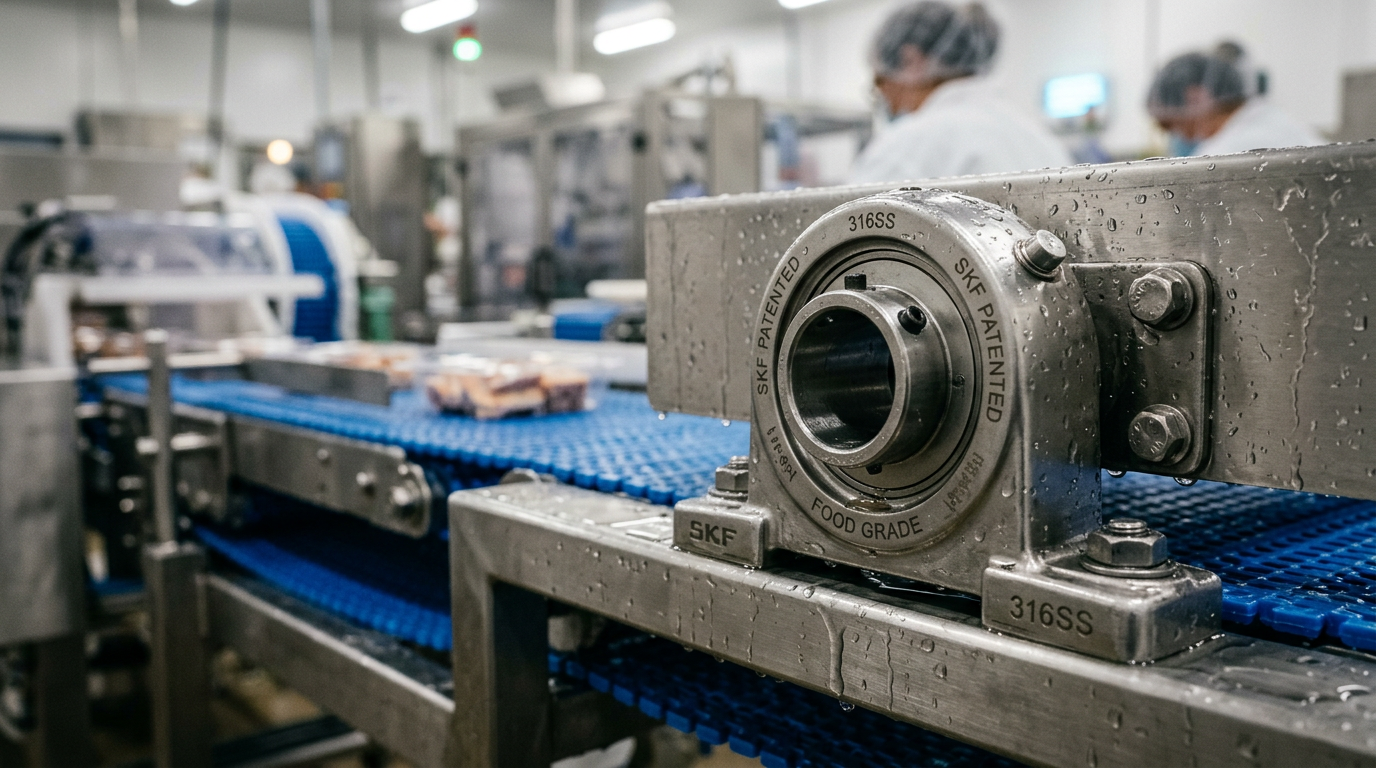
In hygienic material handling, conveyor bearings and shaft seals must prevent bacterial ingress and lubricant leakage, typically requiring 3-A or EHEDG-certified components that can withstand high-pressure washdowns of up to 100 bar (1,450 psi). The gold standard for these environments involves the use of solid-lubricant-filled ball bearings housed in non-porous, high-grade stainless steel or thermoplastic housings with triple-lip contact seals to ensure a hermetic barrier between the food zone and moving parts.
Engineering the Hygienic Barrier: Why Standard Bearings Fail
Standard industrial bearings are designed for load capacity and thermal dissipation, often utilizing open or shielded designs that rely on grease replenishment. In food, beverage, and pharmaceutical production, these designs represent a critical contamination risk. Conventional grease can emulsify when exposed to caustic cleaning agents, leading to premature bearing failure and potential product contamination.
Furthermore, the "crevices" inherent in standard cast-iron housings provide ideal breeding grounds for biofilms. According to EHEDG guidelines, hygienic design dictates that all surfaces must be self-draining, non-absorbent, and free of sharp internal angles. When selecting components for a washdown environment, engineers must prioritize the IP69K rating, which ensures protection against high-pressure, high-temperature jet sprays (ISO 20653).
The Anatomy of a Hygienic Bearing Unit
A robust hygienic bearing assembly consists of three primary layers: the housing, the insert, and the sealing system.
1. Housing Materials and Geometry
For maximum corrosion resistance, AISI 304 or 316 stainless steel housings are preferred. However, high-performance reinforced polymers are increasingly popular due to their resistance to aggressive cleaning chemicals and lower cost. Unlike cast iron, these materials do not flake or rust. The geometry must be spherical and smooth—often referred to as "bolt-hole-free" or "solid base" designs—to eliminate the hollow cavities found in standard units where water and organic matter can collect.
2. Bearing Inserts and Lubrication
The choice of lubrication is pivotal. While H1 food-grade grease is the baseline requirement, many modern modular systems utilize Solid Oil or Solid Lube technology. In these units, the bearing's internal space is filled with a polymer matrix saturated with oil. This eliminates the risk of "breathing"—a phenomenon where temperature changes pull moisture into a greased bearing—and ensures the lubricant cannot be washed out by high-pressure spray.
3. Advanced Sealing Systems
The shaft seal is the primary defense against ingress. In hygienic applications, a simple rubber seal is insufficient. Engineers should look for:
- Triple-lip seals: Three layers of contact that provide redundant protection.
- Flinger shields: A rotating stainless steel shield that uses centrifugal force to throw liquid away from the seal interface.
- Gutter-style configurations: Designed to direct runoff away from the shaft entry point.
| Feature | Standard Industrial | Hygienic/Washdown |
|---|---|---|
| Housing Material | Cast Iron (Painted) | 316 Stainless / PBT Polymer |
| Lubrication Type | Standard Mineral Grease | H1 Food Grade / Solid Lube |
| Seal Rating | IP65 | IP69K |
| Operating Temp | -20°C to +120°C | -35°C to +110°C (Process dependent) |
| Washdown Resistance | Low (Rust/Leaking) | High (Chemical/High-Pressure) |
| Certification | N/A | FDA, EHEDG, 3-A |
Shaft Seals and the Drive Interface
While bearing units handle the structural rotation, the interface between the conveyor belt and the drive motor requires specialized shaft seals. For modular belt systems, the drive shaft is often square or hexagonal to transmit torque without keys. Sealing these non-round profiles presents a challenge.
The solution often involves redundant sealing at the gearbox output. Many European manufacturers, such as Easy Conveyors, integrate these hygienic principles into their modular frameworks, ensuring that the drive end-units utilize sealed-for-life bearings and specialized shaft sleeves. This reduces the "sanitary debt" accumulated during daily cleaning cycles.
Troubleshooting Seal Failure
Primary failure modes for shaft seals in hygienic lines include:
- Chemical Degradation: Nitrile (NBR) seals may swell or crack when exposed to certain peroxide-based cleaners. Viton (FKM) or EPDM is often required for chemical compatibility.
- Dry Running: If a seal runs against a dry shaft at high speeds, friction heat can melt the lip.
- Shaft Grooving: Over time, contact seals can wear a groove into the shaft, rendering new seals ineffective. Utilizing hardened stainless steel sleeves can mitigate this.
Easy Conveyors stocks the conveyor components discussed here — ready to ship across Europe.
Integration with Modular Systems
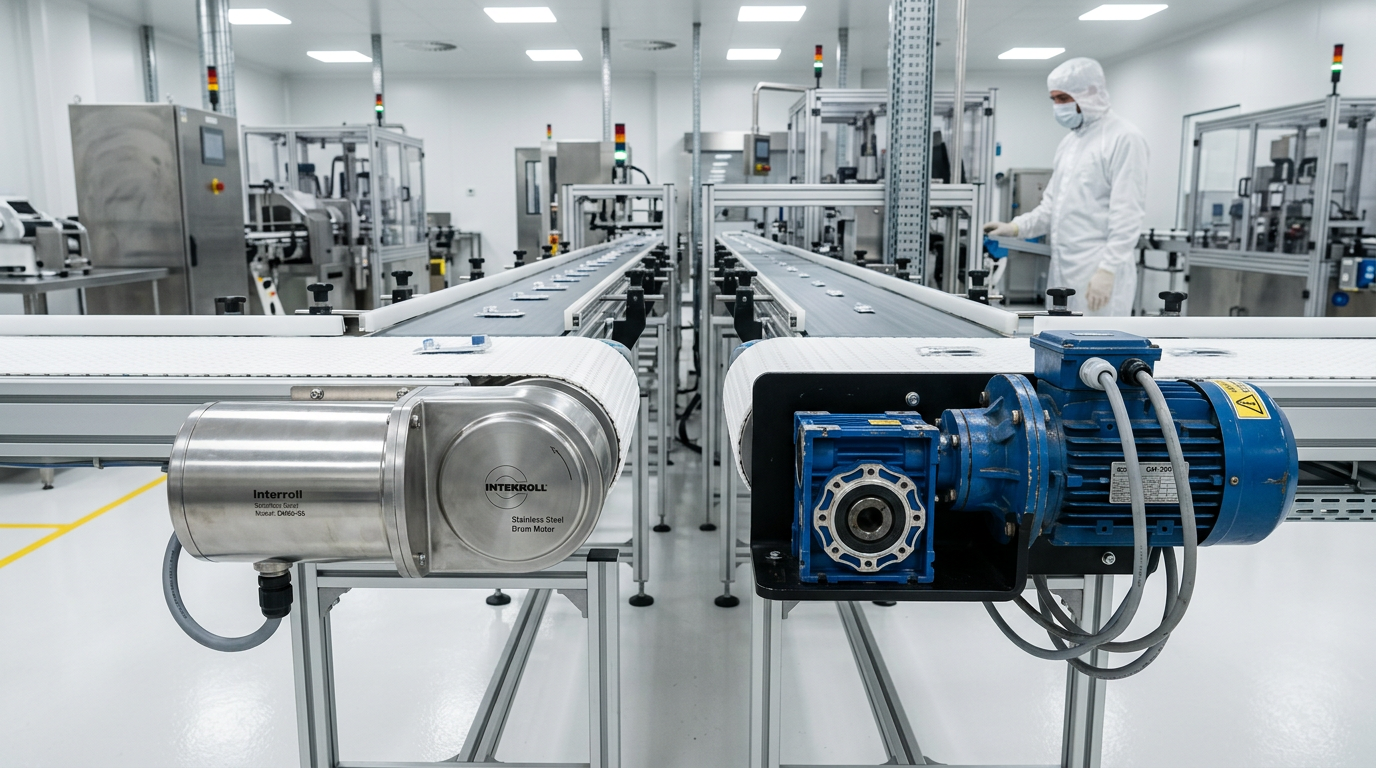
When designing a production line, the choice of bearing and seal interacts with other components like drum motor selection and hygienic wash-down design. For example, a drum motor integrates the motor, gearbox, and bearings into a single hermetically sealed unit (Interroll), eliminating the external shaft seal entirely. However, for traditional external drives, the shaft exit is the most vulnerable point.
For those implementing a new line, it is critical to align the component specifications with the cleaning protocol. If the facility uses automated Clean-in-Place (CIP) systems with caustic concentrations above 2-3%, standard stainless bearings may still experience surface pitting. In such cases, nitrogen-enhanced stainless steels or ceramic hybrids may be considered for the bearing races.
Maintenance and Installation Rules of Thumb
Maintenance for hygienic bearings differs significantly from traditional "grease-it-till-it-purges" methods.
- Never Over-Grease: If using re-lubricatable units, excess grease acts as a magnet for contaminants and can compromise the seal.
- Check Seal Orientation: Ensure flinger shields are properly seated. If the shield is bent during installation, it can rub against the housing, creating metallic debris.
- Monitor VFD Harmonics: In automated systems, uncontrolled shaft currents from a VFD can cause electrical pitting in the bearing races, leading to vibration and seal breach. Integrating proper grounding or ceramic-coated bearings can prevent this.
As the industry moves toward "Industry 4.0" in food processing, we are seeing the rise of smart bearing units equipped with vibration and temperature sensors. These sensors are now being integrated into IP69K-rated housings, allowing for predictive maintenance without compromising the sanitary integrity of the system. Selecting the right combination of housing, internal lubrication, and sealing technology ensures that the conveyor remains a reliable part of the production chain rather than a source of contamination.
Conclusion
The selection of conveyor bearings and shaft seals for hygienic applications is a balance between mechanical durability and microbiological safety. By adhering to FDA standards and selecting IP69K-rated components with solid lubrication, manufacturers can significantly extend the uptime of their material handling systems while meeting the most stringent food safety requirements. Always consult with a modular specialist to ensure that the drive components and support bearings are compatible with your specific chemical cleaning regime.
Frequently Asked Questions
What is the difference between IP67 and IP69K for conveyor bearings?
IP69K is a protection rating under ISO 20653 that certifies high-pressure, high-temperature washdown resistance (80-100 bar at 80°C), whereas IP67 only guarantees immersion for a short period. IP69K is the minimum standard for high-care hygienic conveyor components.
Why is 'Solid Oil' or 'Solid Lube' preferred over grease?
Solid lubrication is a polymer matrix saturated with oil that fills the bearing cavity. It is superior in washdown environments because it cannot be washed out by high-pressure water, prevents 'breathing' (moisture intake during temperature changes), and eliminates the need for manual re-greasing.
Which housing material is best for caustic chemical cleaning?
For caustic environments using peroxides or chlorinated cleaners, 316-grade stainless steel or high-performance polymers like PBT (Polybutylene Terephthalate) are required to prevent pitting and stress-corrosion cracking.
How often should shaft seals be replaced in a food-grade environment?
Replace seals if you observe visible lubricant leakage, discoloration of the shaft (indicating friction heat), or if the seal lip has lost flexibility. In washdown environments, seals are often treated as wear parts and replaced every 12-24 months depending on cleaning frequency.