Incline Conveyors with Cleated Belts for Bulk Goods: Design & Selection
Learn how to optimize bulk material elevation using cleated belt conveyors, covering cleat profiles, steep-incline design, and motor sizing for industrial throughput.
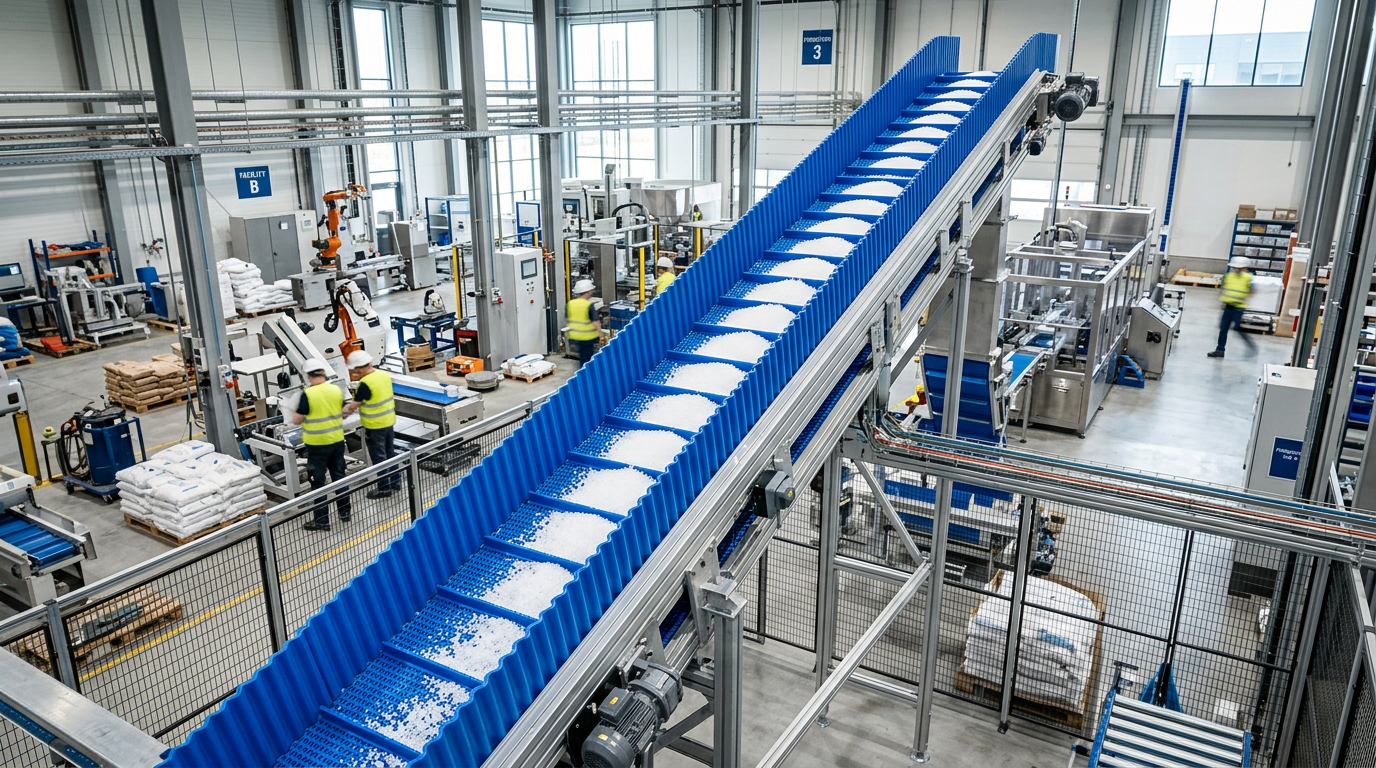
Incline conveyors using cleated belts are essential for elevating bulk goods at angles ranging from 30° to 75°, utilizing transverse flights to prevent material backflow and increase volumetric throughput by up to 40% compared to smooth belts. These systems optimize floor space by verticalizing material flow while maintaining product integrity in industries ranging from food processing to recycling.
The Mechanics of Cleated Belt Elevation
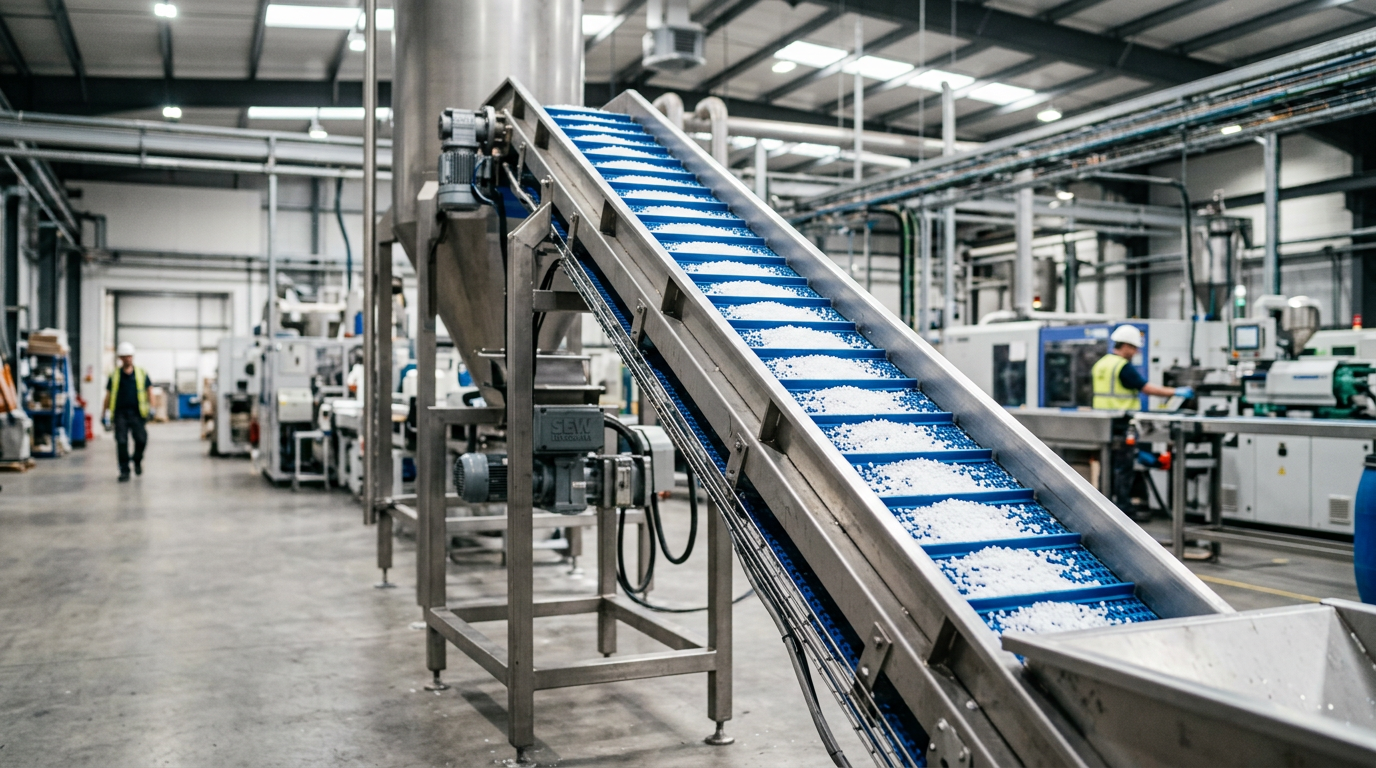
When transporting bulk materials—such as grains, plastic pellets, or small automotive components—gravity is the primary adversary. Standard flat belts generally lose effectiveness at inclines exceeding 15° to 20° due to the "angle of repose," where the product begins to slide backward. Cleated belts, also known as flighted belts, solve this by incorporating integral profiles or T-cleats that act as mechanical barriers.
The height and spacing of these cleats are determined by the maximum particle size and the desired flow rate. For example, in high-volume bulk handling, cleats are often spaced at intervals that allow for "pocket loading," where the material is cradled between two flights. This configuration is particularly effective for preventing the rollout of spherical or round objects.
Designing for Stability and Throughput
Selecting the right cleat profile is the first step in engineering an efficient incline system. The most common profiles include:
- T-Cleats: Vertical ribs used for light to medium-duty applications and inclines up to 40°.
- C-Cleats (Scoop): Curved profiles that act like small buckets, ideal for steeper inclines (up to 60°) and fragile materials.
- I-Cleats: Reinforced vertical flights for heavy-duty bulk goods like gravel or metal scrap.
- S-Cleats (Super-cleats): Extra-wide or reinforced profiles for massive throughput requirements.
Technical Performance Matrix
| Feature | T-Cleat | C-Cleat (Scoop) | Sidewall Cleat |
|---|---|---|---|
| Max Incline | 30° - 45° | 45° - 60° | 60° - 75° |
| Material Containment | Moderate | High | Excellent |
| Cleanability | High | Moderate | Low |
| Typical Height | 20mm - 75mm | 25mm - 100mm | 50mm - 150mm |
| Primary Use Case | Small parts / Food | Wet grains / Powders | Bulk chemicals / Minerals |
The Role of Corrugated Sidewalls
To achieve the steepest possible angles (up to 75° or even vertical "Z-conveyors"), engineers often combine cleats with corrugated sidewalls. These flexible walls prevent material from spilling off the sides of the belt, creating a moving "trough."
However, sidewalls introduce mechanical complexity. They require larger pulley diameters to accommodate the compression and extension of the corrugated material as it wraps around the drive and tail scrolls. When designing these systems, Easy Conveyors provides modular components that simplify the integration of sidewall technology with standard aluminum or stainless steel frames, ensuring that the belt tracking remains stable even under asymmetrical loads.
Easy Conveyors stocks the material handling discussed here — ready to ship across Europe.
Load Calculation and Motor Selection
Sizing the drive system for an incline conveyor is significantly more demanding than for horizontal transport. The motor must overcome not only the friction of the chain or belt against the wear strips but also the constant gravitational force acting on the entire mass of the product on the incline.
- Static Load: The weight of the belt plus the weight of the product per linear meter.
- Dynamic Load: The force required to accelerate the bulk material from the loading point (often a hopper) to the belt speed.
- Efficiency Losses: For steep inclines, the use of a VFD soft-start tuning strategy is critical to prevent the "surging" effect that can occur when a fully loaded belt starts from a standstill.
For food-grade applications, engineers often prefer high-efficiency drum motor selection to eliminate external gearboxes where debris or oil could contaminate the bulk goods. These motors should meet IE3 efficiency standards and provide at least IP66 protection if wash-down procedures are required.
Material Selection: POM vs. PVC vs. PU
The material of both the belt and the cleats must be compatible with the bulk goods being moved. In the food industry, hygienic wash-down design is paramount.
- Modular Plastic (POM/PP): Excellent for durability and easy replacement of damaged sections. POM (Acetal) is preferred for its low friction and high strength, though it has a narrower temperature range than Polypropylene (PP).
- Thermoplastic Polyurethane (TPU): Offers superior oil and grease resistance, making it the standard for meat, poultry, and snack food applications. TPU cleats are typically RF-welded to the base belt for a permanent, crevice-free bond.
- PVC: A cost-effective solution for non-food bulk handling, such as package sortation or plastic recycling, though it lacks the flexibility of TPU at lower temperatures.
Critical Design Considerations for Bulk Loading
Loading a cleated conveyor requires a controlled "in-feed." Dumping a cubic meter of bulk material onto a moving cleated belt will lead to "bridging" or "jamming" at the intake point.
Engineers should implement a vibratory feeder or a tapered hopper to ensure that the material is metered into the pockets between cleats. Furthermore, the "transition zone"—the area where the belt moves from horizontal to inclined—must be supported by large-radius curves or "hold-down" rollers to prevent the belt from lifting off the frame under tension.
Maintenance and Common Failure Modes
The primary failure mode for incline cleated conveyors is cleat detachment. This is usually caused by:
- Impact damage: Heavy bulk objects dropped from too great a height.
- Improper Tracking: If the belt shifts, the cleats can strike the conveyor frame or side guards.
- Back-flexing: Running a cleated belt over a pulley that is too small for the cleat base width.
Standard maintenance should include checking the integrity of the heat-welds or mechanical fasteners on the cleats and ensuring that the return rollers are "disk-type" or "caged" to allow the cleats to pass through the return path without interference. Integrating a belt scraper or brush on the discharge end is also vital for bulk goods that are sticky or prone to "carry-back," which can lead to material buildup in the conveyor bed and premature wear.
Frequently Asked Questions
What is the maximum angle for a cleated belt conveyor?
Standard T-cleats are effective up to 30-45 degrees. For steeper angles (45-75 degrees), scoop-shaped C-cleats or corrugated sidewalls are required to prevent product rollback.
How do I size a motor for an incline conveyor?
Calculate the Lifting Force (F = m * g * sin(theta)) where m is the mass of the product on the incline. Add the friction force and use a safety factor of 1.5 to 2.0 to account for start-up torque.
Can cleated belts run on standard return rollers?
Yes, but they require recessed 'pocket' pulleys or specific return roller configurations (like disc rollers) that support the edges of the belt without touching the cleats.
Is PVC or TPU better for food-grade cleated conveyors?
TPU (Polyurethane) is generally superior for food as it is non-porous, resistant to fats/oils, and supports RF-welding of cleats which eliminates bacteria-harboring crevices.
How high should the cleats be for bulk materials?
Cleat height should be at least 2.5 times the maximum particle size of the bulk material to ensure stable 'pockets' and prevent oversized pieces from tumbling backward.