Accumulation Conveyors for Buffer Management in Packaging Efficiency
Master accumulation conveyors for packaging buffer management. Learn ZPA vs MPA strategies, FIFO logic, and technical sizing to boost OEE and protect fragile products.
The Role of Accumulation in Packaging Efficiency
In high-speed packaging lines, the primary goal is to maintain a Constant Flow Rate (CFR) across disparate machines. However, machine reliability is never 100%; labelers run out of rolls, case packers require minor adjustments, and palletizers wait for empty pallets. Accumulation conveyors act as a mechanical battery, storing products during downstream interruptions to keep upstream processes (like filling or primary packaging) running at peak efficiency.
The fundamental rule of thumb in buffer management is to provide enough accumulation to cover the "Mean Time to Repair" (MTTR) of the most frequent minor stops, typically ranging from 2 to 5 minutes of line capacity. This prevents a 30-second stop at a case packer from cascading into a 20-minute restart sequence for a complex filling machine.
Zero Pressure vs. Minimum Pressure Accumulation
When selecting a conveyor for buffer management, the choice between Zero Pressure Accumulation (ZPA) and Minimum Pressure Accumulation (MPA) dictates how the system handles product integrity and energy consumption.
Zero Pressure Accumulation (ZPA)
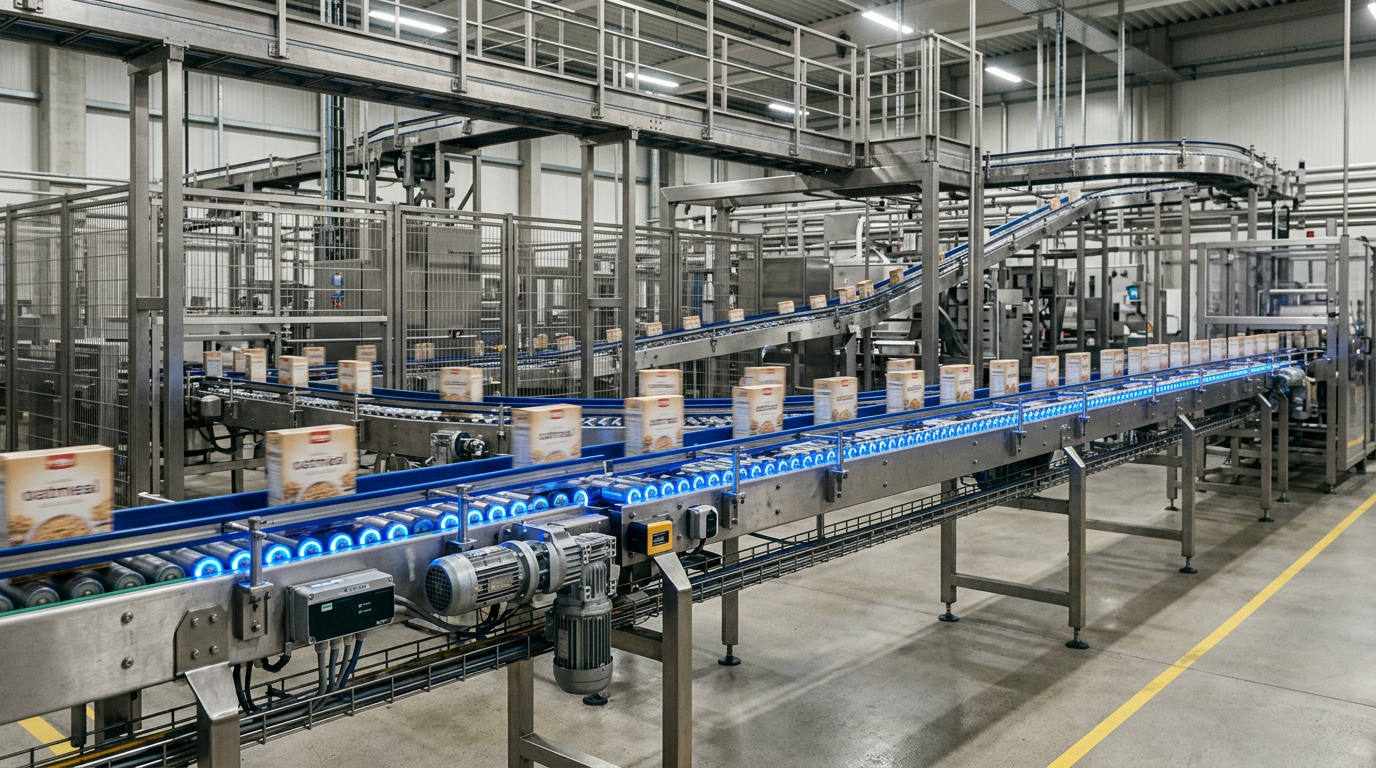
ZPA systems divided the conveyor into "zones," typically controlled by a photo-eye and a logic controller. When a zone is occupied and the downstream zone is full, the motor for that specific zone stops. This ensures that products never touch one another, eliminating "back pressure" that can crush fragile primary packaging or scuff labels.
Modern ZPA systems often utilize 24V DC Brushless motor rollers. These modular systems are highly energy-efficient because power is only consumed in zones where products are actively moving. Easy Conveyors specializes in these types of modular configurations, providing the mechanical flexibility needed to scale buffer zones as production demands increase.
Minimum Pressure Accumulation (MPA)
MPA systems allow products to touch. They utilize a continuously running chain or belt with a low coefficient of friction or "rollers-on-top" (top-roller) chains. While simpler and lower in initial cost, MPA creates constant friction under the product, which can lead to heat buildup, product damage, or "shingling"—where flat products slide over one another.
| Feature | Zero Pressure Accumulation (ZPA) | Minimum Pressure Accumulation (MPA) |
|---|---|---|
| Product Contact | No contact (Zero gaps) | Continuous contact |
| Back Pressure | 0 N (Negligible) | Variable (Increases with line length) |
| Energy Usage | On-demand (Low) | Continuous (Higher) |
| Ideal For | Fragile, lightweight, or irregular shapes | Rigid containers, heavy boxes |
| Control Logic | Discrete zone sensors/PLC | Mechanical friction adjustment |
| Initial Cost | Higher (Sensor/Motor density) | Lower (Single drive motor) |
Advanced Buffer Techniques: Re-circulation and FIFO vs. LIFO
Buffer management isn't just about stopping products; it's about managing the sequence and time-in-system, especially in food and pharma industries where "First-In, First-Out" (FIFO) is often a regulatory or quality requirement.
Bi-directional Buffers (LIFO/FIFO Mix)
Bi-directional tables, often called "Alpine" or "Spiral" buffers, save floorspace by moving products vertically. In a bi-directional table, products are diverted onto a side-track during a downstream stoppage. While these often operate on a "Last-In, First-Out" (LIFO) basis if not managed correctly, they offer the highest density of products per square meter of factory floor.
Re-circulation Loops
In high-speed bottling or canning, a re-circulation loop allows products to travel in a continuous oval path. This design ensures that if the downstream intake is blocked, the products simply stay in motion. This provides "Minimum Pressure" benefits while using centrifugal force and guide rails to manage product orientation.
Easy Conveyors stocks the material handling discussed here — ready to ship across Europe.
Technical Considerations: Friction and Speed Ratios
When designing an accumulation zone, engineers must account for the friction coefficient ($\mu$) between the conveyor surface and the product. For MPA systems, a $\mu$ of 0.1 to 0.15 is standard for plastic modular belts. If the friction is too high, the motor torque requirements escalate rapidly as the buffer fills.
Furthermore, the "Speed-Up" ratio is critical. An accumulation conveyor must be able to "empty" faster than the nominal line speed to clear the buffer once the downstream bottleneck is resolved. A common standard is to design the discharge section of an accumulation zone to run at 1.2x to 1.5x the upstream production speed. This ensures the buffer is ready for the next event.
When selecting motors for these high-cycle applications, engineers should prioritize IE3 efficiency class (IEC 60034-30-1) to reduce TCO, especially in ZPA systems where dozens of small motors may be used.
Safety and Control Standards
In North America and Europe, accumulation systems must adhere to strict safety standards regarding "entrapment points" and "stored energy."
- ISO 13849-1: Relates to the safety of control systems. Logic used in ZPA systems must ensure that a sensor failure doesn't lead to a dangerous pile-up.
- NEMA/IP Ratings: Since packaging lines often involve wash-down procedures, accumulation modules should meet IP66 or IP69K (NEMA 250) to prevent water ingress into the zone controllers and motors.
Proper VFD soft-start tuning is also essential in MPA systems. Abrupt starts on a fully loaded accumulation line can snap chains or damage motor gearboxes due to high starting torque. Integrating electronic soft-starts or specialized conveyor VFDs allows for controlled acceleration ramps that protect the mechanical integrity of the system.
Designing for Ease of Maintenance
Accumulation zones are often the most mechanically "active" parts of a line. When evaluating modular components, look for "drop-in" roller designs and tool-less sensor mounts. Because these systems are the "heartbeat" of the line's OEE (Overall Equipment Effectiveness), downtime for maintenance here is particularly costly.
Utilizing standardized modular components ensures that your spare parts inventory remains lean. By employing a "plug-and-play" architecture, a failed 24V DC roller or a zone controller can be replaced in minutes rather than hours, maintaining the buffer's availability for the long term. Proper hygienic wash-down design is also critical if the packaging line handles open food containers prior to sealing, requiring EHEDG-certified materials and frame geometries.
Summary of Selection Criteria
When specifying an accumulation system, follow these steps:
- Define the MTTR: Identify the longest typical stop of the downstream machine.
- Calculate Product Length: Multiply (MTTR in minutes) x (Line speed in units/minute) x (Product length) to find the required conveyor length.
- Choose ZPA vs MPA: Use ZPA for fragile or high-value items; MPA for robust, high-volume containers.
- Evaluate Floorspace: If linear space is limited, consider spiral or multi-lane bi-directional buffers.
- Motor Efficiency: Select IE3 or IE4 motors for continuous-run MPA systems to lower energy overhead.
Frequently Asked Questions
What is the difference between ZPA and MPA?
Zero Pressure Accumulation (ZPA) uses sensors and independent motor zones to prevent products from touching, whereas Minimum Pressure Accumulation (MPA) allows products to push against each other with low friction.
How much buffer time should an accumulation conveyor provide?
The standard rule of thumb is to provide 2 to 5 minutes of line capacity at full production speed to account for the Mean Time to Repair (MTTR) of minor downstream interruptions.
Is ZPA or MPA better for high-speed labeling lines?
ZPA is generally better because it eliminates back pressure that can scuff labels or crush primary packaging, and it only consumes energy when moving product.
What IP rating is required for food-grade accumulation conveyors?
Accumulation systems should be rated IP66 or IP69K (per NEMA 250 standards) to survive the high-pressure, high-temperature wash-down protocols common in food and beverage packaging.
How do I manage accumulation when floor space is extremely limited?
Vertical spirals or Alpine conveyors are the most common solutions, as they utilize the height of the facility to create a long travel path (buffer) within a small footprint.