VFD Tuning and Soft-Start Strategies for Modular Conveyors
Learn how to optimize VFD tuning and soft-start strategies for modular conveyors to reduce mechanical wear by 60% and improve energy efficiency using IEC standards.
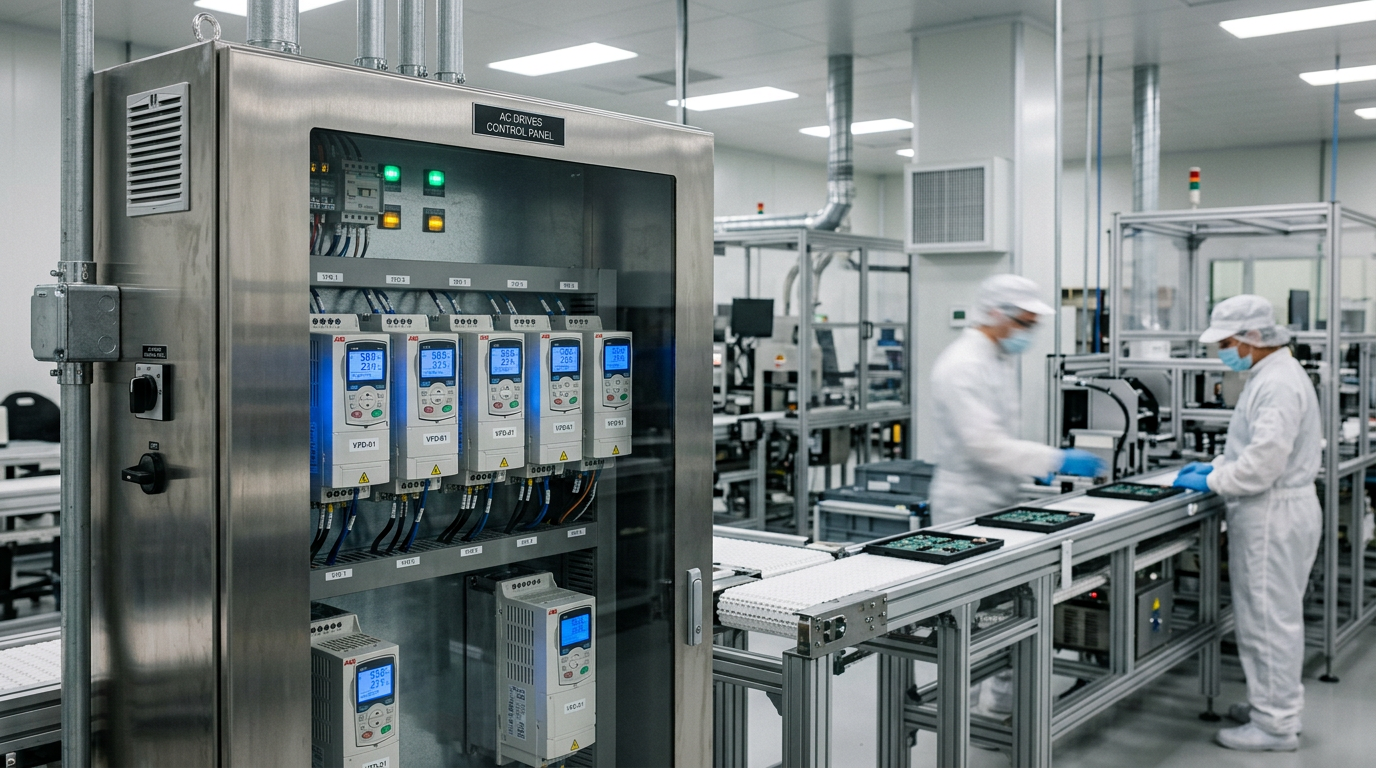
To optimize conveyor performance and longevity, VFD tuning should prioritize a linear acceleration ramp between 1.5 and 3.0 seconds, which typically reduces mechanical shock loads by up to 60% compared to direct-on-line (DOL) starting. Proper configuration of the Variable Frequency Drive (VFD) ensures that modular belts, which are sensitive to chordal action and tensile spikes, operate within their design limits while maximizing energy efficiency through optimal V/f (Voltage-to-Frequency) ratios.
The Role of VFDs in Modular Conveyor Systems
Modular plastic belt conveyors rely on the interlocking of plastic modules and sprockets. Unlike flat rubber belts, these systems are susceptible to "surging" or "pulsation" if the motor torque is applied too abruptly. A VFD (Variable Frequency Drive) serves as the primary controller for the three-phase induction motors that drive these systems, typically following the IEC 60034-30-1 efficiency standards for IE3 or IE4 motors.
Implementing a VFD is no longer just about speed control; it is about protecting the mechanical integrity of the conveyor. By managing the starting current—which can be 6 to 8 times the full-load current in DOL scenarios—VFDs prevent premature sprocket wear and belt elongation.
Soft-Start Strategies: Linear vs. S-Curve Ramping
The most critical parameter in VFD tuning for modular systems is the acceleration profile. There are two primary strategies:
- Linear Ramp: The frequency increases at a constant rate. This is standard for general material handling where the load is stable.
- S-Curve (Jerk Limitation): The drive rounds off the start and end of the acceleration phase. This is essential for conveying unstable products (e.g., tall bottles or stacked electronics) because it minimizes the "jerk" or the rate of change of acceleration.
For most modular plastic belts, a slight S-curve (approximately 20% of the total ramp time) is recommended to prevent the belt from "jumping" on the sprockets during the transition from static friction to kinetic motion.
VFD Parameter Selection Table
| Parameter | Recommended Value | Impact on System |
|---|---|---|
| Accel Time | 1.5s – 3.0s | Reduces tensile stress on belt modules |
| Decel Time | 0.5s – 2.0s | Prevents product pile-up and belt bunching |
| V/f Pattern | Linear or Square | Matches torque to load characteristics |
| Carrier Frequency | 4kHz – 8kHz | Balances motor noise vs. heat generation |
| Current Limit | 110% - 150% | Protects motor and belt during jams |
| DC Injection Braking | Minimum or Disabled | Reduces heat buildup in the motor |
Tuning for Energy Efficiency and Torque
Energy efficiency in automation is often dictated by the relationship between voltage and frequency. For conveyors, a constant torque V/f pattern is usually preferred. This ensures that the motor provides sufficient torque to overcome the static friction of the modular belt against its wear strips, regardless of the speed.
Ho
Easy Conveyors stocks the industrial automation discussed here — ready to ship across Europe.
wever, in applications with variable loads, such as airport baggage handling or large-scale e-commerce sortation, enabling "Auto-Energy Optimization" (AEO) functions can reduce energy consumption by up to 10% during light-load periods. These functions dynamically adjust the voltage to the minimum required to maintain the commanded speed.
Advanced Tuning: PID Loops and Sensor Integration
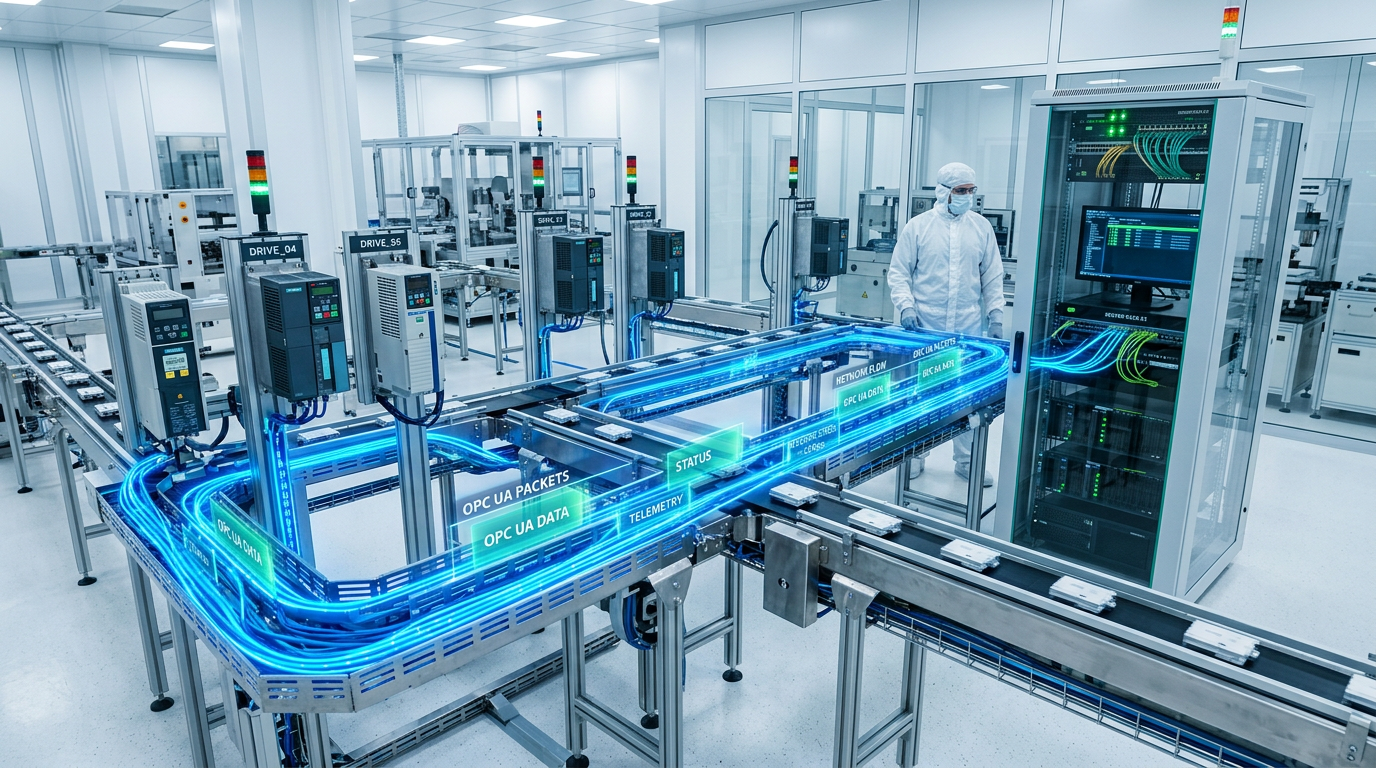
In sophisticated modular layouts, especially those involving accumulation or precise positioning, VFDs are often integrated into a wider control loop. Easy Conveyors systems frequently utilize VFDs with integrated STO (Safe Torque Off) and fieldbus communication (Profinet/EtherNet/IP) to allow for real-time adjustments based on downstream sensor data.
When tuning a PID loop for a conveyor:
- Proportional Gain (P): Should be high enough for responsiveness but low enough to avoid belt oscillation.
- Integral Time (I): Must be tuned to eliminate steady-state error without causing overshoot during speed changes.
Common Failure Modes in VFD-Driven Conveyors
Failure to properly tune the VFD can lead to several preventable issues:
- Harmonic Distortion: High-speed switching in VFDs can cause electrical noise. Using shielded cables and following NEMA guidelines for grounding is vital.
- Motor Overheating: Running motors at very low frequencies (below 15Hz) for extended periods without external cooling fans can lead to thermal failure, as the internal fan's effectiveness is proportional to shaft speed.
- Resonance: Every mechanical system has a natural frequency. If the conveyor vibrates excessively at a specific RPM, "skip frequencies" should be programmed into the VFD to bypass those dangerous zones.
Integration with Modern Control Systems
In the era of Industry 4.0, VFDs are more than power converters; they are data nodes. By monitoring the "Active Current" or "Motor Torque" parameters via the PLC, operators can predict maintenance needs. An increase in steady-state torque over several weeks often indicates that the modular belt is over-tensioned or that wear strips need replacement. Properly tuned drives allow for this type of predictive maintenance, reducing unplanned downtime significantly.
For complex layouts, ensure you refer to documentation regarding VFD soft-start tuning to match the specific inertia of your drive rollers. Furthermore, when selecting components, consider the efficiency differences discussed in our guide on drum motor selection to ensure the VFD and motor are a matched pair. Managing these electrical variables is just as important as the physical hygienic wash-down design of the conveyor frame itself.
Step-by-step
- 1
Identify Motor Nameplate Data
Enter the rated voltage, frequency (50/60Hz), and full-load amps into the VFD to ensure the thermal model of the motor is accurate.
- 2
Set Acceleration Ramp
Configure a linear or S-curve acceleration ramp between 1.5s and 3.0s to minimize tensile spikes in the modular belt.
- 3
Define Minimum and Maximum Frequency
Set the minimum frequency to at least 15Hz to ensure adequate motor cooling and the maximum to 50/60Hz unless the mechanical components are rated for overspeed.
- 4
Enable Current Limit Protection
Set the current limit to 110-120% of the motor's rated current to trigger a controlled stop in the event of a mechanical jam.
- 5
Perform Auto-Tune Routine
Run the VFD's static or dynamic auto-tune feature to measure motor stator resistance and optimize the torque-to-current ratio.
Frequently Asked Questions
What is the difference between a linear ramp and an S-curve in VFD tuning?
A linear ramp is a constant increase in speed, while an S-curve rounds off the beginning and end of the acceleration to reduce jerk, which is crucial for preventing fragile products from tipping.
What is the recommended acceleration time for a modular plastic belt?
Most modular conveyor applications benefit from an acceleration time of 1.5 to 3.0 seconds to balance throughput with mechanical protection.
Can running a conveyor at low speeds damage the motor?
Running a standard motor at very low speeds (under 20Hz) significantly reduces the cooling efficiency of the internal fan, potentially leading to overheating unless an external blower is used.
How do skip frequencies help in conveyor maintenance?
Skip frequencies are programmed settings in a VFD that tell the motor to 'jump over' specific RPM ranges where the system experiences mechanical resonance or excessive vibration.