Implementing Safety PLCs and Light Curtains: A Guide to SIL Ratings on Conveyor Lines
Learn how Safety PLCs and light curtains ensure SIL 2/3 compliance on conveyor lines. Explore ISO 13849-1 standards, muting techniques, and safety distance formulas.
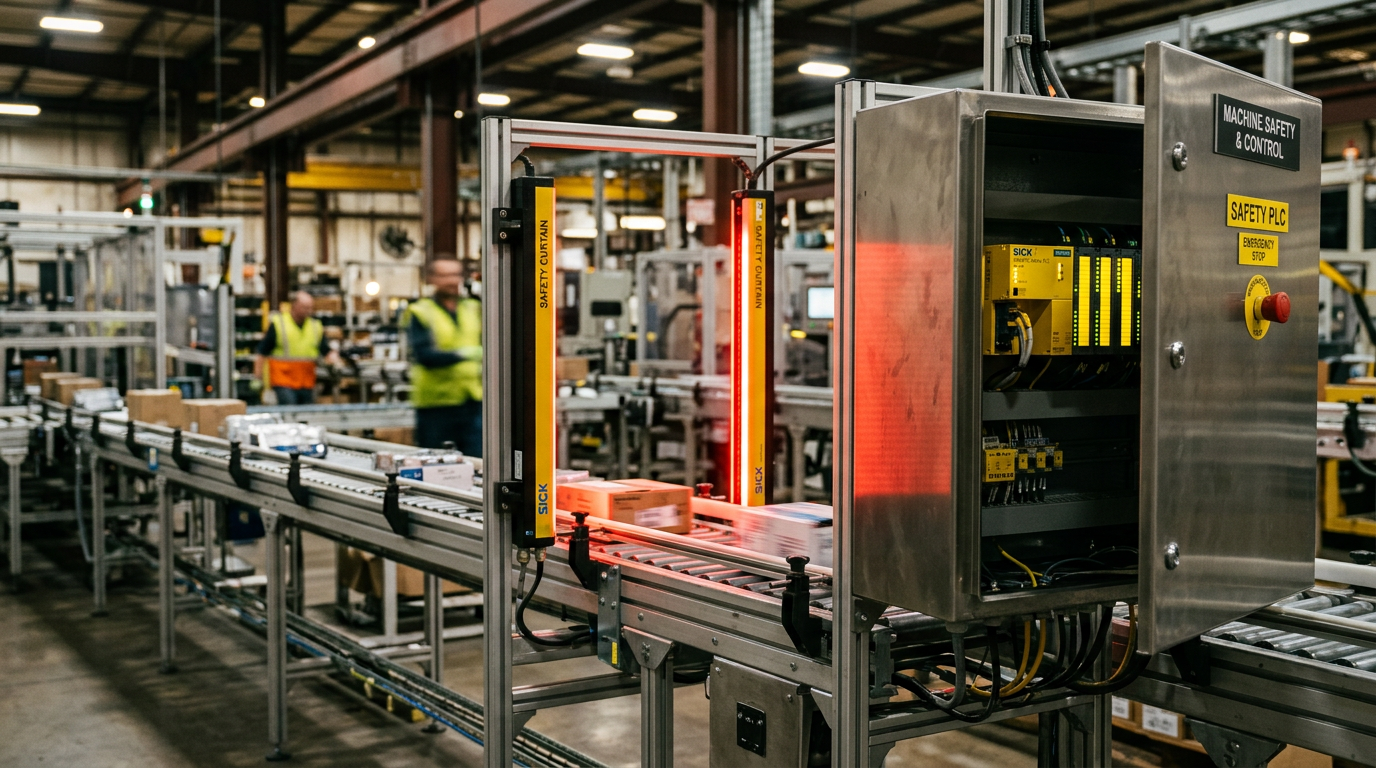
Modern conveyor safety systems rely on the integration of Safety PLCs and light curtains to achieve Safety Integrity Levels (SIL) 2 or 3, ensuring that hazardous motion stops within 100 to 500 milliseconds of a breach. Implementing these systems correctly involves a rigorous risk assessment following ISO 13849-1 standards to determine the required Performance Level (PL) for each specific zone of the material handling system.
The Role of Safety PLCs in Modular Conveying
A standard Programmable Logic Controller (PLC) is designed for process efficiency, but a Safety PLC is engineered with hardware redundancy and self-diagnostic capabilities to handle critical failure modes. Unlike standard controllers, Safety PLCs use "safe" I/O modules that continuously monitor for short circuits, cross-talk, and internal hardware discrepancies.
When designing high-speed sortation or heavy-duty pallet handling lines, the Safety PLC acts as the "brain." It processes signals from E-stops, interlocks, and light curtains to execute a controlled shutdown. According to IEC 61508, these controllers must maintain their safety function even in the event of a single component failure. In modular systems provided by partners like Easy Conveyors, integrating these controllers allows for "zonal safety," where only the affected section of the line stops while the rest of the facility continues to operate, significantly reducing downtime.
Understanding SIL and PL Ratings
Engineers often navigate two primary standards: ISO 13849-1 (Performance Levels 'a' through 'e') and IEC 62061 (Safety Integrity Levels 1 through 3). While they use different mathematics, they both measure the probability of a dangerous failure per hour (PFHd).
| Safety Level | Equivalent PL | PFHd (Probability of Dangerous Failure/Hour) | Typical Application |
|---|---|---|---|
| SIL 1 | PL c | ≥ 10⁻⁶ to < 10⁻⁵ | Low-risk transport, non-pinch areas |
| SIL 2 | PL d | ≥ 10⁻⁷ to < 10⁻⁶ | Standard packaging, box conveyors |
| SIL 3 | PL e | ≥ 10⁻⁸ to < 10⁻⁷ | Robotic cells, high-speed palletizing |
For most industrial conveyor applications, SIL 2 / PL d is the industry benchmark. Achieving SIL 3 usually requires dual-channel redundancy and advanced monitoring, which is often reserved for high-speed robotic intersections or areas with significant crushing hazards.
Light Curtains: Selection and Placement
Light curtains (AOPDs - Active Opto-electronic Protective Devices) are the primary method for guarding conveyor entry and exit points without physical barriers. They are classified into "Types" based on their self-monitoring capabilities as defined by IEC 61496.
- Type 2 Light Curtains: Suitable for SIL 1/PL c. They have a larger effective aperture angle and are more prone to interference.
- Type 4 Light Curtains: Required for SIL 3/PL e. These offer high levels of fault detection and are mandatory in high-risk zones.
Muting vs. Blanking A critical technical challenge in conveyor automation is allowing products to
Easy Conveyors stocks the industrial automation discussed here — ready to ship across Europe.
pass through a light curtain without triggering an E-stop.
- Muting: The temporary automatic suspension of the safety function using secondary sensors (e.g., photo-eyes) that recognize the shape of the pallet or box. If the sensors detect a human shape instead, the safety function remains active.
- Blanking: Disabling specific beams within the light curtain to allow a fixed object (like a conveyor rail) to pass through the field permanently.
Safety Distances and Stop Time Calculation
The physical placement of a light curtain is not arbitrary. It must be positioned far enough from the hazard so that the machine stops before a human limb can reach the danger zone. The formula provided by ISO 13855 is:
S = (K × T) + C
Where:
- S: Minimum safety distance (mm).
- K: Human approach speed (typically 1600 mm/s or 2000 mm/s).
- T: Total response time (Safety PLC logic + Light curtain reaction + Braking time of the motor).
- C: Intrusion distance (based on the resolution of the light curtain).
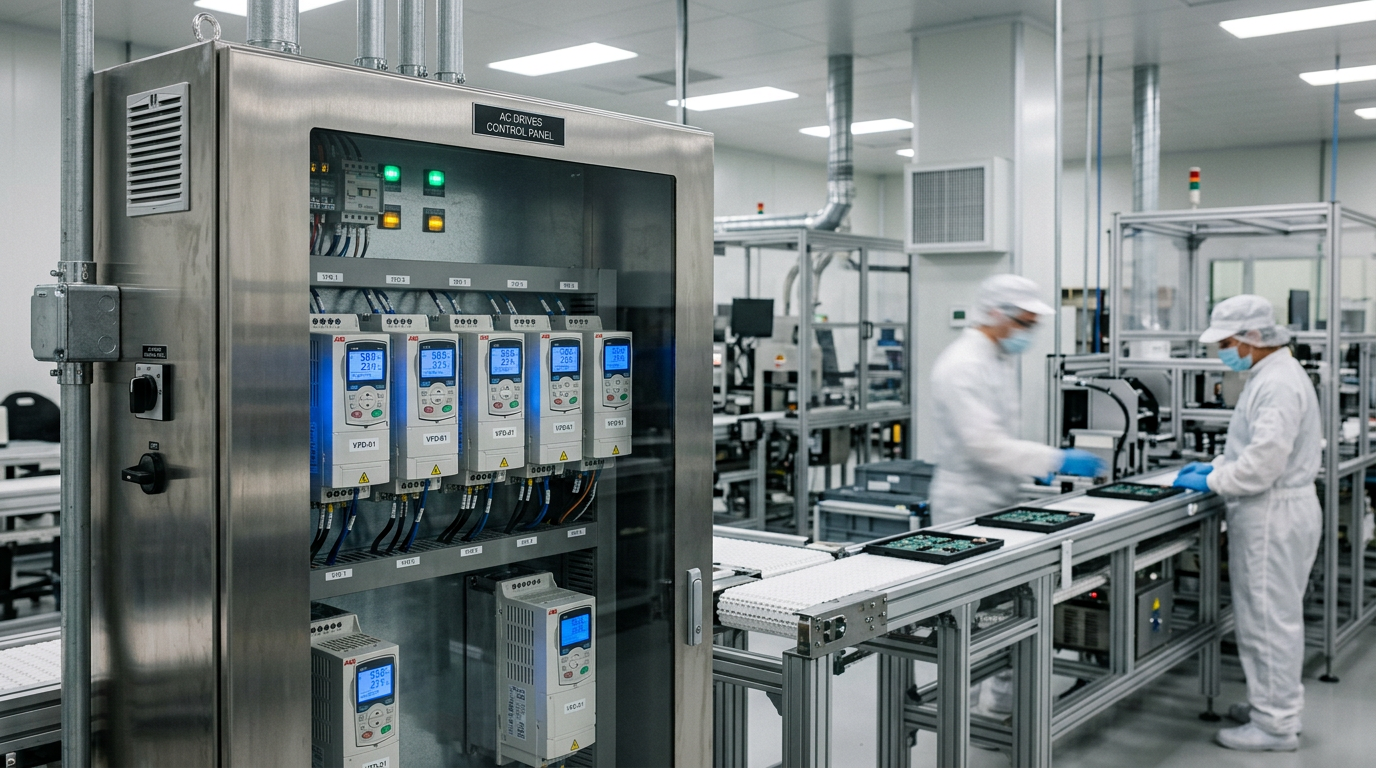
If your conveyor uses a VFD soft-start tuning profile, you must ensure that the "Safe Torque Off" (STO) function is correctly mapped in the Safety PLC to override any ramp-down settings during an emergency.
Integration with Drive Systems
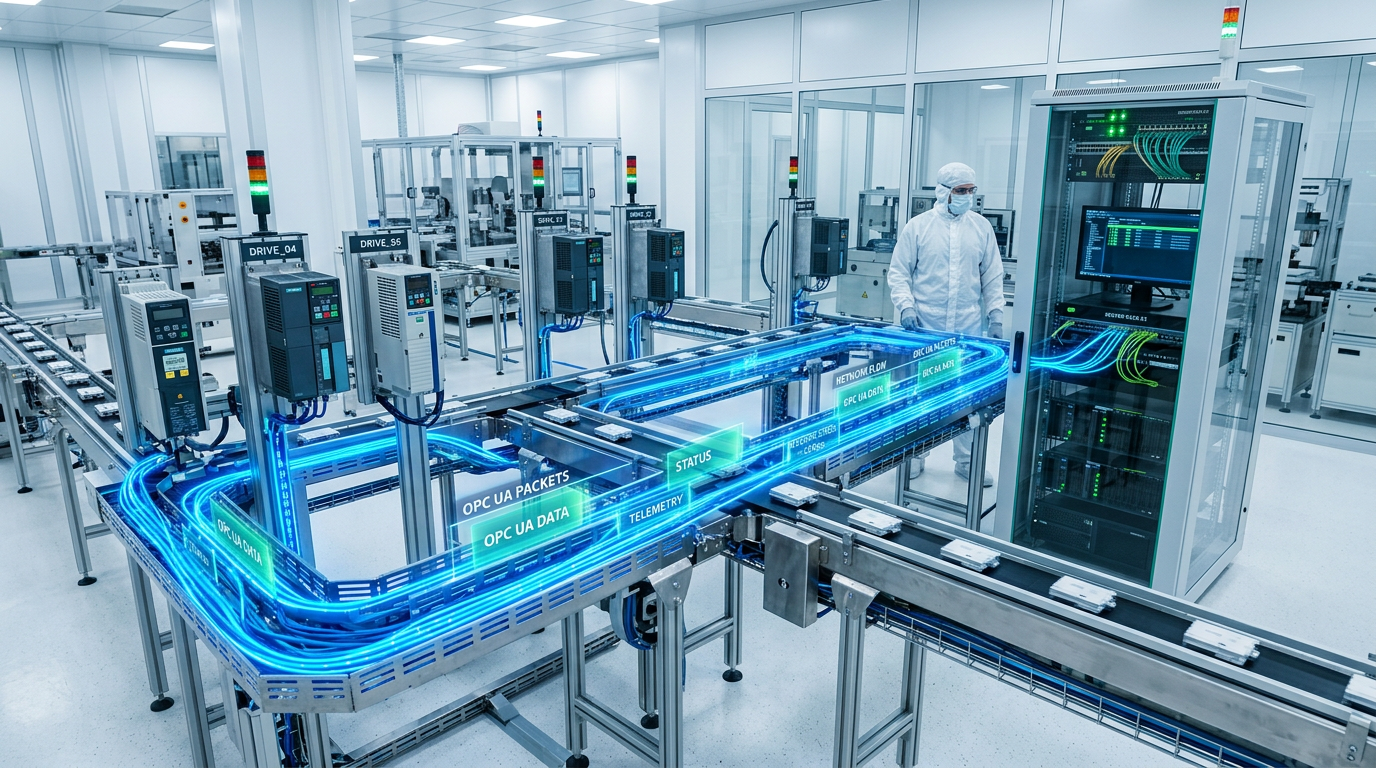
Safety doesn't end at the controller; it must be executed by the motor. Modern drum motor selection often includes integrated electromagnetic brakes or STO-compatible terminals. When a light curtain is breached, the Safety PLC triggers the STO on the drive, removing power from the motor while preventing an unintended restart. This is a critical component of maintaining a SIL 2/3 rating across the entire "safety loop."
For wash-down environments, such as those requiring hygienic wash-down design, safety components must meet IP69K ratings. Standard light curtains will fail or trigger false positives if moisture enters the optical housing or if condensation forms on the lenses. Always specify IP67/IP69K rated safety sensors for food processing or pharmaceutical lines to ensure long-term reliability.
Common Failure Modes in Safety Loops
Even the best hardware can fail if the architecture is flawed. Common issues include:
- Series Masking: Connecting too many mechanical interlocks in series can lead to "fault masking," where a failure in one switch is hidden by the operation of another, effectively lowering your SIL rating.
- Incorrect Muting Sensors: Using standard proximity sensors for muting that can be easily "tricked" by workers seeking to bypass the safety system.
- Ignoring Braking Distance: Failing to account for the inertia of a fully loaded conveyor. A motor might stop, but the belt may coast for several inches, violating the calculated safety distance.
By strictly adhering to SIL/PL standards and utilizing certified Safety PLCs, manufacturers can protect their workforce while maintaining the high throughput demanded by modern logistics. The transition from hard-wired relays to networked safety protocols (like PROFIsafe or CIP Safety) has further enabled complex, modular layouts that remain safe without sacrificing flexibility.
Step-by-step
- 1
Perform a Risk Assessment
Identify all crushing, shearing, and entanglement points on the conveyor line according to ISO 12100.
- 2
Determine Required SIL/PL
Assign a target Safety Integrity Level (typically SIL 2 for conveyors) based on the severity and frequency of potential injury.
- 3
Calculate Total Response Time
Sum the reaction times of the light curtain (ms), the Safety PLC logic (ms), and the motor braking time (ms).
- 4
Position Safeguards
Install light curtains at the calculated safety distance (S) to ensure the belt stops before a worker reaches the hazard.
- 5
Validate Muting SequencesNodes
Configure muting sensors to ensure they only trigger for intended loads and time out if the path is blocked for too long.
Frequently Asked Questions
What is the difference between SIL and PL ratings?
SIL (Safety Integrity Level) comes from IEC 61508, while PL (Performance Level) comes from ISO 13849-1. SIL 2 is generally equivalent to PL d, and SIL 3 corresponds to PL e. Both measure the reliability of a safety function.
When should I use muting versus blanking on a conveyor?
Muting is a temporary bypass that allows cargo to pass through a light curtain using sensors to identify the load, whereas blanking permanently disables specific light beams to accommodate fixed machine structures.
How do I calculate the mounting distance for a light curtain?
Safety distance is calculated using the formula S = (K x T) + C, which accounts for human approach speed, the total system response time (including braking), and the sensor resolution.
Is a standard VFD sufficient for a safety-rated conveyor?
STO (Safe Torque Off) is a functional safety feature that ensures a motor cannot generate torque. It is the most basic integrated safety function and is essential for SIL 2/3 compliant conveyor drives.