ESD-Safe Conveyor Automation for Electronics Assembly: A Technical Guide
Learn how to design ESD-safe conveyor systems for electronics assembly. Secure your PCBs with dissipative materials, grounding protocols, and IEC 61340-5-1 compliance.
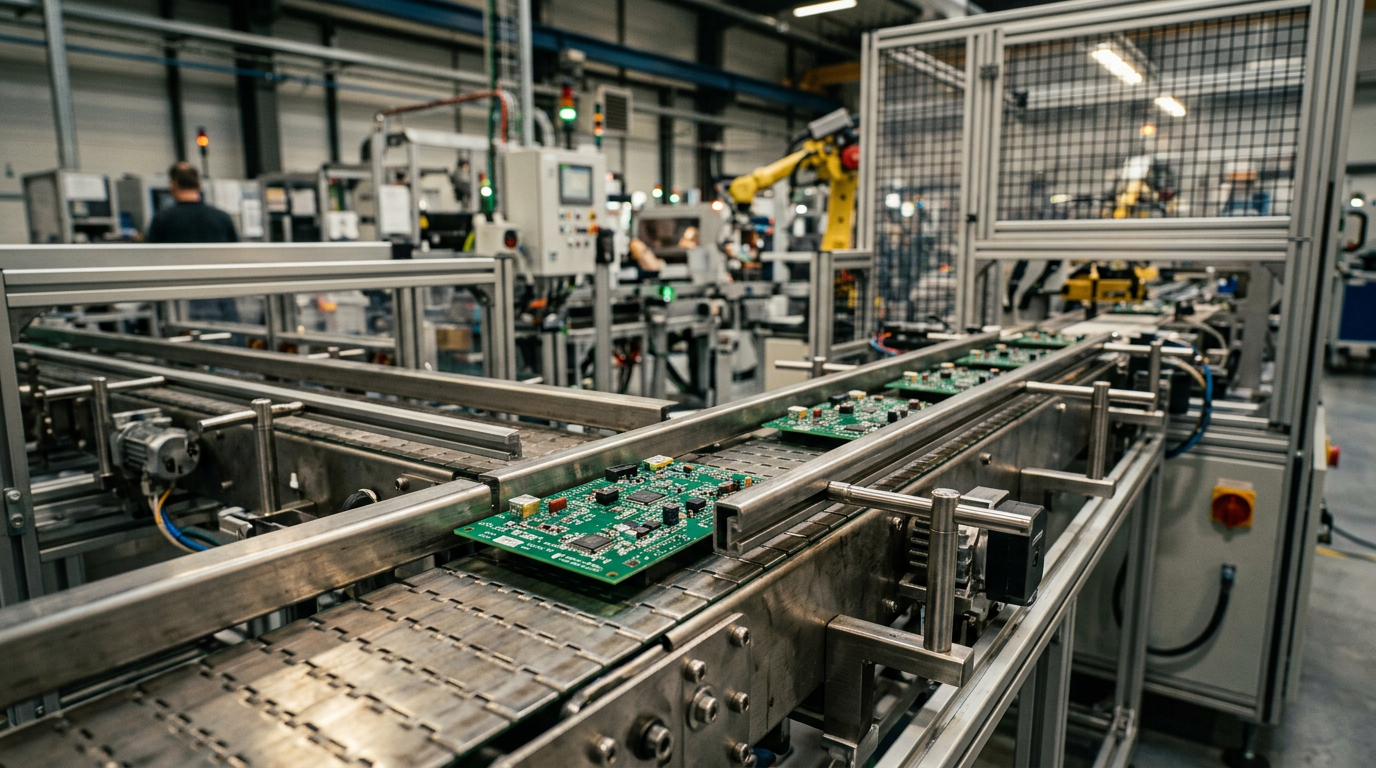
For electronics assembly, an ESD-safe conveyor system must maintain a surface resistance between 10^4 and 10^9 ohms to safely dissipate static charges in accordance with the IEC 61340-5-1 standard. Integrating conductive components, specialized grounding paths, and ionisation equipment allows manufacturers to reduce electrostatic discharge (ESD) failure rates by up to 90% compared to non-protected transport lines.
The Physics of ESD in Automated Material Handling
Electrostatic Discharge is the sudden flow of electricity between two electrically charged objects caused by contact, an electrical short, or dielectric breakdown. In an automated conveyor environment, the primary culprit is tribocharging—the generation of static electricity through the friction of the belt moving over the slider bed or the product sliding on the belt surface.
Without proper mitigation, a conveyor can act as a massive Van de Graaff generator. As printed circuit boards (PCBs) or semiconductor components travel down the line, they can accumulate charges exceeding 10,000V. When these components encounter a grounded tool or worker, the resulting discharge can melt internal circuitry or cause latent defects that lead to field failures months later.
Surface Resistivity vs. Conductivity
In ESD protection, "conductive" is not always better. If a material is too conductive (resistance < 10^4 ohms), the discharge happens too quickly, creating a spark that can still damage sensitive MOSFETs. The goal is dissipative performance, typically defined by ISO 284 as having a surface resistance high enough to control the discharge speed but low enough to prevent charge accumulation.
Critical Components for ESD-Safe Conveyor Design
Designing a system for electronics assembly requires a holistic approach where every module in the chain is linked to a common ground point.
1. Dissipative Belts and Chains
Standard PVC or modular plastic chains are insulators. For electronics, modular belts are typically manufactured with carbon-filled acetal (POM) or specialized permanent anti-static additives. Unlike topical coatings that wear off, these additives ensure the belt remains ESD-safe throughout its service life.
2. Conductive Wear Strips and Slider Beds
The belt must have a path to discharge the static it generates. Using conductive Ultra-High Molecular Weight Polyethylene (UHMW-PE) wear strips ensures that as the belt moves, the charge is transferred to the conveyor frame.
3. Grounding the Frame
The aluminum or stainless steel frame must be electrically continuous. Standard anodized aluminum profiles act as insulators at the joints. Technicians must use star washers or dedicated grounding straps to pierce the anodized layer, ensuring a low-resistance path to the building's earth ground.
4. ESD-Safe Pallet Systems
In many assembly lines, components travel on workpieces or pallets. These pallets must be made of volume-dissipative materials. When the pallet stops at a robotic workstation, a "grounding pin" often engages the pallet to ensure it is at zero potential before a robotic arm touches the PCB.
ESD Selection Criteria for Automation Components
| Feature | Standard Industrial | ESD-Safe Electronics |
|---|---|---|
| Belt Surface Resistance | > 10^12 $\Omega$ (Insulative) | 10^4 to 10^9 $\Omega$ (Dissipative) |
| Material Type | Standard POM / PVC | Carbon-filled or Anti-static POM |
| Drive System | Standard Gearmotor | Inverter-rated with Grounding Brushes |
| Frame Connectivity | Mechanical joining | Verified Electrical Continuity |
| Compliance | General Safety | IEC 61340-5-1 / ANSI/ESD S20.20 |
Easy Conveyors stocks the industrial automation discussed here — ready to ship across Europe.
Automation Integration: Sensing and Control
In an ESD-safe environment, "automation" goes beyond simple movement. It involves the integration of active neutralization and monitoring.
Ionization Bars
Even with dissipative belts, high-speed movement can generate air-borne charges. Overhead ionizers or "ionizing bars" are mounted at critical transition points (like 90-degree transfers) to flood the area with positive and negative ions, neutralizing any residual charge on non-conductive components of the PCB.
Precision Indexing and Soft Starts
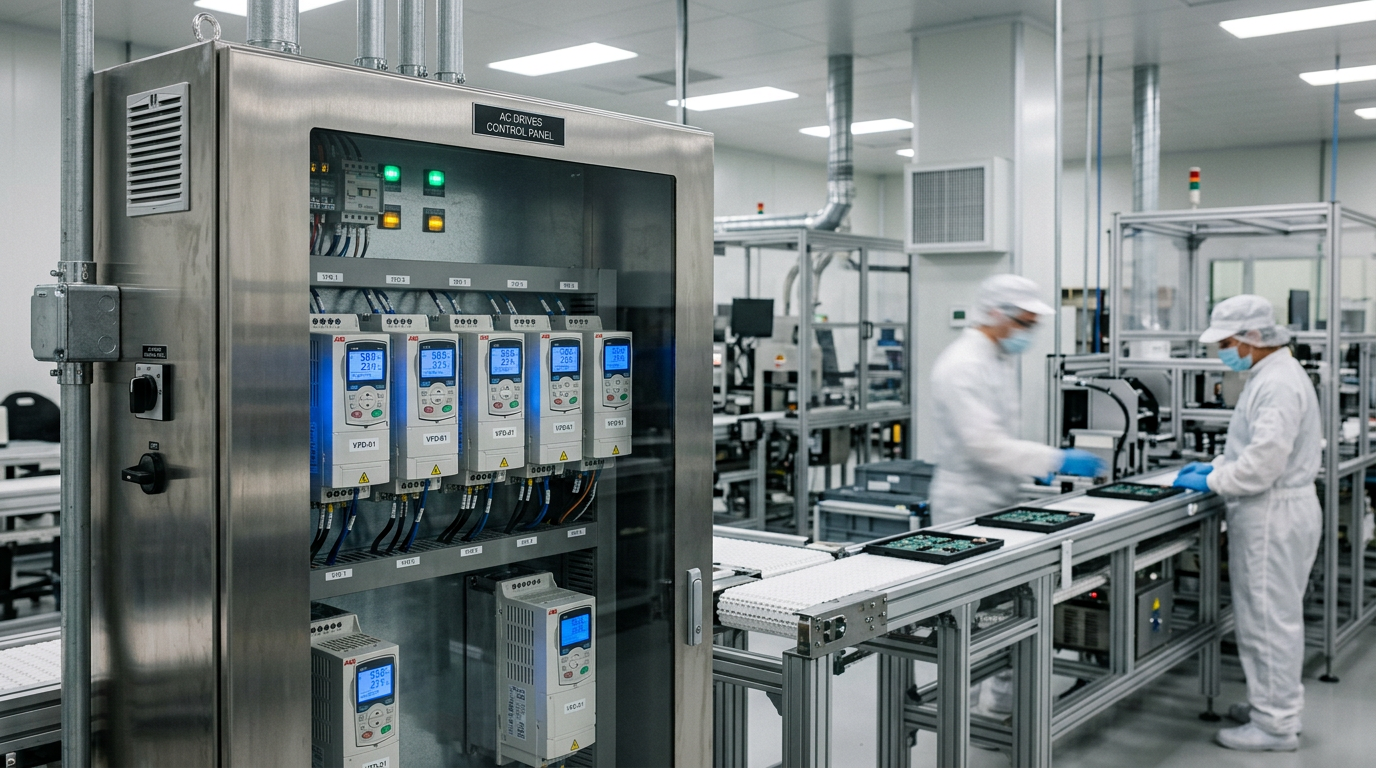
Mechanical shock can exacerbate tribocharging. Utilizing high-efficiency motors with VFD soft-start tuning reduces the sudden friction at startup. Furthermore, precise indexing ensures that components are positioned exactly over grounding pads during automated assembly steps.
For European manufacturers looking to implement these standards, Easy Conveyors provides modular roller and belt systems specifically engineered for ESD-sensitive environments, ensuring compliance with both CE and international ESD standards.
Maintenance Protocols for ESD Systems
The primary failure mode for ESD-safe conveyors is the accumulation of non-conductive debris. Dust, oil, and adhesive residue from packaging can form an insulative layer over the dissipative belt.
- Cleaning: Use only ESD-safe cleaners. Standard detergents can leave a surfactant film that increases surface resistance.
- Verification: Periodic testing with a surface resistance meter is mandatory. Engineers should measure the resistance from the belt surface to the building ground at least quarterly.
- Wear Component Replacement: As carbon-filled chains wear, they may shed conductive micro-particles. While the belt remains ESD-safe, these particles must be managed via vacuum systems to prevent short-circuiting the electronics being assembled.
Future Trends: Industry 4.0 and ESD Monitoring
The next generation of electronics assembly lines will feature real-time ESD monitoring. Sensors embedded in the conveyor wear strips will continuously log surface resistance and charge levels, transmitting data via IO-Link to a central PLC. If the resistance drifts out of the 10^4 to 10^9 ohm range, the system can trigger a maintenance alert before a single component is damaged.
When scaling up, designers must also consider drum motor selection to minimize the footprint and reduce the number of exposed moving parts that could generate static through windage or friction. Modern drum motors with internal grounding brushes are becoming the gold standard for cleanroom-compatible, ESD-safe automation.
Properly implemented, an ESD-safe conveyor is an invisible insurance policy. By adhering to ANSI/ESD S20.20 and integrating dissipative materials with active grounding, manufacturers protect their margins and their reputation for quality.
Frequently Asked Questions
What is the ideal surface resistance for an ESD-safe conveyor belt?
A dissipative surface resistance between 10^4 and 10^9 ohms is required. Values higher than this are too insulative, while values lower than this are too conductive and may cause rapid, damaging discharges.
Can I use standard aluminum profiles for an ESD conveyor frame?
Standard anodized aluminum is an insulator. To ground the frame, you must use specialized grounding clips, star washers that pierce the coating, or conductive joining plates to ensure a continuous electrical path to the earth ground.
Does cleaning a conveyor affect its ESD properties?
No. Standard cleaners can leave an insulative residue that raises the surface resistance. Only use approved ESD-safe cleaners that maintain the dissipative properties of the material.
What is the benefit of carbon-filled POM in modular belts?
Carbon-filled POM is a 'volume-conductive' material, meaning the ESD properties are integrated throughout the plastic. It does not wear off like topical sprays, providing a permanent solution for the life of the belt.